 Happy Summer to all of our readers. Another week has come and gone, and we’re back with the latest installment of This Week in Early American History. Feel free to weigh in on posted links or share any interesting stories and newsworthy items we might’ve missed. Let’s jump right into it:
Tag Archives: pedagogy
The Week in Early American History
Here at The Junto, we’ve spent the last week with our noses buried in one really, really good book. But there’s been much afoot elsewhere, both on the web and beyond.
A View from Beyond the Valley
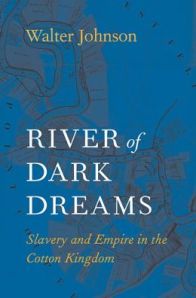 Ben, Mandy, Matt, and Roy have done a marvelous job so far this week summarizing the arguments, the strengths, and a few of the (few) weaknesses of River of Dark Dreams. I therefore want to confine myself to just a few general thoughts, and then focus in on the area where my expertise lies: what this book means for the non-expert in slavery studies. Continue reading
Teaching Narrative in Graduate School
This past Monday I turned in my final paper in a graduate seminar given by John Demos entitled, “Narrative and Other Histories.” I initially registered for the class not long after watching Bill Cronon’s Presidential Address at this year’s AHA Annual Meeting and engaging in conversation about it on Twitter as well as in a piece for The Junto. With all the focus on “storytelling” and narrative as a means for carving out a twenty-first-century model of the historical profession, the course offering appeared quite timely. Continue reading
Plagiarism, Cheating, and Craigslist
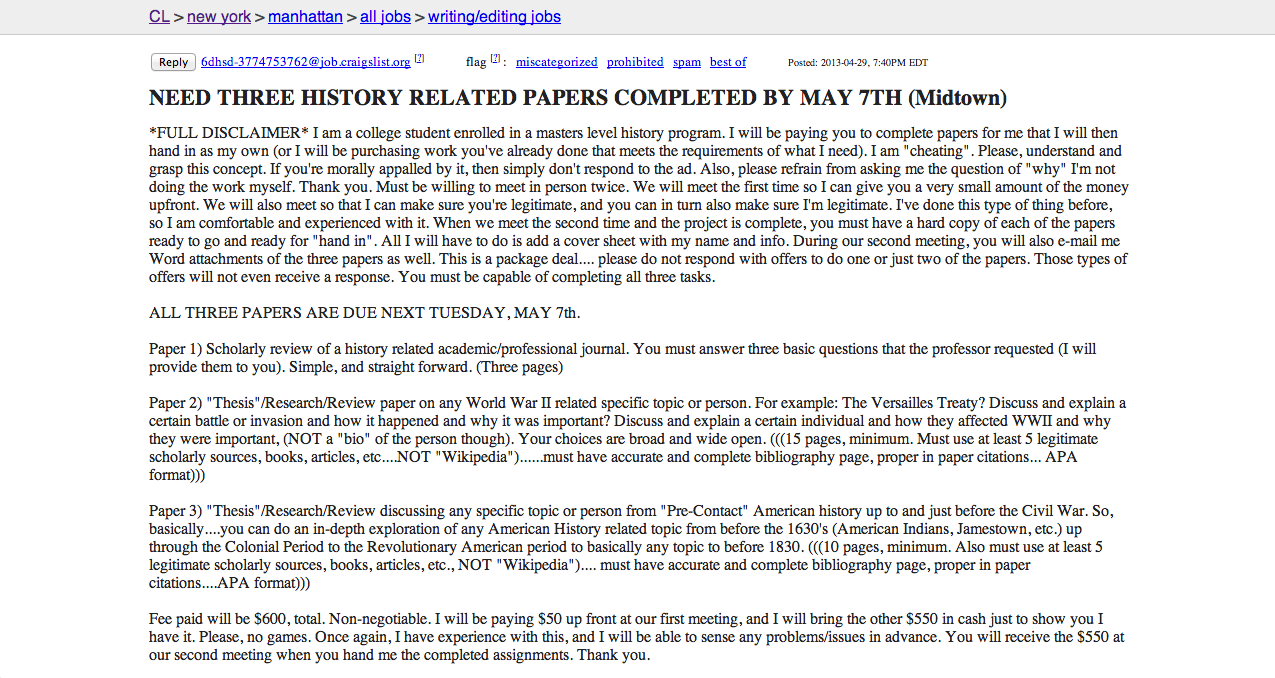 Before reading this post, take a moment to read this genuine, recent ad from Craigslist (click picture for full size). It is from a student in New York and the assignment(s) are due today, one of which is an early American history paper.
As I wrote last week, I am currently finishing up my coursework and in the fall will begin my first teaching assistantship. Because teaching has been on my mind anyway, the ad above struck me a bit harder than I imagine it would have done before. I’ve heard stories of cheating and plagiarism from my professors and my peers in my own program now in their teaching years, but the ad above really “takes the cake” for me. Continue reading
Gaming In The Classroom: Washington’s War
 One of the key difficulties of teaching the American Revolution is the seeming inevitability of it all. Why did Britain even bother pursuing its bothersome colonists? After all, the patriot cause was so noble and glorious that there was surely no way that such perfidious villains as the redcoats could possibly have triumphed. And yet within that myth, there is a persistent paradox: the patriot cause is often “proven” by the victory of such an inferior force against the strongest military power in the world in the late 18th century. But for this narrative to make any sense at all, there must have been a real risk of defeat; unless Britain could realistically have defeated their colonists, why would the morality of the patriots be of any consequence whatsoever? Continue reading
Make your Mark

Some friends asked me last week how I felt, as an historian, about the current assault on the teaching of cursive in public schools, and I had to admit that I didn’t know this was a thing. Long story short, with classroom time always at a premium, many school districts have replaced instruction in cursive writing with instruction in typing, the latter seemingly more relevant to our times. Apparently, concern over students’ resulting inability to read or write script has been growing for a while, but a Wall Street Journal story at the end of January brought the issue new prominence. Many people seem to think that continuing to teach students to write in cursive is important, and a handful of state legislatures have introduced bills to rectify the situation.
The question has a neat resonance with the history of education: writing may go back to being thought of pedagogically as a craft, just as it was before the nineteenth century, when it was something that boys learned while girls learned to sew. (See, in particular, E. Jennifer Monaghan’s work on this history). Beyond that, though, two central pieces of the “save cursive” argument resonate with historical questions. Continue reading
Favorite Sources in the Survey
Teaching the survey, I have found, can be a blur. Events, people, and places zip by—on Monday, you’re at Jamestown in 1607, on Wednesday, Plymouth in 1620, and by Friday Cotton and Increase Mather are angling for a new charter for Massachusetts. (Okay, I don’t move quite that fast, but it’s still quick.) And in the meantime students deal mostly with brief snippets of texts in a document reader. Someday I may ditch it, but for now, it does the job.
One of my favorite parts of the course, therefore, is working with students a little more deeply on select texts, and getting to practice the craft of the historian more fully. So today I’ll share one or two of my favorites with you, offering no claims to originality.
I’ll start with my absolute favorite, which will come as no surprise to my friends: Benjamin Franklin’s Autobiography. Continue reading
Some Thoughts on Teaching: An Interview with James H. Merrell
 I first met Jim Merrell in the spring of my sophomore year at Vassar College, when I registered for his Revolutionary America class. Over the next two and a half years I took several more courses with Mr. Merrell (professors at Vassar go by “Mr.” or “Ms.,” rather than “Dr.” or “Professor”), where I received multi-page responses to my essays, and comments on my research papers with words like “Huzza!”
Eventually, I began work on my senior thesis, which he kindly agreed to supervise. During the course of that year he met with me weekly to check on my progress with research and writing. His feedback was thoughtful but tough—after receiving his comments on the first full draft, I recall needing to go to the gym to run, lift, and then swim before being able to read them calmly. His assurance “that the draft gets critical treatment that is closer to graduate school than to first or second year college. (Huzza, sez you!)” should indicate the substance of his remarks [1]. Continue reading
The Abolitionists: A Recap
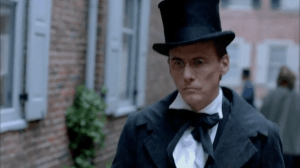 Over the last three weeks, Jonathan Wilson and Ken Owen have reviewed the PBS documentary series The Abolitionists. Their reviews of part 1, part 2, and part 3 are already available for you to read. In this final post, Wilson and Owen will discuss the series as a whole, focusing especially on its value for history professors in the classroom.
Ken: Jonathan, I thought that we might start this discussion by looking at the producers’ public statements on what they were attempting with the series. For reference, there is a video entitled ‘Why We Made The Abolitionists‘, and an article ‘From The Executive Producer‘. For me, the most striking statement of the video is the opening assertion that no transformative moment in American history ‘stems from the actions of ordinary Americans as much as the abolitionists’. The producers then say that the five characters that they chose were deliberately intended to invoke different strands of the abolitionist movement.
 The Junto