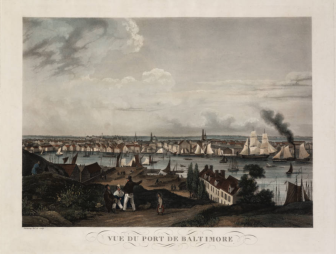
Vue du Port de Baltimore, ca. 1834 by Louis Garneray (photo courtesy of the Enoch Pratt Free Library)
Today’s Guest Post comes from Nathan H. Dize, Ph.D. Candidate in the Department of French and Italian at Vanderbilt University. He specializes in Haitian literature and history. His dissertation, currently entitled “Mortuary Poetics: Power and the Performance of Mourning in the Haitian Literary Imaginary,” explores how Haitian writers and artists revivify the dead through creative acts of mourning to challenge official memories and mythologies of the Haitian past. He is a content curator, translator, and editor of A Colony in Crisis: The Saint-Domingue Grain Shortage of 1789. He is also the co-editor of the H-Haiti series “Haiti in Translation,” which interviews translators of Haitian writing. Nathan has published articles, reviews, and translations in journals such as sx archipelagos, the Journal of Haitian Studies, Francosphères, SX Salon, Contemporary French Civilization, and the Haitian History Journal of which he is also an advisory board member. Follow him on Twitter @NathanHDize.
In September 1782, Julia de Recour boarded the St. Patrick in Cap Français with her mother, a woman of about 40, to join some relations in Baltimore. When she arrived, Charles Biddle writes that she had the “good fortune” of attracting the French First Consul, Charles François Adrien Le Paulmier le Chevalier d’Annemours, who immediately took her as his wife.[1] Biddle describes Julia as a lively French lady and a “spritely brown girl of 16.”[2] Biddle’s account of Julia’s travel on the St. Patrick is shrouded in innuendo, particularly when Julia took to the ship’s deck in the cold to dance and “perform some other monkey tricks.”[3] Without providing more information Biddle writes in his autobiography that we do not know when or where Julia died, but that it is reasonable to believe that she was not living in 1792. As Saidiya Hartman once wrote of the enslaved girl immortalized in William Wilberforce’s speech before the House of Commons in April of 1792, “a few musty lines […] are the entire story of a girl’s life.”[4]
 Today is our final post in the roundtable series on the History of Childhood & Youth. If you missed previous posts click
  If you missed previous posts in our new roundtable series on the history of childhood and youth, click
  If you missed previous posts in our new roundtable series on the history of childhood and youth, click
 ![Holly+Headshot_2bw[2]](https://earlyamericanists.com/wp-content/uploads/2018/09/hollyheadshot_2bw2.jpg?w=286&h=307) If you missed previous posts in our new roundtable series on the history of childhood and youth, click
If you missed previous posts in our new roundtable series on the history of childhood and youth, click  If you missed the first two posts in our new roundtable series on the history of childhood and youth, click
  If you missed our first post on Friday in our new roundtable series on the history of childhood and youth with Bianca Premo, click
 ![Holly+Headshot_2bw[2]](https://earlyamericanists.com/wp-content/uploads/2018/09/hollyheadshot_2bw2.jpg?w=204&h=219) Today’s guest post comes from
Today’s guest post comes from  As we continue to learn more about the seizure and internment of migrant infants and children, both along the U.S.-Mexico border and in ICE raids throughout the nation, historians have asked us to wrestle with our
  “My friends and I might still be 11, and we might still be in elementary school, but we know . . . that we have seven short years until we too have the right to vote.”
 The Junto