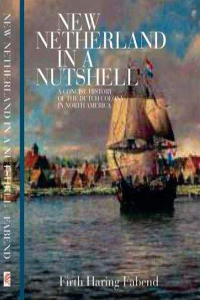
Review of “New Netherland in a Nutshell”

Public history can take many forms. We, here at The Junto, are committed to engaging with and covering public history regarding early America. The New Netherland Institute is an excellent example of an organization dedicated to bringing early American history to the public. I want to use this space to talk about its most recent publication, Firth Haring Fabend’s New Netherland in A Nutshell: A Concise History of the Dutch Colony in North America.

Fabend is an independent historian (though she holds a PhD in American Studies from NYU) and is the author of numerous books of fiction as well as two award-winning works of history also dealing with New Amsterdam, both of which were published by Rutgers University Press. Continue reading

Hybrid Moments: Should there/Could there be Atlantic Musicology?

In a week I’ll be heading to Little Rock for the Society of American Music Conference, where I’ll be chairing and presenting at a session on music in the Atlantic world. My paper is titled “Strategizing Atlantic Musicology” and in it I’m discussing some of the benefits and drawbacks for incorporating ideas from Atlantic studies into musicology. (I’m also hoping to claim the Pithiest Title Prize). I thought I’d try out a few of my ideas and concerns here, and hopefully tap the collective wisdom of the Junto community.

To give a little background: I’ve been thinking about Atlantic studies and music for a while–I wrote a dissertation about how transatlantic music shaped the identities of early American communities, and wrote a musicology article that uses concepts from Atlantic history to interpret musical networks in the early modern period. I’ve also delivered conference papers on that touch on this topic. But this is the first paper I’ve written that is devoted entirely to question of how (and whether) musicology could engage with Atlantic studies. Continue reading

The Historian’s Appetite

Hello, world.

I am slowly becoming accustomed to the feeling of having defended my dissertation, and reacquainting myself with the idea that it’s okay to take a day off here and there. Earlier this week I prepped and served pho, a Vietnamese noodle soup that takes two days to prepare.

I spent time earlier this month exploring a new cookbook, The Smitten Kitchen Cookbook, by Deb Perelman, of Smitten Kitchen blogosphere fame.

I came to the field of food history in part because I love food—cooking it, eating it, and sharing it with others—a love which has, at times, demanded that I stretch my knife skills, my ability to multitask, and my willingness to fail. Continue reading

Make your Mark

simpsons_cursive

Some friends asked me last week how I felt, as an historian, about the current assault on the teaching of cursive in public schools, and I had to admit that I didn’t know this was a thing. Long story short, with classroom time always at a premium, many school districts have replaced instruction in cursive writing with instruction in typing, the latter seemingly more relevant to our times. Apparently, concern over students’ resulting inability to read or write script has been growing for a while, but a Wall Street Journal story at the end of January brought the issue new prominence. Many people seem to think that continuing to teach students to write in cursive is important, and a handful of state legislatures have introduced bills to rectify the situation.

The question has a neat resonance with the history of education: writing may go back to being thought of pedagogically as a craft, just as it was before the nineteenth century, when it was something that boys learned while girls learned to sew. (See, in particular, E. Jennifer Monaghan’s work on this history). Beyond that, though, two central pieces of the “save cursive” argument resonate with historical questions. Continue reading

The Week in Early American History

TWEAHIt seems to have become a tradition to open this post with a weather report for New England. This morning we’re looking at a slushy Sunday, which while annoying is quite an improvement over the snowpocalypse of a few weeks ago. In any case, a little sleet/snow won’t stand any longer between you and your weekly supply of links. On we go!
Continue reading

Tracing the Path of “American Journeys”

Edwin James, "An Account of an Expedition from Pittsburgh to the Rocky Mountains, Performed in the Years 1819, 1820."

Edwin James, “An Account of an Expedition from Pittsburgh to the Rocky Mountains, Performed in the Years 1819, 1820.”

Still searching for new sources to use in your survey, or maybe a new midwinter project to research? The Wisconsin Historical Society’s American Journeys site is a hub for 18,000 pages’ worth of diaries, eyewitness accounts, manuscripts, images, and travel narratives of exploration and settlement in North America– all set in a timeline that stretches from the Vikings to the Rockies. Michael Edmonds, Head of Digital Collections & Web Services in the Library-Archives Division of WHS, told us how the site has transformed the research process, on both sides of the library desk. Continue reading

Favorite Sources in the Survey

Teaching the survey, I have found, can be a blur. Events, people, and places zip by—on Monday, you’re at Jamestown in 1607, on Wednesday, Plymouth in 1620, and by Friday Cotton and Increase Mather are angling for a new charter for Massachusetts. (Okay, I don’t move quite that fast, but it’s still quick.) And in the meantime students deal mostly with brief snippets of texts in a document reader. Someday I may ditch it, but for now, it does the job.

One of my favorite parts of the course, therefore, is working with students a little more deeply on select texts, and getting to practice the craft of the historian more fully. So today I’ll share one or two of my favorites with you, offering no claims to originality.

I’ll start with my absolute favorite, which will come as no surprise to my friends: Benjamin Franklin’s Autobiography. Continue reading

A View from Albion

Readers of The Junto may not be familiar with the early American history scene in the UK. Hailing one from each side of the Atlantic but both working in Britain, Tom Cutterham and I have had to grapple with the problems and positives of working on the history of one continent while living on another. Here is a brief sketch of how the land lies on the other side. Continue reading

This Week in American History

TWEAHAlright folks, it’s time for another roundup of links from the past seven days. New England is finally dethawing from Nemo, Valentines Day was celebrated, the Dunk Contest was held, and spring is only a month away, so I’d say things are looking up.

The newest issue of Journal of American History is now available online, so your bedside reading for the next week is ready. Make sure to read Nathalie Caron and Naomi Wulf’s thoughtful “American Enlightenments: Continuity and Renewal,” as well as our own Joseph Adelman’s overview of some important new online resources.

Over at the excellent U.S. Intellectual History Blog, there was a vibrant debate over the boundaries of the field. Nils Gilman offered a pretty rigid “qualitative” analysis of “text-based” interpretation, and Edward J. Blum offered a thoughtful response. Sparks flew both on the blog and in an explosive discussion on Twitter, Storified by our own Michael Hattem.  Continue reading

The “Extra-Illustrated” Man: NYPL’s Emmet Archive

When more than 10,000 early American documents find new life in the digital world, we at The Junto want to know more about the challenges and opportunities of the project. Thomas Lannon, Assistant Curator of the Manuscripts and Archives Division at the New York Public Library, kindly took our questions on Thomas Addis Emmet’s extra-illustrated archive. Continue reading