 Every sub-field has its classic books. It should not take long for most of us to rattle off a couple of titles. In my field of church-state relations in the early American republic (particularly in the upper South), few books tower over the field more than Thomas E. Buckley’s Church and State in Revolutionary Virginia, 1776-1787.[1] Despite being published thirty-six years ago references to this classic litter the footnotes of subsequent books from fellow classic histories like Rhys Isaac’s Transformation of Virginia to more recent works such as David Sehat’s Myth of American Religious Freedom.[2] Anyone grappling with the politics of religion in early national Virginia, that overheated cauldron of disestablishment, must grapple with Buckley’s work. But this great historian did not stop there; in a series of articles Buckley expanded his analysis to include much of the evolution of religious freedom in the Old Dominion over the nineteenth century.[3] Continue reading
Monthly Archives: February 2013
Review: Todd Andrlik, “Reporting the Revolutionary War”
 My interests in the late colonial and revolutionary periods include print culture and history of the book. Ever since I was an undergraduate and first accessed a Readex database, I have been fascinated with colonial newspapers and not just the content but with the mechanics, logistics, and persons involved. Every major research project I have undertaken has made significant use of newspapers and pamphlets. In that time, I have come to understand and appreciate the centrality and importance of newspapers to colonial life, particularly in but not limited to urban areas. Indeed, I have always felt quite privileged to have access to such primary sources and perhaps it is part of the standard vanity of the historian but I also always suspected that general readers—the kind who buy books about the Revolution by the truckload—would be just as interested in seeing and just as excited by these primary sources as I continue to be. Todd Andrlik thought the same thing and his book, Reporting the Revolutionary War: Before it was History, it was News, appears to have proven me right. Continue reading
Charles Beard, Economic Interpretation, and History
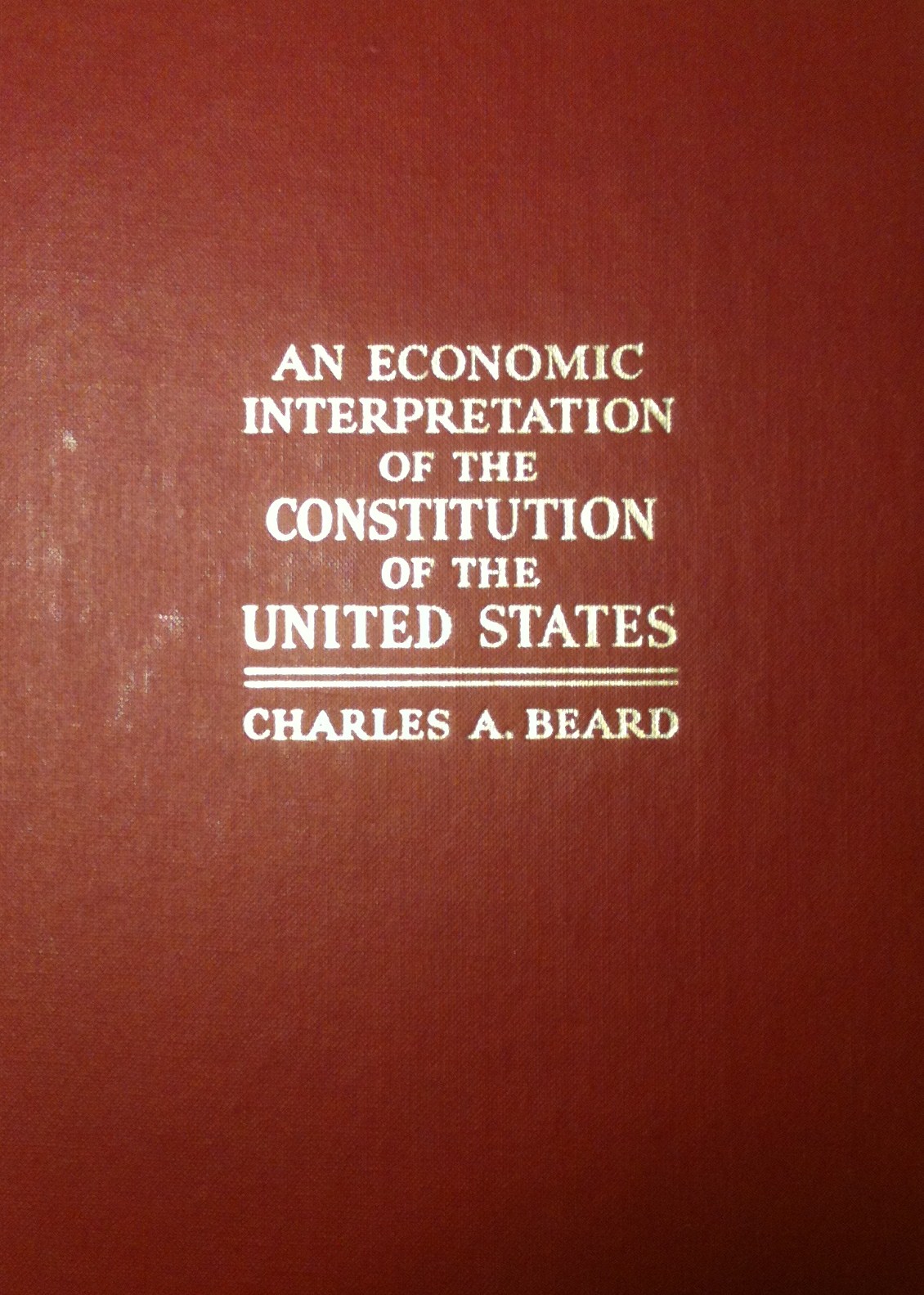 It’s been a century since Charles Beard published An Economic Interpretation of the Constitution of the United States. That book has a central role in more or less every overview of the historiography of the constitution and the founding. Just what that role is, though, is still open to debate. That Pauline Maier’s Ratification (2010) has no listing for Charles Beard in the index might have been taken as a sign that scholars no longer have to deal directly with his towering legacy. But that Seth Cotlar called her out on it in a recent William & Mary Quarterly forum, and took her to task for the “absence of any direct engagement” with Beardian, “conflict-oriented” interpretations of the period, reminds us just the opposite. As Saul Cornell put it, in light of powerful and varied strands of contemporary neo-Beardian scholarship, from Robert McGuire to Woody Holton and Terry Bouton, “one wonders if we have fully laid the ghost of Charles Beard to rest.” Well, if you have to wonder… Continue reading
Articles of Note: Early 2013
Scholarship can come at such a fast clip nowadays that it can be tough to keep up. Actually, scratch that; it is impossible to keep up with the massive amounts of articles that come out at an unrelenting rate. With the number of journals out there publishing quality work in early American history—journals that are both dedicated to our field or just sometimes carry work in our field amongst other periods—there is often an avalanche of new work that one can feel overwhelmed. Whether you receive hard copies of the many journals, use those from your institution’s library, or just get all of the content online (guilty), your reading list is always at such a ridiculous height that it is difficult to just keep track of all the recent articles, let alone read them. Such are the #firstworldproblems of the modern-day academic.
Well, that’s where the Junto comes in. Periodically, we hope to highlight recent articles that we found especially noteworthy. I’ll list a handful in the post (that are, of course, reflective of my own interests), and then we will rely on you, our dear reader, to share other recent articles you found important. Together, perhaps we can slay the beast that is the growing mound of unread articles. Continue reading
The Week in Early American History
 Mail service was suspended in New England on Saturday (sadly, a possible harbinger of things to come), but a massive snowstorm (and the pain of shoveling) cannot stop the Junto’s week-in-review post.
It seems odd that the day is passing with relatively little fanfare, but today is actually the 250th anniversary of the Treaty of Paris ending the Seven Years’ War. A momentous occasion with enormous consequences (that were, as often happens, largely unforeseen at the time).
In any event, on with the links!
Forgotten Giant: Restoring Simms

“Washington Irving and His Literary Friends at Sunnyside.” Simms is seated at the left end of the table, shown in full profile.
(Christian Schussele, Oil on canvas, National Portrait Gallery, Smithsonian Institution, 1864)
Meet a Southern man of letters, William Gilmore Simms, through his life’s work of literature—much of it now available in the form of free, digital editions thanks to the Simms Intitiatives at the University of South Carolina. A well-known editor, critic, poet and historian of Southern life and culture in his day, Simms (1806-1870) occupies a unique position in early American literature, and (re)introducing him to modern readers has presented new challenges for scholars. The Junto asked the Initiatives’ Todd Hagstette, Simms Curator, to talk about creating a digital portrait of the author, and why Simms’s work belongs on the syllabus. Continue reading
A Very Old Book: The Case for Eric Hobsbawm’s Age of Revolution
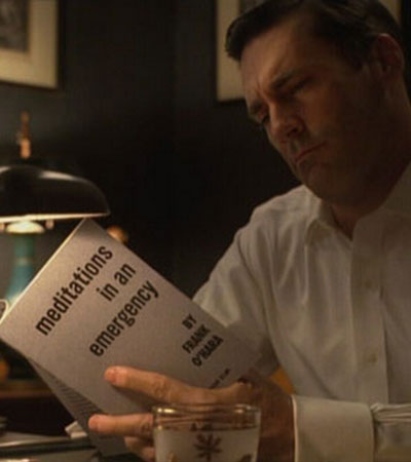
Put the poetry down, Don. It’s time to get your Chartism on.
Last year marked the fiftieth anniversary of the publication of Eric Hobsbawm’s Age of Revolution, 1789-1848, a milestone that was largely overlooked in the more general hubbub over the great historian’s death in October. But it’s an impressive number all the same, and an inescapable reminder that when we return to The Age of Revolution we are dealing with a Very Old Book. The battered cover of my own 1962 Signet paperback (see below), whose author still preferred the high-academic modesty of “E.J. Hobsbawm,” offers a striking visual proof of the antiquities that lie within. It is after all technically possible, and perhaps not as improbable as you may think, for this book to have lain on Don Draper’s desk. When he was still married to Betty Draper.
What can a 21st century early American historian learn from such an artifact? Amid the clamors and confusions of the debate over the New New Political History, why should anyone bother to resuscitate the Old? Can we learn anything vital about the Age of Revolution in a book written during the Age of Draper? Well, obviously, the answer is yes. Continue reading
Some Thoughts on Teaching: An Interview with James H. Merrell
 I first met Jim Merrell in the spring of my sophomore year at Vassar College, when I registered for his Revolutionary America class. Over the next two and a half years I took several more courses with Mr. Merrell (professors at Vassar go by “Mr.” or “Ms.,” rather than “Dr.” or “Professor”), where I received multi-page responses to my essays, and comments on my research papers with words like “Huzza!”
Eventually, I began work on my senior thesis, which he kindly agreed to supervise. During the course of that year he met with me weekly to check on my progress with research and writing. His feedback was thoughtful but tough—after receiving his comments on the first full draft, I recall needing to go to the gym to run, lift, and then swim before being able to read them calmly. His assurance “that the draft gets critical treatment that is closer to graduate school than to first or second year college. (Huzza, sez you!)” should indicate the substance of his remarks [1]. Continue reading
Dos and Don’ts: Cover Letters and C.V.s
Today’s post was spurred by some conversations between Junto contributors about cover letters, C.V.s, and the dos and don’ts of the applications process. Whether applying for research grants or starting out on the job market, how do we make sure we’re presenting our best selves on paper?
We thought that this would be a great opportunity to ask our Junto readers: Do you have any advice for formatting C.V.s and cover letters? What do you look for in a strong cover letter or C.V.? Do you have any ‘must haves’ or pet peeves? How can we best tailor our applications for either academic or professional settings?
We welcome any thoughts, links to additional resources, or tales of application joy and woe. Continue reading
The Week in Early American History
A relatively quiet week here; with the semester now underway everywhere, it’s probably not such a bad thing that we have fewer links to share. In any case, a little Revolution, an unidentified diary, and a forgotten war … on to the links!
 The Junto