 Summer! That wonderful, studentless, seminar-free oasis of uninterrupted relaxation, when we can all settle down to some quality time with those alluring new acquisitions on our bookshelves—and maybe even tackle some of the glowering doorstops that have remained there unread for all too long. Yes, we know it’s a complete fantasy, but it’s a pleasant one to indulge in while the last few exam scripts are being marked and three months of self-direction are stretching in front of you (and while we wait for Zara Anishanslin and Alan Taylor‘s books to come out!). In that spirit, I thought I’d share the handful of books I’ve been fantasising about reading this summer . We’d love you to pitch in with your own lists in the comments. Continue reading
Category Archives: Recent Scholarship
#WhatComesNext? Book Ideas for the Hamilton Lover in Your Life
 With Hamilton’s sweep at the Tonys last night, this year’s phenomenal tide of Hamilton-mania has hit the high-water mark. You’ve cheered each much-deserved award and accolade, you’ve memorized every word of the soundtrack, you’ve devoured the #Hamiltome. Perhaps you’ve kept up with professional historians’ wide range of responses to Lin-Manuel Miranda’s blockbuster. Maybe you’re even one of the lucky few who’ve managed to score tickets to the show itself. But now, fans of the musical (and folks who are simply surrounded by them) might well find themselves asking, #WhatComesNext?
The Junto has the answer! Tomorrow afternoon, when you lose the daily ticket lottery yet again, why not start lookin’ for a mind at work? Grab a great history book and drown your sorrows in a flagon of sweet American Revolution knowledge. Here are some picks, creatively paired with favorite characters from the musical. Continue reading
What Happened to the “Democratic” in the “Age of Democratic Revolutions”?
 This past semester I taught a course on “18th Century Atlantic Revolutions: America, France, and Haiti,” which included both undergraduate and graduate students. (I wrote about the assigned readings at my personal blog.) I’d like to highlight a central theme that I emphasized throughout the course as a way to discuss historiographical and pedagogical questions.
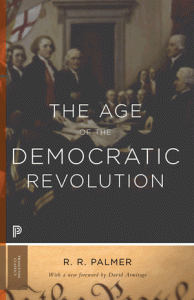
To give my grad students a sense of the field’s starting point, I had them read R. R. Palmer’s classic 2-volume The Age of Democratic Revolution: A Political History of Europe and America, 1760-1800 (1959, 1964; 2014), recently combined and re-published by Princeton University Press. Advancing through the semester and reading much more recent books, the dated nature of Palmer’s book is readily apparent. Most obvious is its avoidance of Haiti. (At an AHA panel on the Age of Revolutions last January, Nathaniel Perl-Rosenthal mention that it’s basically an academic ritual to mention this whenever discussing Age of Democratic Revolution.) Palmer also focuses on high-end (and male-centric) intellectual history, ignores economic interests and intersections, and only engages the nations whose revolutions “succeeded.” This last point is obviously problematic, of course, given what happens in France after their Revolution. But as Janet Polasky’s recent book shows, a more comprehensive view can be gleaned through looking at revolutionary moments that did not have successful outcomes. Like any book published over a half-century ago, even a classic book like Palmer’s, there are plenty of holes to acknowledge. Continue reading
The Sacred and the Secular in Early National Virginia
 Is revolutionary Virginia the birthplace of American secularism?
My attention was returned to this critical question by a recent twitter exchange between Annette Gordon-Reed and Sam Haselby (and others) along side a recent piece by Haselby in Aeon.[1] The scuffle between Gordon-Reed and Haselby focuses on the time-is-a-flat-circle question of Thomas Jefferson’s religious beliefs. Was he a secularist? Some variant of Christian? A Unitarian? An atheist? Haselby’s Aeon piece takes a different tack, arguing that the American founding represented a “rogue wave of rationality in a centuries-long sea of Protestant evangelising, sectarianism and God-talk.” Haselby marks out the Founders—particularly Jefferson and James Madison—as “visionary secularists” who created a secular republic, which was eventually co-opt by decidedly non-secular political and cultural forces. He singles out late eighteenth-century Virginia as the primary canvas upon which the great artists of American secularism worked.[2] Continue reading
Q&A: Zachary Hutchins, editor of Community without Consent: New Perspectives on the Stamp Act
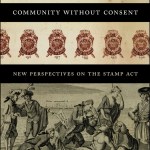
 On Sunday, the United States Postal Service introduced a stamp commemorating the 250th anniversary of the repeal of the Stamp Act. Today we are pleased to present an interview with Zachary Hutchins, editor of a new collection of essays from Dartmouth College Press that challenges traditional understandings of the Stamp Act Crisis as (in the words of the USPS) “setting [the colonists] on a path toward revolution and independence.” Zach is an Assistant Professor of English at Colorado State University. In 2014 he published his first book, Inventing Eden: Primitivism, Millennialism, and the Making of New England. A 2016 Fellow of the National Endowment for the Humanities, Hutchins is currently completing his second monograph, Before Equiano: A Prehistory of the North American Slave Narrative. Continue reading
Guest Post: Reporting from the Edges of Exceptionalism: Early American History in Oceania in 2016
Today’s post is by Taylor Spence, a Lecturer in Monash University’s School of Philosophical, Historical and International Studies and a Research Fellow with the Monash Indigenous Centre. Agricultural History will publish Dr. Spence’s next article, “The Canada Thistle: The Pestilence of North American Colonialisms and the Emergence of an Exceptionalist Identity, 1783-1839” (vol. 90, no.3), this fall. He lives in Melbourne and Brooklyn.
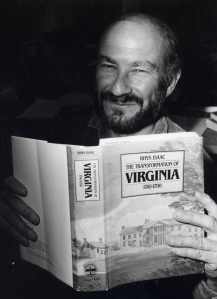 As a local representative of American Empire in Melbourne, Australia, and fifteen years after Michael McGerr and Ian Tyrrell’s spirited exchange in the pages of the American Historical Review, in which they wrestled with the potential gains and losses of a transnational American history, I thought it was time, in the spirit of Alistair Cooke, to send a “Letter to America,” checking in on the topic of American Exceptionalism and the viability of the transnational historical project in Oceania.[1] Reporting from the front lines of the outward-pression of the exceptionalist frontier, I can report that it has only partially been successful: you in the U.S. have much more work to do if you hope to bring Australians to worship at the altar of Washington, Hamilton, and Lincoln. Perhaps a touring company of Hamilton would be in order? But if, in all seriousness, the continued popularity of American history courses at my Australian university and a similar lack of popularity for Australian history courses attests to the successful mystification of a certain segment of the population, the clear-eyed work of Oceanic Early Americanists demonstrates that the U.S. metanarrative is but grist for the mill. For decades, now, these scholars have produced an unabating stream of masterful transnational studies, which are methodically eroding the exceptionalist juggernaut. Continue reading
On The Origins of American Religious Nationalism
 Right after I agreed to review Sam Haselby’s The Origins of American Religious Nationalism for the Journal of Religion, Gordon Wood’s review of it appeared in the New York Review of Books. When one of our number gets that kind of exposure with their first book, we should all applaud, but there I was, feeling out-classed before I even opened the book. Now that I’m done with my review, everything about Wood’s makes sense to me—it was big exposure on a big stage for a big book. And I learned something from Wood there, which was to have enough patience with a big book’s faults to appreciate what it’s trying to do. Wood called Origins an “unusual book” with a meandering argument, but nevertheless “a book to be reckoned with.” I have to agree, and (spoiler alert) said as much in my forthcoming JR review. In writing that, though, I realized that if I hadn’t been primed for indulgence by Wood’s review I would have judged Origins more harshly. I think Origins is a good book that’s in too much of a hurry. Without repeating what I’ve written in JR for a religious-studies audience, I want to use this space for something of an historian’s rant about the hurried use of sources in this book. Continue reading
Commodification, Specialization, Mechanization
This post is the second in a two-part report on a roundtable session at this year’s Organization of American Historians annual meeting in Providence, Rhode Island, entitled, “Open Question: What’s the Relationship Between Slavery and Capitalism?” The panelists were James Oakes, Craig Wilder, Sven Beckert, and Caitlin Rosenthal. Yesterday’s post focused on Beckert’s comments, today’s looks at Rosenthal’s.
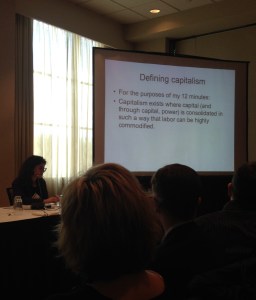 The new historians of capitalism have sometimes been criticised for refusing to offer a definition of their object of study. At the OAH panel, Caitlin Rosenthal (an assistant professor at the University of California, Berkeley) responded to that criticism directly. The refusal to start out with a strict definition has been, on one level, an asset to recent scholarship—freeing it from earlier dogmatic approaches. But the downside, Rosenthal said, is that it leads to misunderstandings among historians, and between historians and economists. Her tentative definition, then: “Capitalism exists where capital (and through capital, power) is consolidated in such a way that labor can be highly commodified.” Capital is at the centre, but so is labour; and what connects them is the process of commodification. Continue reading
Primitive Accumulation as Creative Destruction?
This post is the first part of a two-part report on a roundtable session at this year’s Organization of American Historians annual meeting in Providence, Rhode Island, entitled, “Open Question: What’s the Relationship Between Slavery and Capitalism?” The panelists were James Oakes, Craig Wilder, Sven Beckert, and Caitlin Rosenthal (Ed Baptist was sadly unable to be there). My first post will focus on Beckert’s comments, my second on Rosenthal’s.
 As a protagonist in the debate over slavery and capitalism, Sven Beckert’s principal aim seems to be to show just how crucial violence was to the emergence and success of capitalism. This violence is not something standard, mainstream, or traditional accounts—the kind we see in economics textbooks or breezy historical surveys—are willing to acknowledge. Rather, the role of violence and slavery in the history of capitalism was erased, Beckert noted in his roundtable comments, by a “process of mystification,” an “active act of forgetting,” that took place from the late nineteenth through the twentieth centuries. Especially after the Russian Revolution and the beginning of the Cold War, he argued, American scholars and public intellectuals transformed the story of capitalism into a story of the spread of freedom. In this narrative, the nineteenth-century Civil War took on the role of a violent clearing of the decks, eliminating slavery as a remnant of the past, and opening the way for capitalist modernization. Continue reading
Guest Post: Native American History & the Explanatory Potential of Settler Colonialism
Today’s post comes from Bryan Rindfleisch, Assistant Professor of History at Marquette University. Bryan received his Ph.D. from the University of Oklahoma in 2014. He is currently working on a book that examines the intersections of colonial, Native, imperial, and Atlantic histories, peoples, and places in eighteenth-century North America. This is his second post for The Junto. The first can be found here.
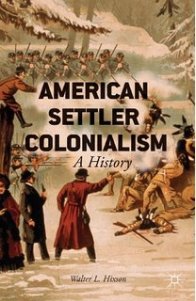 One of the trending themes in Native American history is “Settler Colonialism.” From Patrick Wolfe’s foundational essay, to recent works by historians and literary scholars—Bethel Saler, Jodi Byrd, Gregory Smithers, David Preston, and Lisa Ford, for instance—this theoretical model has attracted significant attention within the field.[1]
In fact, I’ve deployed this concept as the framework for my upper-division class, “A History of Native America, 1491–Present,” at Marquette. But over the past several weeks it has become evident that settler colonialism is a bit of a minefield. Nevertheless, I find it to be an apt, if not critical, theory for researching and teaching Native American history. But it must be understood, and it must be used responsibly. Continue reading
 The Junto