Today’s guest post is a book review from Keith Grant, a PhD candidate in History at the University of New Brunswick, Canada. He is also the co-editor of Borealia, a new group blog on early Canadian history. We strongly encourage everyone to bookmark this new and exciting blog.
Jonathan J. Den Hartog, Patriotism & Piety: Federalist Politics and Religious Struggle in the New American Nation (Charlottesville: University of Virginia Press, 2015).
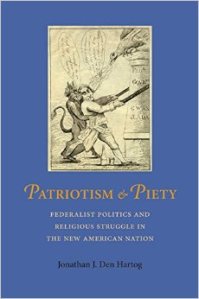 Religion was an “engine of politics” in the early American republic. Jonathan Den Hartog explains how religion energized (and then, ironically, diverted energy from) Federalist politics, and how the national vision of Federalists changed American religion. He considers northern evangelical Federalists such as John Jay (and his two sons), Caleb Strong, and Elias Boudinot, Unitarian Federalists including John Adams, and Federalists with a southern accent, Henry De Saussure and Charles Pinckney. These individuals are located, through impressive archival research, in a web of interpersonal relationships. Continue reading
 In October of 1780, the governor of Quebec, Frederick Haldimand, warned against changing the laws and regulations of the British colony. It required “but Little Penetration,” he claimed, to reach the sobering conclusion that “had the System of Government Sollicited by the Old Subjects been adopted in Canada, this Colony would in 1775 have become one of the United States of America.” He continued, “Whoever Considers the Number of Old Subjects who in that Year corresponded with and Joined the Rebels, of those who abandoned the defense of Quebec… & of the many others who are now the avowed well wishers of the Revolted Colonies, must feel this Truth.”[1]
 Historian Christopher Schmidt-Nowara passed away suddenly in Paris on Saturday, June 27th at the age of 48. Schmidt-Nowara was a prolific chronicler of the history of slavery and emancipation in the Hispanic world, as well as politics and ideas in the Spanish empire. He received his B.A. from Kenyon College in 1988. He completed his PhD from the University of Michigan in 1995, under the direction of Rebecca Scott, and taught at Fordham University in New York City for over a decade before joining the faculty at Tufts University in 2011. At the time of his death, he was Prince of Asturias Chair of Spanish Culture and Civilization at Tufts.

 I’m grateful to The Junto blog for inviting me to discuss how to publish a journal article. Although the views that follow are my own and the details of the process vary somewhat from journal to journal, I know from conversations with other editors that there is consensus on the essentials.
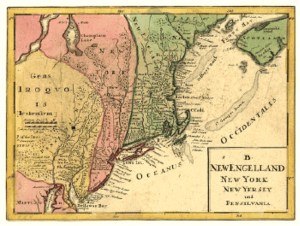 States’ rights looms large in discussions of both historical and contemporary American politics and its federal union. For good reason, the ante-bellum states’ rights movement of the South is often the first to come to mind, but such a narrow focus does not do justice to the topic as a dynamic historical phenomenon, nor does it provide adequate context for the more modern manifestations of states’ rights movements. In the early republic, New Englanders promoted their own brand of states’ rights, to protect a type of near-sovereignty they attributed to their legislatures, as the best way to promote their interests and shield individuals from distant oppression.
 The Junto