The Origins of the American Revolution: Politics and Politicized Societies

This is the fifth post in a weeklong roundtable about “The Origins of the American Revolution.” On Monday, Tom Cutterham kicked things off by exhorting historians to stop “separat[ing] economic from constitutional, imperial, political, or even intellectual causes of the revolution.” On Tuesday Jessica Parr raised questions about the convergence of religious and political rhetoric during the Revolution. Mark Boonshoft considered the importance of civil society and associationism, and yesterday Michael Hattem called for sharper attention to the periodization of the Revolution. In today’s post, Ken Owen argues for using politics as the lens with which to sharpen our focus on the disjunctures of the 1760s and 1770s. Tomorrow, the roundtable will conclude with a guest post from Jackie Reynoso.
7080030Revolutionary America was a politicized society. All of the most important conflicts of the American Revolution, from the Stamp Act through Independence to the ratification of the Constitution, were sharply divisive events which demanded citizens take sides. Even neutrals were compelled to give outward displays of support to either patriots or loyalists (often both!). There were very little chances to avoid conflict over such weighty issues—they would reshape and redefine friendships, families, and communities. Continue reading
The Origins of the American Revolution: Definition, Periodization, and Complexity

This is the fourth post in a weeklong roundtable about “The Origins of the American Revolution.” On Monday, Tom Cutterham kicked things off by exhorting historians to stop “separat[ing] economic from constitutional, imperial, political, or even intellectual causes of the revolution.” His post was followed on Tuesday by Jessica Parr’s post, which raised questions about the convergence between religious and political rhetoric during the Revolution. Yesterday, Mark Boonshoft considered the importance of civil society and associationism in thinking about the origins of the Revolution. The roundtable will continue tomorrow with a post by Ken Owen and on Saturday with a final guest post by Jackie Reynoso.

7080030In thinking over my contribution to this roundtable, I realized that, in the last two years, I have written at least five posts and done an episode of The JuntoCast on this very topic. In “The Return of the Revolution,” I called for a recommitment to the questions of origins and causes, something that had been hampered by synthetic studies of the late colonial period based on a consensus model. In “#RevReborn, Periodization, and the American Revolution,” I discussed the problematic uncertainty regarding periodization of the Revolution, particularly the recent trend to extend the endpoint of the Revolution and the reluctance to do the same in terms of the beginning of the Revolution. In “Have Cultural Historians Lost the American Revolution?” I tried to understand the recent relative ennui regarding study of the Revolution’s “origins and causes” in the broader context of developments in the field as a whole. And, in “The ‘Suddenness’ of the ‘Alteration’: Some Afterthoughts on #RevReborn2,” I noted the disappointing lack of papers directly engaging the questions of origins and causes at a recent conference devoted to the 250th anniversary of the Stamp Act.[1] Continue reading
The Origins of the American Revolution: Social Experience and Revolutionary Politics

This is the third post in our roundtable on the origins of the American Revolution. Tom Cutterham kicked things off on Monday with a post about Nick Bunker’s recent book and on Tuesday Jessica Parr wrote about religion and the American Revolution.

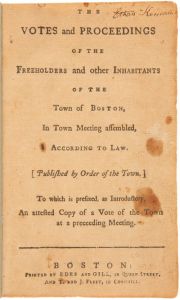
BCC Votes and ProceedingsThis roundtable grew out of a sense that the study of the Revolution’s origins or causes has been neglected of late. Which seems true enough. At the very least, historians have proven more comfortable talking in more amorphous ways about the “the coming of the Revolution” or “the making of revolutionary America.” I am certainly guilty of that. Yet there are, I think, compelling reasons for approaching the Revolution this way. Continue reading

The Origins of the American Revolution: Religion

Yesterday, Tom Cutterham kicked off our week-long roundtable on the Origins of the American Revolution with a discussion of Nick Bunker’s recent book, An Empire on the Edge. Today, we continue with a discussion of religion and the American Revolution.

George Whitefield Preaching in Philadelphia

George Whitefield Preaching in Philadelphia

In 1781, as the American Revolution raged, a Connecticut magazine reported that a spectral George Whitefield (1714-1770) had appeared over a regiment of British troops, including Benedict Arnold. So frightened were these British regulars, the magazine claimed, that they burned their British finery. Those familiar with the consumer politics of the Revolutionary period will recognize the political statement implicit in the burning of British goods. With refinement, British clothing, textiles, and other goods had become attractive to well-heeled colonists, who emulated the latest London fashions. As T.H. Breen and others have noted, the wearing of British fashions became problematic during the Revolution. Textiles and other factories began to crop up in the northeast, the start of an American industry.[1]

Continue reading

The Origins of the American Revolution: A Roundtable

“The origins and causes of the Revolution remain the two least studied parts of the Revolution in the last thirty years.” So we suggested in these pages back in spring. Was that assessment correct? Where have historians got to in understanding the origins of the revolution; and where do we still need to go? All this week, members of The Junto will weigh in on the question of causes, in an effort to take stock. This is not intended as a definitive overview of current scholarship. Rather, we’ll be exploring our own idiosyncratic approaches to revolutionary origins, and to the recent scholarship that interests us. We invite you to join in the conversation!

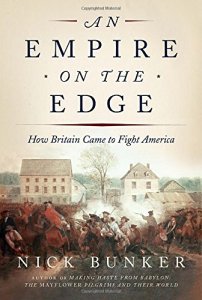
Empire on the EdgeBeyond any new discoveries of evidence and perhaps new technological capacities, every new generation of historians has something unique to contribute to the study of the past—a consciousness of its own time and place. History is written on a tightrope between then and now. Even telling the same story again will always come out differently. Each time you walk the tightrope, there’s a slightly different view. In Nick Bunker’s recent trade book, An Empire on the Edge: How Britain Came to Fight America (Knopf, 2014), that slight shift of view comes from the economic crisis that took hold in 2008. At his most interesting, Bunker presents the revolution as a story of concatenating crises, how states try to deal with them, and how they are transformed in the attempt. The dominant context for Bunker’s account is not ideological or cultural. It’s what Sven Beckert would call “war capitalism”—the entwined processes of empire and commerce. Continue reading
Guest Post: Slave Horse: The Narragansett Pacer

Today, The Junto welcomes guest poster Charlotte Carrington-Farmer, Assistant Professor of History at Roger Williams University. Her current research focuses on framing dissent, deviance, and crime in early America in a wider Atlantic World context.

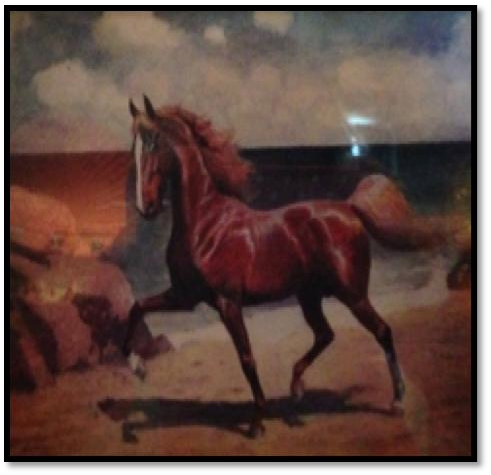
Image via Ann Holst and Pettaquamscutt Historical Society, Kingston, Rhode Island

Image via Ann Holst and Pettaquamscutt Historical Society, Kingston, Rhode Island

Once considered a breed of “no beauty,” the Narragansett Pacer moved fast enough for an 18th-century rider to cover 50-60 miles a day of rocky New England ground. As a natural pacer, its backbone moved through the air in a straight line without inclining the rider from side to side. Bred in and named for a southern community of coastal Rhode Island, the story of Narragansett Pacer horse is tightly entwined with the history of the early slave trade. Throughout the 18th and 19th centuries, these horses were traded for rum, sugar and slaves. Often, the horses were raised by slaves on the plantations of Narragansett, then shipped around the Atlantic World to work on sugar plantations alongside other slaves. Continue reading

Digital Pedagogy Roundtable: Your Links

Over the last week, Joseph Adelman, Ken Owen, Jessica Parr, and I have compiled a four part series of posts describing our attempts to incorporate digital methods into our early American history classes. As all of us are aware, however, we’re not experts–nor do we consider our posts the last word on such assignments. Continue reading

Digital Pedagogy Roundtable, Part 4: Funeral Trains and Social Media

This week, The Junto features a roundtable on digital pedagogy, in which we discuss our different approaches to using digital sources in the classroom. Today, Ken Owen shares his experience of an MA class’s project using social media for public history uses. You can also read Part 1 by Rachel Herrmann on source accesibility, Part 2 by Jessica Parr on teaching digital history to non-majors, and Part 3 by Joseph Adelman about working with students on technical knowledge.

Back in April, I had a rather surreal teaching experience. A class project, focusing on tweeting the assassination and funeral train of Abraham Lincoln, attracted a good deal of media attention in central Illinois. My class ended up appearancing in local newspapers, radio, and even with a featured spot on the local news channel. I even had a waiter in a local restaurant recognize me as the ‘Lincoln and twitter professor’. Continue reading
Digital Pedagogy Roundtable, Part 3: Technical Knowledge

This week, The Junto features a roundtable on digital pedagogy, in which we discuss our different approaches to using digital sources in the classroom. Today, Joseph Adelman talks about working with students on technical knowledge. You can also read Part 1 by Rachel Herrmann on source accesibility, and Part 2 by Jessica Parr on teaching digital history to non-majors.

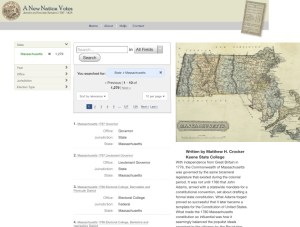
newnationvotesI’m always both impressed and intimidated when I see a digital history project pop up in my social media channels. Faculty are doing some amazing work getting students to create work using sophisticated software, apps, and other programs. They create websites, run statistical analyses, markup text using TEI … and I have no idea how to replicate it in my classroom either for myself or my students. To be fair, I have not yet taught a course on digital history specifically (nor do I plan to in the near future). So I’d like to focus instead on some practical thoughts about integrated digital history methods into the classroom in topical upper-level courses.

Continue reading

Digital Pedagogy Roundtable, Part 2: Pitching Courses for Non-Majors

This week, The Junto features a roundtable on digital pedagogy, in which we discuss our different approaches to using digital sources in the classroom. Today, Joseph Adelman talks about working with students on technical knowledge. You can also read Part 1 by Rachel Herrmann on source accesibility, and Part 3 by Joseph Adelman on the role of technical knowledge in digital pedagogy.

morIn her kick off of this week’s roundtable on Digital Pedagogy, Rachel talked about the shades of Digital History, noting Lincoln Mullen’s 2010 post “Digital Humanities Spectrum;  or, We’re all Digital Humanists Now.” I have written on spatial humanities approaches to religious history, and I do have some experience with text mining and coding. (XML, CSS, as well as some rudimentary Perl and Python.) By virtue of my library science background, I also have some training and experience in digitization, metadata, and digital stewardship. I am not a coder in the sense that true digital scholars like Mullen are, but I can speak techie and navigate that world with relative ease. Continue reading