
Walter Johnson’s River of Dark Dreams is a meditation on the making of the Cotton Kingdom in the nineteenth century American South. The book is rich with the intimacies and delicacies of detail—details that describe the fundamental material circumstances in which enslaved men, women, and children forcibly transformed Native America into cultivated grids of mono-crop culture at the behest of “Manifest Destiny”; details that are gut-wrenching in their vivid depictions of the social relations of white supremacy—the torture, the hunger, the bleeding, and the raping of the enslaved—the malignant, violent underbelly that made and forcibly maintained the Cotton Kingdom; details that connect the smallest common denominators of plantation life, whether measured in lashes (upon flesh), or pounds (of cotton), or any other metric of rule—to the global economy, which itself connected slaveholders and merchant capitalists from the fields and riverbanks of New Orleans to the factories of Manchester and Liverpool. Continue reading
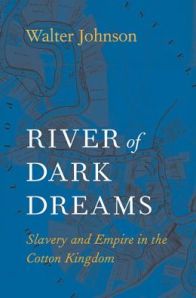 This week at The Junto, we are pleased to offer a roundtable review on Walter Johnson’s recent
  I am grateful to The Junto for this chance to reflect on my experiences earning both a Master’s in Library Science and a PhD in American history and to advocate for others to consider joining me.
  Savannah is one of those southern cities where historic atmosphere and charm drape over everything like Spanish moss on live oaks. But amidst all this atmospheric charm, one of the sights I remember most was a distinctly uncharming thing: the desiccated body of a dead squirrel on a tray, tucked away in the attic of the

 I first met Jim Merrell in the spring of my sophomore year at Vassar College, when I registered for his Revolutionary America class. Over the next two and a half years I took several more courses with Mr. Merrell (professors at Vassar go by “Mr.” or “Ms.,” rather than “Dr.” or “Professor”), where I received multi-page responses to my essays, and comments on my research papers with words like “Huzza!”
 Historians of early America often stereotype each other as being adverse to the use of theory. However, a closer look at the historiography of early America over the last century does not bear out that claim. In the first decades of the twentieth century, Progressives derived their materialist conception of history from Marx.[1] The Progressive interpretation held for decades until the 1960s when a group of historians based at Harvard University displaced it with an interpretation influenced by the sociological theories of anthropologist, Clifford Geertz.[2] Even though postmodernism and postcolonialism, as theories, never took a strong hold on the field, there have been early American historians who have sought to incorporate, in a general sense, their broader modes of inquiry.[3] The historiography of early America has hardly been devoid of theory over the last one hundred years.
 The Junto