Not Only for Readers: Why Scholars Need Narrative

Not Only for Readers: Why Scholars Need Narrative

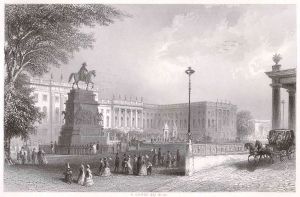
1024px-Berlin_Universitaet_um_1850This week’s roundtable began with a reference to Kurt Newman’s confession, earlier this summer, of feeling “anxiety” about a defining medium of historical scholarship: the book-length narrative. Writing for the USIH Blog in July, Kurt charged that narrative tends to conceal the historian’s assumptions and methods. More specifically, he observed, any narrative will be constructed around an ideological telos. Therefore, the book-length narrative is a dubious vehicle for a scholarly argument.

In our roundtable, we have responded to this useful provocation primarily by assuming its truth. Narrative is a powerful means of ideological initiation; its power is what makes it so valuable to historians-as-artists when they try to communicate with a reading public. On that basis, we and our commenters have been discussing the various ways narratives can exert power. Sara Georgini explored the ways Henry Adams adapted medieval narrative strategies. Jessica Parr described using stories of George Whitefield’s life as a convenient, though dangerous, structure on which to hang an argument about his public image. In the comments, similarly, J. L. Bell observed that Alan Taylor’s book William Cooper’s Town usefully subverts the very expectations its narrative structure inspires in readers.

As we wrap up today, however, I want to return to Kurt’s perceptive critique. I am not sure our response so far is adequate.

Continue reading

Narrative, Biography, and Hagiography: Reflections on Some Challenges in Microhistory

Narrative, Biography, and Hagiography: Reflections on Some Challenges in Microhistory

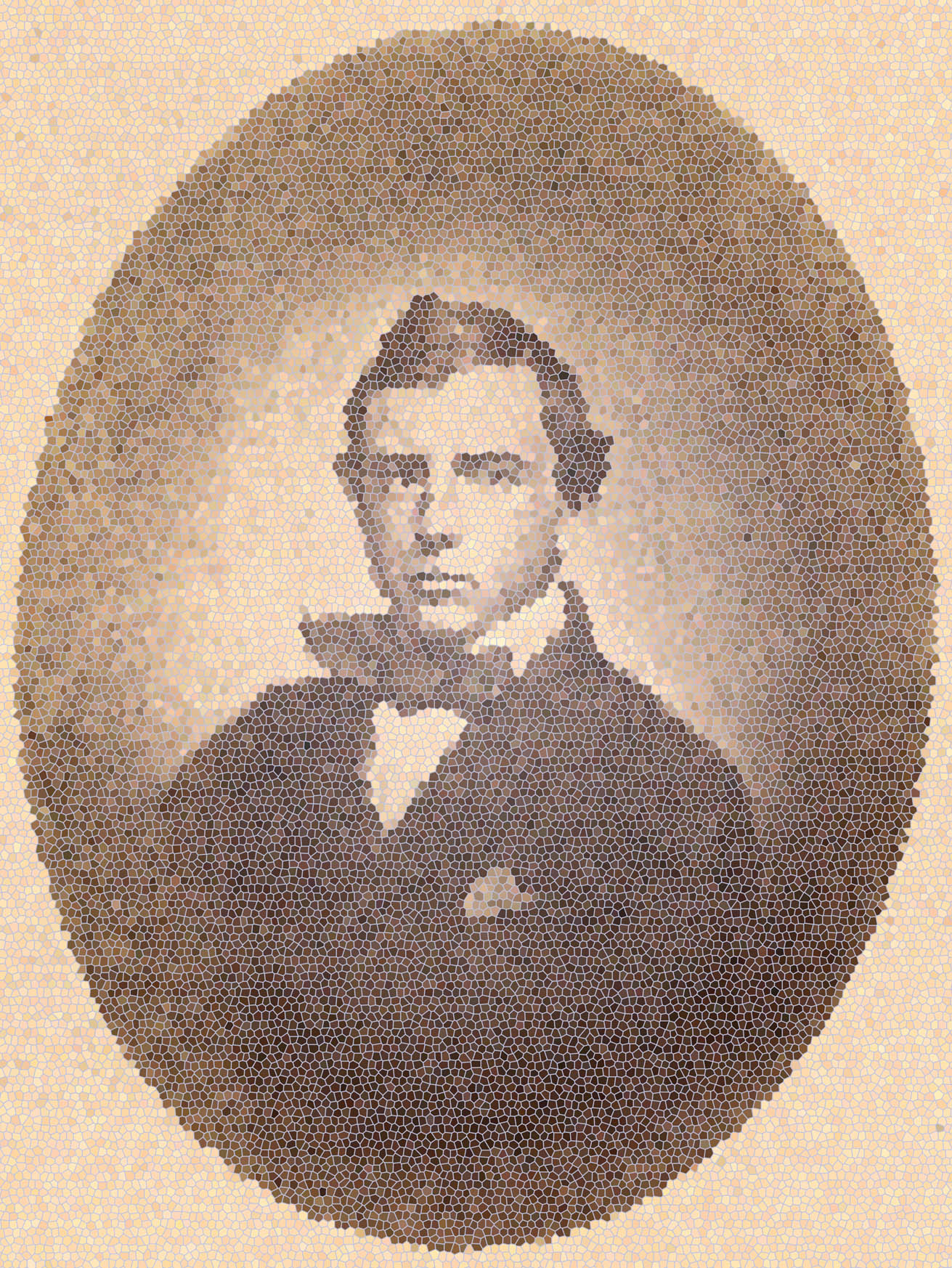
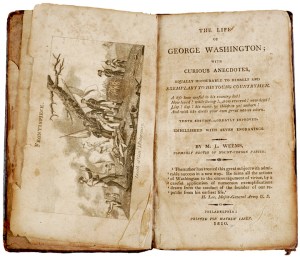
1810weemsthelifeofgeorgewashingtonShortly after the publication of Parlor Politics, Catherine Allgor was invited to reflect not only the political wives she’d written about, but also their husbands. Reflecting on John Quincy Adams, Allgor quipped “I like complicated men.”[1] While tongue-in-cheek, Allgor’s comment undoubtedly reflects why historians decide to study individuals. Unpacking the layers of “complicated men” (and women) can make for a fascinating project. But historians have also had a complicated relationship with biographies. No doubt this is because, like many narrative histories, some of the earliest Early American biographies were written as exercises in nationalism, and/or with hagiographic tendencies.[2] Moreover, when researching and writing on higher-profile individuals, many of the sources we encounter ourselves are of the narrative sort.

Continue reading

History & Story

1134henryadamsOnce or twice upon a chapter, as you work to tell history as story, take comfort in knowing that even American sage Henry Adams sometimes had a not-great writing day. By 1878, the 40-year-old Harvard professor of medieval history was a polished scholar. Hailing from a family that wrote for the archive, he navigated easily the uncatalogued byways of an early Library of Congress. He swept up obscure state records and gathered local maps for his 9-volume History of the United States. As editor of the North American Review, Henry instructed freelancers to write “in bald style.” He sliced his private letters down to acid cultural commentary that, to the modern reader, feels meta-enough to border on code. Continue reading

The Question of Narrative

borgesdesmazieres2Should historians embrace the art of narrative, or treat it with more suspicion? In his review of Sven Beckert’s Empire of Cotton back in July, USIH’s Kurt Newman argued that “the book-length narrative” is not “the proper form for the presentation of a historical argument.” Narrative, he wrote, involves too much selection, too many authorial choices hidden from the reader. “Most importantly,” Newman suggested, “constructing a narrative is almost always tied up with some telos or end,” a teleology that serves as expression or conduit of ideology, pulling us towards the outcome we imagine fits. Narrative, in other words, is something more than reasoned argument. It enlists desire to shape the way we think. Continue reading

Putting the “Pop” into Popular History: Pop Culture Videos in the Classroom

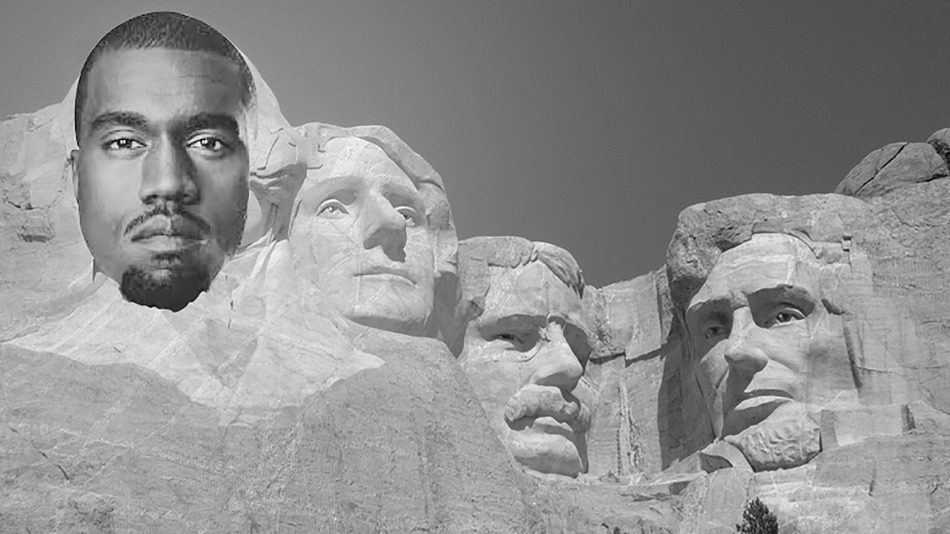
Kanye West may not be ready to enter our historical surveys, but there are other pop culture references that deserve more attention.

President Kanye West may never become a reality, but I’d like to think he’d choose a Secretary of Education who’d endorsed creative pedagogy.

Kanye West’s presidential ambitions remind us that American history is full of fun surprises—even if most of them are short-lived and forgettable. Although it’s probably too much of a stretch to make the entertainment of #Kanye2020 relevant to American history—though Donald Trump’s candidacy perhaps proves that nothing is outside the realm of possibility—I do love to find pop culture references and videos and bring relevance to what students might see as staid topics.

I’m declaring this post a judgment-free zone so that I can be frank: I have a tough time keeping the attention of the freshmen students in my undergraduate survey class. But I have found that one thing that works well is video clips, and so I find myself drawing from youtube nearly as much as I do from powerpoint. Luckily, I’m a TV-show junkie, and so I have have a lot of background at my disposal. (Finally a way to justify my Netflix binges!) Indeed, my use of videos in class is one of the constant positives in my students’ evaluations, so I know it’s not just me who enjoys this approach. Continue reading

The Origins of the American Revolution: Empire

Guest poster Jacqueline Reynoso is a PhD candidate at Cornell University. This is the sixth post in a weeklong roundtable about “The Origins of the American Revolution.” On Monday, Tom Cutterham kicked things off by exhorting historians to stop “separat[ing] economic from constitutional, imperial, political, or even intellectual causes of the revolution.” On Tuesday Jessica Parr raised questions about the convergence of religious and political rhetoric during the Revolution. Mark Boonshoft considered the importance of civil society and associationism. On Thursday, Michael Hattem called for sharper attention to the periodization when discussing the origins and/or causes of the Revolution. In yesterday’s post, Ken Owen argued for using politics as the lens with which to sharpen our focus on the disjunctures of the 1760s and 1770s. Today, the roundtable concludes with Reynoso commenting on alternative vantage points of empire during the American Revolution.

7080030In October of 1780, the governor of Quebec, Frederick Haldimand, warned against changing the laws and regulations of the British colony. It required “but Little Penetration,” he claimed, to reach the sobering conclusion that “had the System of Government Sollicited by the Old Subjects been adopted in Canada, this Colony would in 1775 have become one of the United States of America.” He continued, “Whoever Considers the Number of Old Subjects who in that Year corresponded with and Joined the Rebels, of those who abandoned the defense of Quebec… & of the many others who are now the avowed well wishers of the Revolted Colonies, must feel this Truth.”[1]
Continue reading

The Origins of the American Revolution: Politics and Politicized Societies

This is the fifth post in a weeklong roundtable about “The Origins of the American Revolution.” On Monday, Tom Cutterham kicked things off by exhorting historians to stop “separat[ing] economic from constitutional, imperial, political, or even intellectual causes of the revolution.” On Tuesday Jessica Parr raised questions about the convergence of religious and political rhetoric during the Revolution. Mark Boonshoft considered the importance of civil society and associationism, and yesterday Michael Hattem called for sharper attention to the periodization of the Revolution. In today’s post, Ken Owen argues for using politics as the lens with which to sharpen our focus on the disjunctures of the 1760s and 1770s. Tomorrow, the roundtable will conclude with a guest post from Jackie Reynoso.

7080030Revolutionary America was a politicized society. All of the most important conflicts of the American Revolution, from the Stamp Act through Independence to the ratification of the Constitution, were sharply divisive events which demanded citizens take sides. Even neutrals were compelled to give outward displays of support to either patriots or loyalists (often both!). There were very little chances to avoid conflict over such weighty issues—they would reshape and redefine friendships, families, and communities. Continue reading
The Origins of the American Revolution: Definition, Periodization, and Complexity

This is the fourth post in a weeklong roundtable about “The Origins of the American Revolution.” On Monday, Tom Cutterham kicked things off by exhorting historians to stop “separat[ing] economic from constitutional, imperial, political, or even intellectual causes of the revolution.” His post was followed on Tuesday by Jessica Parr’s post, which raised questions about the convergence between religious and political rhetoric during the Revolution. Yesterday, Mark Boonshoft considered the importance of civil society and associationism in thinking about the origins of the Revolution. The roundtable will continue tomorrow with a post by Ken Owen and on Saturday with a final guest post by Jackie Reynoso.

7080030In thinking over my contribution to this roundtable, I realized that, in the last two years, I have written at least five posts and done an episode of The JuntoCast on this very topic. In “The Return of the Revolution,” I called for a recommitment to the questions of origins and causes, something that had been hampered by synthetic studies of the late colonial period based on a consensus model. In “#RevReborn, Periodization, and the American Revolution,” I discussed the problematic uncertainty regarding periodization of the Revolution, particularly the recent trend to extend the endpoint of the Revolution and the reluctance to do the same in terms of the beginning of the Revolution. In “Have Cultural Historians Lost the American Revolution?” I tried to understand the recent relative ennui regarding study of the Revolution’s “origins and causes” in the broader context of developments in the field as a whole. And, in “The ‘Suddenness’ of the ‘Alteration’: Some Afterthoughts on #RevReborn2,” I noted the disappointing lack of papers directly engaging the questions of origins and causes at a recent conference devoted to the 250th anniversary of the Stamp Act.[1] Continue reading
The Origins of the American Revolution: Social Experience and Revolutionary Politics

This is the third post in our roundtable on the origins of the American Revolution. Tom Cutterham kicked things off on Monday with a post about Nick Bunker’s recent book and on Tuesday Jessica Parr wrote about religion and the American Revolution.

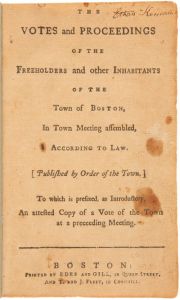
BCC Votes and ProceedingsThis roundtable grew out of a sense that the study of the Revolution’s origins or causes has been neglected of late. Which seems true enough. At the very least, historians have proven more comfortable talking in more amorphous ways about the “the coming of the Revolution” or “the making of revolutionary America.” I am certainly guilty of that. Yet there are, I think, compelling reasons for approaching the Revolution this way. Continue reading

The Origins of the American Revolution: Religion

Yesterday, Tom Cutterham kicked off our week-long roundtable on the Origins of the American Revolution with a discussion of Nick Bunker’s recent book, An Empire on the Edge. Today, we continue with a discussion of religion and the American Revolution.

George Whitefield Preaching in Philadelphia

George Whitefield Preaching in Philadelphia

In 1781, as the American Revolution raged, a Connecticut magazine reported that a spectral George Whitefield (1714-1770) had appeared over a regiment of British troops, including Benedict Arnold. So frightened were these British regulars, the magazine claimed, that they burned their British finery. Those familiar with the consumer politics of the Revolutionary period will recognize the political statement implicit in the burning of British goods. With refinement, British clothing, textiles, and other goods had become attractive to well-heeled colonists, who emulated the latest London fashions. As T.H. Breen and others have noted, the wearing of British fashions became problematic during the Revolution. Textiles and other factories began to crop up in the northeast, the start of an American industry.[1]

Continue reading