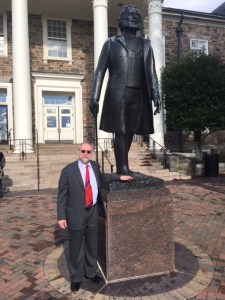
Jeremy C. Young is an assistant professor of history at Dixie State University and the author of The Age of Charisma: Leaders, Followers, and Emotions in American Society, 1870-1940 (Cambridge University Press, 2017).
 Too often, as American historians, we imagine the Civil War as an impenetrable barrier between eras—as if American history simply stopped in 1861 and an entirely new nation, filled with new people, came to replace it. In reality, of course, people who cast their first ballots for Andrew Jackson cast their last for William Jennings Bryan; people born into slavery died after the advent of talking motion pictures. Nevertheless, professionally speaking, we’re often tacitly discouraged from placing the antebellum and postbellum worlds in conversation with one another. This way of thinking disadvantages historians of the modern era in particular, I think, in that it makes us less likely to investigate the early American roots of the phenomena we study. In my case, it explains why it took me so long to realize that the story I was telling about the 1920s actually began in the 1820s. I want to tell you about that moment of discovery, about how my reluctance to look at early American history almost caused me to miss the most explosive revelation in my book—and about what I found when I finally pulled back the curtain to reveal the early-American origins of my narrative. Continue reading
 In researching and writing my book, Pulpit & Nation, I became keenly interested in the religious language employed by participants in the ratification debates of 1787-88. Not only did it illuminate the role of religion and clergymen in the politics of Revolutionary America, but it seemed particularly relevant to the almost canonical way in which so many twenty-first century politicians and pundits view the Constitution. Of course, when—or if—these individuals ever consult that document’s history, they rarely bother to question what political motivations drove so many of the seemingly religious expressions made by early national leaders. And there are many such statements. Yet, amid the numerous examples of Federalists and Anti-Federalists employing (and exploiting) providential language and Old Testament Biblicism in arguing for ratification, one example stands out as particularly complex in its motives and implications: the argument Benjamin Rush made for ratification in the Pennsylvania ratifying convention.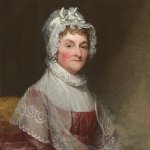

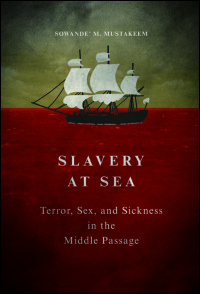
 I am fortunate that in graduate school, I had quite a bit of guidance in writing across the curriculum pedagogy. I have since taught approximately a dozen designated writing-intensive courses. Most history courses are writing-intensive by default, and many history faculty do find themselves teaching writing and research techniques. Here, I am focusing primarily on the strategies I use in survey courses, with a short list of monographs that I have found work well for this purpose.
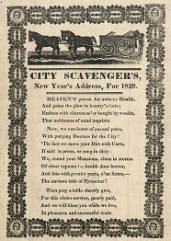 Every day they took apart the city, and put it back together again. New Year’s Day was no different. They worked while dawn, then dusk, threaded the sky, to patch up narrow streets. Lamplighters, an urban mainstay heroicized by
  Joyce Oldham Appleby was born in Nebraska on April 9, 1929. After a rootless childhood that involved a number of moves from Illinois to California (and a number of places in between), Appleby attended Stanford University, where she received her BA in History in 1950. After spending a few years working as a writer for Mademoiselle in New York City, she returned to California and subsequently decided to pursue graduate study in history. Following an MA at UC-Santa Barbara, Appleby went on to complete her PhD at Claremont Graduate University in 1966 with a dissertation entitled, “An American in Paris: The Career of an American Pamphlet in French Revolutionary Politics, 1787-89.” In 1968, after a year abroad in Paris with her family, which, by now, included three children, Appleby published her first article in the American Historical Review, “