Guest Post: Law and Sexual Misconduct in New England, 1650-1750

Abby Chandler is Assistant Professor of History at the University of Massachusetts, Lowell. She received her PhD from the University of Maine at Orono. Her first book, Law and Sexual Misconduct in New England, 1650-1750: Steering Towards England is due to be released by Ashgate in November.

Chandler CoverMy forthcoming book, Law and Sexual Misconduct in New England, 1650-1750: Steering Toward England, uses sexual misconduct trials to examine the ways in which the growing Anglicization of the New England colonies played a role in the daily lives of ordinary colonists. Such trials may seem an unusual source base for studying broader political change, but their frequency and consistency allowed me to track the often subtle shifts toward more Anglicized legal systems. Likewise, both men and women were routinely charged with sexual misconduct, which allowed me to examine these shifts from male and female perspectives. This is the story of two widows in Essex County, Massachusetts, and their very different experiences with the Puritan dominated legal system of the seventeenth century and the Anglicized legal system of the eighteenth century.

Continue reading

Legal Professionalization and the American Revolution

nypl.digitalcollections.1d31b7c0-ed26-0132-b11b-58d385a7b928.012.wJohn Adams thought that James Otis set the whole American Revolution in motion in 1761. Otis’ argument against writs of assistance, in a legal case that year, Adams wrote, “was the first scene of the first Act of opposition to the Arbitrary claims of Great Britain. Then and there the Child Independence was born.”[1] Of course, Adams also though that July 2nd would be the most famous date in history. So forgive me for at least questioning Adams’ view that the “Writs of Assistance Case” basically jumpstarted the Revolution. That said, I do think the evidence base for the “Writs of Assistance Case” suggests that it was a major turning point in the development of the colonial legal profession. Picking up on themes in yesterday’s guest post by Craig Hanlon, the case may help make sense of the connections between legal professionalization and the American Revolution. Continue reading

Guest Post: John Adams–Attorney and Barrister

Today’s guest post comes from Craig Hanlon, a Ph.D. candidate at the University of Stirling. He holds a B.A. (Hons.) and a M.Res., both from Stirling. His dissertation focuses on John Adams’s legal career.

Johnadamsvp.flippedJohn Adams is a familiar figure to early American historians. His public service before, during, and after the Revolution has received considerable attention over the years, and quite rightly so. But there are gaps in Adams-related scholarship. Perhaps most prominently, Adams’s legal career prior to the American Revolution has been heretofore underappreciated. From 1758 until his appointment to the Continental Congress, in 1774, Adams was an attorney and barrister. He practiced in the courts of Massachusetts. My research examines Adams’s legal career in detail, particularly his professional and intellectual development between 1758 and 1774. I start from the premise that Adams’s knowledge and understanding of the law related to, and indeed influenced, his political ideology.[1] Continue reading

Edifying Terror: Publicity and the Problem of Punishment

Emily Merrill is a PhD student at the University of Pennsylvania. Her dissertation, “Judging Empire: British Military Courts and the Politics of the Body,” explores the intersections of gender, military, and empire in the late eighteenth century by examining cases of bodily assault prosecuted by British military courts during the Revolutionary War.

The brutality of military discipline in the British Army, which regularly sentenced enlisted soldiers to severe floggings of hundreds of lashes with the cat o’nine tails for relatively minor crimes—such as drunkenness or not wearing their uniforms properly—horrified civilian observers in Britain and America alike.
What justifications did the officers who administered these punishments give for this customary treatment of offenders? Did they believe that these severe floggings would convince miscreants of the error of their ways, or instill in them a determination to reform their behavior? Or were they unconcerned with rehabilitation, seeking only to inflict suffering upon convicted soldiers in retribution for their crimes? Continue reading

Revisiting Red Jacket, alias Cow Killer

Image from Wikimedia Commons

Image from Wikimedia Commons

Lately I’ve been thinking about names and what they mean. The Seneca orator Red Jacket had several of them. Red Jacket lived on the Buffalo Creek reservation, and according to Christopher Densmore, he was less influential than other leaders—though his name increasingly appears in council speeches in the 1780s and 1790s.[1] U.S. Indian commissioner Timothy Pickering recorded his Seneca name as “Saco-que-y-wan-tau,” translating as “Sleeper Wake up.”[2] Usually Red Jacket seems to appear in the records as Red Jacket—but I am interested in a fourth name. According to most historians Red Jacket’s alias, Cow Killer, was derogatory, meant to tease him for “his distinct disinclination to fight during the American Revolution.”[3] Continue reading

Not Only for Readers: Why Scholars Need Narrative

Not Only for Readers: Why Scholars Need Narrative

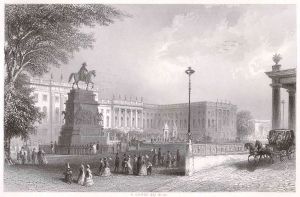
1024px-Berlin_Universitaet_um_1850This week’s roundtable began with a reference to Kurt Newman’s confession, earlier this summer, of feeling “anxiety” about a defining medium of historical scholarship: the book-length narrative. Writing for the USIH Blog in July, Kurt charged that narrative tends to conceal the historian’s assumptions and methods. More specifically, he observed, any narrative will be constructed around an ideological telos. Therefore, the book-length narrative is a dubious vehicle for a scholarly argument.

In our roundtable, we have responded to this useful provocation primarily by assuming its truth. Narrative is a powerful means of ideological initiation; its power is what makes it so valuable to historians-as-artists when they try to communicate with a reading public. On that basis, we and our commenters have been discussing the various ways narratives can exert power. Sara Georgini explored the ways Henry Adams adapted medieval narrative strategies. Jessica Parr described using stories of George Whitefield’s life as a convenient, though dangerous, structure on which to hang an argument about his public image. In the comments, similarly, J. L. Bell observed that Alan Taylor’s book William Cooper’s Town usefully subverts the very expectations its narrative structure inspires in readers.

As we wrap up today, however, I want to return to Kurt’s perceptive critique. I am not sure our response so far is adequate.

Continue reading

Narrative, Biography, and Hagiography: Reflections on Some Challenges in Microhistory

Narrative, Biography, and Hagiography: Reflections on Some Challenges in Microhistory

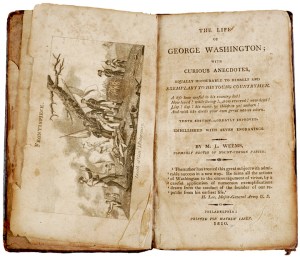
1810weemsthelifeofgeorgewashingtonShortly after the publication of Parlor Politics, Catherine Allgor was invited to reflect not only the political wives she’d written about, but also their husbands. Reflecting on John Quincy Adams, Allgor quipped “I like complicated men.”[1] While tongue-in-cheek, Allgor’s comment undoubtedly reflects why historians decide to study individuals. Unpacking the layers of “complicated men” (and women) can make for a fascinating project. But historians have also had a complicated relationship with biographies. No doubt this is because, like many narrative histories, some of the earliest Early American biographies were written as exercises in nationalism, and/or with hagiographic tendencies.[2] Moreover, when researching and writing on higher-profile individuals, many of the sources we encounter ourselves are of the narrative sort.

Continue reading

History & Story

1134henryadamsOnce or twice upon a chapter, as you work to tell history as story, take comfort in knowing that even American sage Henry Adams sometimes had a not-great writing day. By 1878, the 40-year-old Harvard professor of medieval history was a polished scholar. Hailing from a family that wrote for the archive, he navigated easily the uncatalogued byways of an early Library of Congress. He swept up obscure state records and gathered local maps for his 9-volume History of the United States. As editor of the North American Review, Henry instructed freelancers to write “in bald style.” He sliced his private letters down to acid cultural commentary that, to the modern reader, feels meta-enough to border on code. Continue reading

The Question of Narrative

borgesdesmazieres2Should historians embrace the art of narrative, or treat it with more suspicion? In his review of Sven Beckert’s Empire of Cotton back in July, USIH’s Kurt Newman argued that “the book-length narrative” is not “the proper form for the presentation of a historical argument.” Narrative, he wrote, involves too much selection, too many authorial choices hidden from the reader. “Most importantly,” Newman suggested, “constructing a narrative is almost always tied up with some telos or end,” a teleology that serves as expression or conduit of ideology, pulling us towards the outcome we imagine fits. Narrative, in other words, is something more than reasoned argument. It enlists desire to shape the way we think. Continue reading

The Wandering Essay: A Lesson Plan for Teaching Writing

commas

Image by Zazzle.com

Before I even started teaching I knew that one of the most difficult parts of the job would be teaching writing. It’s not that I consider myself a great writer; I know I’m prone to tangents, and I’ve never met a dash, comma, or semi-colon I didn’t want to use. It’s just that I find writing pretty intuitive. For informal pieces like this one, I tend to write the way that I talk, and for more structured academic writing my first drafts are pretty crappy—but they get written and then ironed out in my editing process. The takeaway here is that I’ve had to think hard about how to teach writing because the process of writing isn’t really one that I had to articulate before I had students. Knowing that many of you are almost ready to collect first essay assignments, I thought I’d talk a bit today about how we teach writing to students. My Wandering Essay lesson plan is one of the meanest, most productive approaches I’ve used because it makes clear the fact that writing is a process. Here’s how you do it: Continue reading