 As most, if not all, of our readers are aware, this past weekend was the “So Sudden an Alteration” conference hosted by the Massachusetts Historical Society in commemoration of the 250th anniversary of the Stamp Act.[1] It was the second of three conferences dedicated to rebirthing Revolution studies, hence, the hashtag #RevReborn2. (NB: You can find the immense backchannel coverage of the conference Storified here: Day 1, Day 2, and Day 3. You can also find Joseph Adelman’s interactive TAGSExplorer that chronicled the Twitter coverage). This post is not intended to be a standard Junto-type conference recap. Instead, I just want to offer some afterthoughts on the conference, specifically in light of the piece I wrote before the conference, entitled “Have Cultural Historians Lost the Revolution?” as well as numerous other pieces I have written about the historiography of the Revolution and the state of Revolution studies for the blog, particularly before the first #RevReborn conference back in 2013. Continue reading
Tag Archives: American Revolution
Live Coverage of “So Sudden an Alteration” Conference
As you know from last week’s posts by Michael and Ken, this weekend is the second major conference in two years on the American Revolution, So Sudden an Alteration, hosted by the Massachusetts Historical Society.
There have already been a number of great papers, and some hot debates on the meaning of studying the Revolution, with more to come today.
We will have full coverage next week, but in the meantime, you can keep up with the conference on Twitter by following the hashtag, #RevReborn2, or Juntoists at the conference, including me (@jmadelman), Jessica Parr (@ProvAtlantic), Michael Hattem (@MichaelHattem), and Tom Cutterham (@tomcutterham).
You can also follow several friends of the blog: Liz Covart (@lizcovart), John Bell (@Boston1775), and the MHS institutional account (@MHS1791).
UPDATE (4/12, 8pm): Now that the conference is over, you can also check out several summations of the conference.
Michael Hattem created a Storify for each of the three days of the conference:
And there is also a more basic archive of tweets and an interactive explorer.
Spring Reads
 Here’s our seasonal roundup of new and forthcoming titles. Share your finds below! Continue reading
No Politics, No Revolution
 If there is a current orthodoxy among historians of the American Revolution, it is that the study of the Revolution has lost its focus. In their introduction to the Common-Place edition recapping the McNeil Center’s “The American Revolution Reborn” conference, Patrick Spero and Michael Zuckerman wrote of “a field that had grown stale” and that was “losing its verve, and worse, its center.” The call for papers for the forthcoming Massachusetts Historical Society conference effectively described the field as being stuck in a historiographical rut. There is a reason that study of the Revolution has lost its center. It has failed to concentrate its focus on politics. Continue reading
This Week in Early American History
 Welcome to another edition of This Week in Early American History! We wish a safe and healthy holiday to those who are observing Easter this weekend, and a Chag Kasher V’Sameach to those who are celebrating Passover. Now, on to the links….
Have Cultural Historians Lost the American Revolution?
 In just over a week from now, the Massachusetts Historical Society is hosting, “‘So Sudden an Alteration’: The Causes, Course, and Consequences of the American Revolution,” an important conference on the American Revolution in recognition of the the 250th anniversary of the Stamp Act. This is the second of three conferences dedicated to rediscovering or re-energizing study of the American Revolution, the first of which, “The American Revolution Reborn,” was hosted by the McNeil Center for Early American Studies in the spring of 2013. And so with the conference fast approaching, I want to use this piece to think about the specific moment and circumstances in which American Revolution studies currently finds itself, which has been the catalyst for this series of conferences, and suggest possibilities going forward. The primary circumstance of that moment, with which many seem to agree, is that the study of the Revolution is in a rut, plodding along in the same “well-worn grooves of historical inquiry” for the “past fifty years,” according to the conference’s call for papers. Continue reading
Bernard Bailyn’s Last Act?: An Interview with the Harvard Historian on His New Book
 Bernard Bailyn’s contribution to our understanding of early American history is so vast that it’s easy to forget he’s still publishing books. His writings on the American Revolution, begun in the 1960s, remain required reading for any doctoral student studying for orals. And even since retiring from Harvard a quarter century ago, he’s continued to influence the field, perhaps nowhere more than through his promotion of Atlantic history.
Yet even at 92, Bailyn isn’t finished. His new book, Sometimes An Art: Nine Essays on History (Knopf), can be read in a number of ways: as an introduction to his vast corpus of work; a chance to respond to his critics; a reflection on the meaning of history; and, perhaps, a summing up of sorts. “It reflects some of my own work over the years,” Bailyn told me during an interview from Boston. The essays he’s chosen to include, dating from 1954 to 2007, have only appeared in either obscure publications or dated back issues of prominent journals. But in one way or another, he said, they “concentrate on certain major themes” in all his work. Continue reading
Guest Post: [Enter Catchy Title Here]: Working towards a Book Title
Today’s guest poster, Christopher Minty, is a Bernard and Irene Schwartz Postdoctoral Fellow at the New-York Historical Society and Eugene Lang College at The New School for Liberal Arts. He received his PhD from the University of Stirling. His current book project examines the role of popular partisanship and its effects on New Yorkers’ allegiances on the eve of the American Revolution. He is also the author of two previous guest posts at The Junto, “The Problem of Loyalism before the American Revolution” and “Working on the Papers of Francis Bernard.”
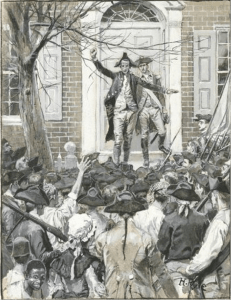 I like eye-catching book titles. Who doesn’t, right? A good title should run of the tongue without too much fuss, while also championing the main argument(s) of the book. Recent books with titles that caught my eye include Benjamin Irvin’s Clothed in Robes of Sovereignty, Jessica Roney’s Governed by a Spirit of Opposition, and Albrecht Koschnik’s “Let a Common Interest Bind Us Together.” To be sure, there are others, and they are held together by a common thread: Despite looking at different periods with different objectives, each title offers a snapshot of what the reader can expect to find. Continue reading
The JuntoCast, Episode 15: “Founders” in Early America
 We’re happy to bring you the fifteenth episode of “The JuntoCast.” Continue reading
Reading the Field from a Book: Some Thoughts on Eric Nelson’s The Royalist Revolution
 Eric Nelson’s The Royalist Revolution: Monarchy and the American Founding is, to put it simply, an important book. It is perhaps, the most important book on the Revolution in almost a decade. Yet, at the same time, its argument, methodology, and importance are indicative of (one might say, testament to) the long-standing stasis in which Revolution political studies has been mired for a very long time. This post is less reviewing the book itself than exploring its relationship with its historiographical context regarding political studies of the Revolution, particularly, its origins and causes.[1] Continue reading
 The Junto