Today’s Founding Fiction post is by Emily Sneff, Research Manager of the Declaration Resources Project at Harvard University. The mission of the Declaration Resources Project is to create innovative and informative resources about the Declaration of Independence. To learn more, follow @declarationres.

How do we get kids to read and comprehend the Declaration of Independence? Great authors and illustrators can transform the characters, events, and text of the Declaration (which, as you may expect, registers at about a 12th grade reading level) into true stories that are both entertaining and educational for younger readers. On the Declaration Resources Project’s blog, Course of Human Events, we recently interviewed authors Barbara Kerley (Those Rebels, John & Tom), Steve Sheinkin (King George: What Was His Problem? The Whole Hilarious Story of the American Revolution), and Gretchen Woelfle (Answering the Cry for Freedom: Stories of African Americans and the American Revolution). Their books, and a few other favorites, form an exciting non-fiction reading list for children and young adults. Continue reading
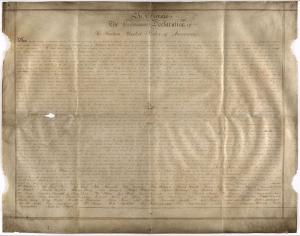
 Following on from
  At a time when political events seem to place the very meaning of American democracy under the microscope, it is perhaps unsurprising that so many recent works have looked to re-evaluate the American Founding. Books focusing on the mid-1770s in general have included Kevin Philips’s 1775, Richard Beeman’s Our Lives, Our Fortunes, & Our Sacred Honor, and Joseph Ellis’s American Quartet. Recent books that have looked more specifically at the Declaration of Independence itself include Danielle Allen’s Our Declaration. Robert Parkinson’s The Common Cause, too, has called for a re-evaluation of what motivated those who fought for Independence, though his work calls for a much less celebratory conclusion. Such a list demonstrates the importance of the mid-1770s to America’s national identity. With The Heart of the Declaration, Steven Pincus throws his hat into the ring, too.
 After a month of narrowing down our field of 64 primary sources on early American history, the results for March Madness are in!
 “Is it the Fourth?” Indeed, it is. And, along with it comes no shortage of interesting conversations about the Declaration of Independence. So here is our quick roundup…
 Good morning and welcome to another Week in Early American History. I’m your host, Tom Cutterham.
  The Junto