Today’s guest poster, Spencer McBride, received his PhD at Louisiana State University in 2014 and is now a historian and documentary editor at the Joseph Smith Papers. His research examines the politicization of clergymen during the American Revolution and in the early American republic.
In my work at The Joseph Smith Papers, I have recently been examining dozens of documents surrounding the trip Joseph Smith made to Washington D.C. in 1839. As I have prepared these documents for publication in one of the project’s future volumes, they have drawn my mind to the way men and women living in rural America during the nineteenth century perceived the federal government and what they thought occurred in its different branches. Though Smith’s experience in this regard is but one example, I think that it is a telling one. Continue reading →
We begin this Week in Early American History with James Oakes’ powerful and timely reflection on white abolitionism. “The Real Problem with White Abolitionists,” Oakes argues, is that “even the most radical abolitionists betrayed a blind faith in the magical healing powers of a free market in labor. Scarcely a single theme of the broader antislavery argument strayed far from the premise.” Continue reading →
Jessica Parr received her PhD from the University of New Hampshire at Durham in 2012. Her research interests are on race and religion in the Early Modern British Atlantic. Her first book, Inventing George Whitefield: Race, Revivalism, and the Making of a Religious Icon is forthcoming from the University Press of Mississippi (2015). She currently teaches at the University of New Hampshire at Manchester. Here she recaps the recent “George Whitefield at 300” conference.
In 1740, during George Whitefield’s first visit to New England, Connecticut minister Reverend Daniel Wadsworth wrote in his diary: “met with the famous life of Whitefield: but what is it?”[1] Wadsworth’s comments no doubt reflected both the excitement and the unease that Whitefield’s visit provoked among New England clergy, who both looked to him as a man who could renew piety and New England, but also feared his potential for exacerbating existing religious tensions. Nonetheless, it is a poignant question, and one anyone who is familiar with “the Grand Itinerant” might ask. Continue reading →
I’ll just admit it: Freemasonry is one of those things in American history that I have trouble getting my head around. I suppose I understand the importance of guy-time, but many of my closest friends are women. The very idea of secret societies, with initiations and special rings, just seems boyish to me. I would suppose that the boyishness is the point–a search for wonder and enchantment and all of that–except that early in the nineteenth century the Masons banned alcohol at meetings: no stein hoists here. The largest group at midcentury actually required its members to be teetotalers, making enchantment a much harder sell, for my money. More to the point, in the same period enchantment without booze could be had at a Methodist camp meeting, which seems like it would have been quite a lot more interesting, what with women there. Continue reading →
Religious liberty, perhaps, is the key legacy of the Revolutionary generation. The new United States was a society where slavery was a growing economic force, gender inequality was becoming entrenched, and the new nation’s expansion relied on the exploitation and expropriation of Native Americans. If there was one freedom, however, on the march in the early republic it was religious freedom. The progress of religious freedom in the United States was also the progress of religion itself. “[T]he number, the industry, and the morality of the priesthood and the devotion of the people have been manifestly increased by the total separation of the Church from the state” noted James Madison, that famous advocate of religious liberty, in an 1819 letter.[1] Religious freedom, then, is the American freedom. This has been the animating assumption behind most scholarship on the religious development of late eighteenth and early nineteenth centuries. Continue reading →
With Christmas right around the corner, we are re-posting this piece from three years ago. All of us at The Junto would like to wish happy holidays to all our readers.
As an historian of early America, I suspect I am not alone in sighing a little bit to myself when hearing the often heated rhetoric about the “War on Christmas” emanating from right-wing and evangelical media outlets at this time of the year. That, of course, is because the real war on Christmas was not waged by 21st-century godless, liberal secular humanists and the ACLU but by 17th-century New England Puritans, particularly the clergy.
Saturnalia was a pagan Roman festival held annually from December 17-25. Its customary celebrations were both chaotic and violent and, hence, were popular amongst lower-class Romans. In the fourth century, as the Catholic Church sought to bring the pagan masses into the Christian fold, the Church adopted the final day of the festival as Jesus’s birthday, which the New Testament does not indicate and on which, until this time, there had been no widespread consensus. The Church effectively killed two birds with one stone. Throughout the centuries, the most violent aspects of the celebration (which, allegedly, may have included human sacrifices) fell away, but the customs of near-lawless revelry persisted, and indeed defined the celebrations in the early modern period.
At the start of the early modern period, the holiday was not yet the priority it has become, as Easter dominated the Catholic calendar. But the Reformation had a significant impact on the perception of Christmas, both positively and negatively. The holiday celebration customs were continued by the Church of England. The often uninhibited revelry of the holiday (which Puritans derisively referred to as “Foolstide”) appealed to the English lower classes while the gentry celebrated with “eating and drinking, [and] banqueting and feasting.”
In addition there was a distinct class aspect to one of the customs, in which the poorest man in the town was named “The Lord of Misrule” and treated like a gentleman.[1] Another custom, known as “wassailling” involved lower-class persons going to the homes of wealthy individuals and “asking” for food and drink, which they would then use to toast that individual. Due to the penchant for disorder, immodesty, gluttony, and the (temporary) breakdown of the social order, it should come as no surprise that in the late sixteenth and early seventeenth centuries, English dissenters began to take a very dim view of the holiday. Indeed, the hotter the Protestant, the stronger the aversion to Christmas. But their opposition to Christmas was not just due to the overtly social nature of its celebration. Puritan faith derived wholly from scripture, and, in 1645 and again in 1647, the Long Parliament declared the abolition of all holy days except the Sabbath, which was the only day described as such in the Bible.[2]
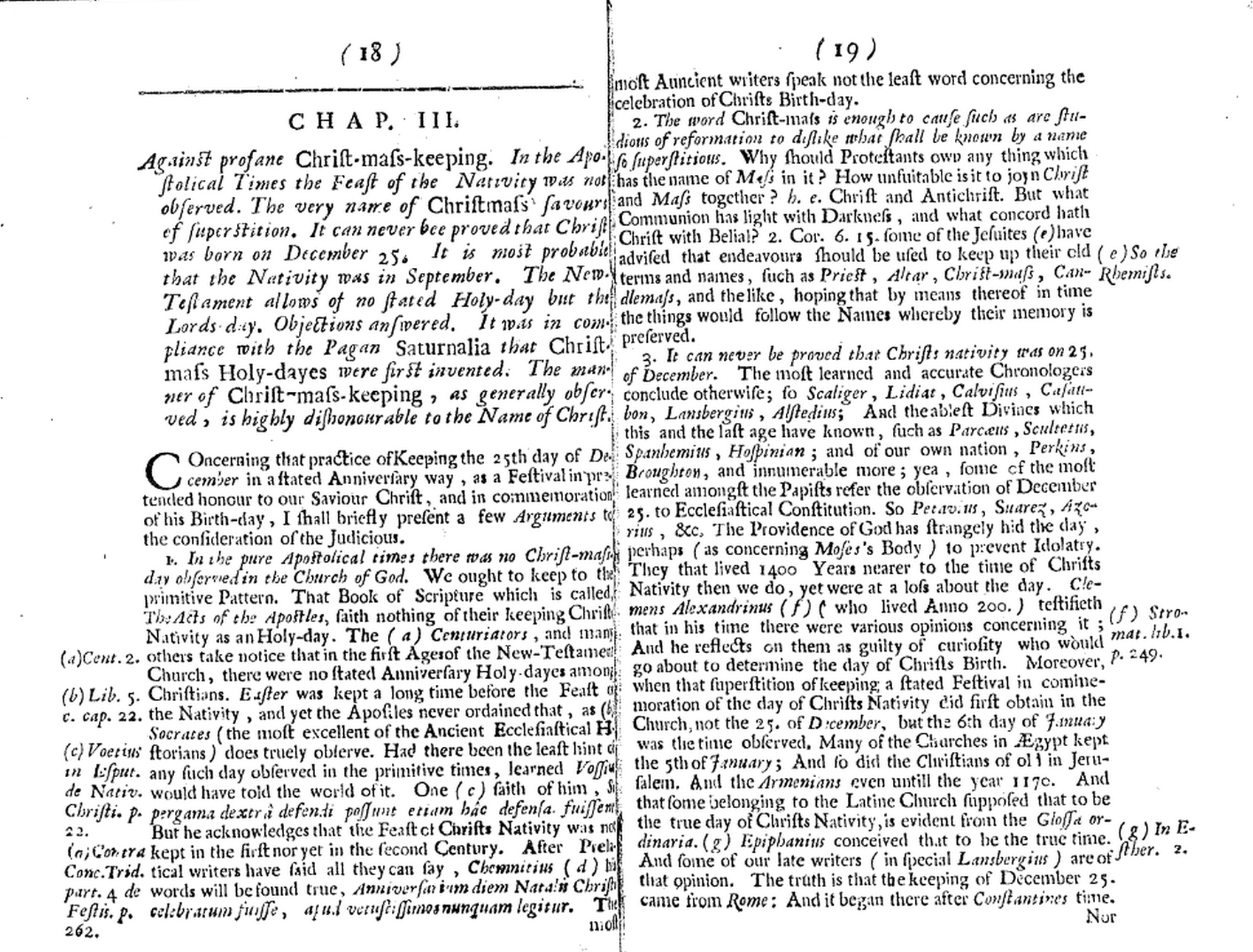
In the pure Apostolical times there was no Christ-mass day observed in the Church of God. We ought to keep the primitive Pattern. That Book of Scripture which is called The Acts of Apostles saith nothing of their keeping Christ’s Nativity as an Holy-day.
[. . .]
Why should Protestants own any thing which has the name of Mass in it? How unsuitable is it to join Christ and Mass together? [. . .] It can never be proved that Christ’s nativity was on 25 of December.
[. . .]
[They] who first of all observed the Feast of Christ’s Nativity in the latter end of December, did it not as thinking that Christ was born in that Month, but because the Heathens’ Saturnalia was at that time kept in Rome, and they were willing to have those Pagan Holidays metamorphosed into Christian ones.
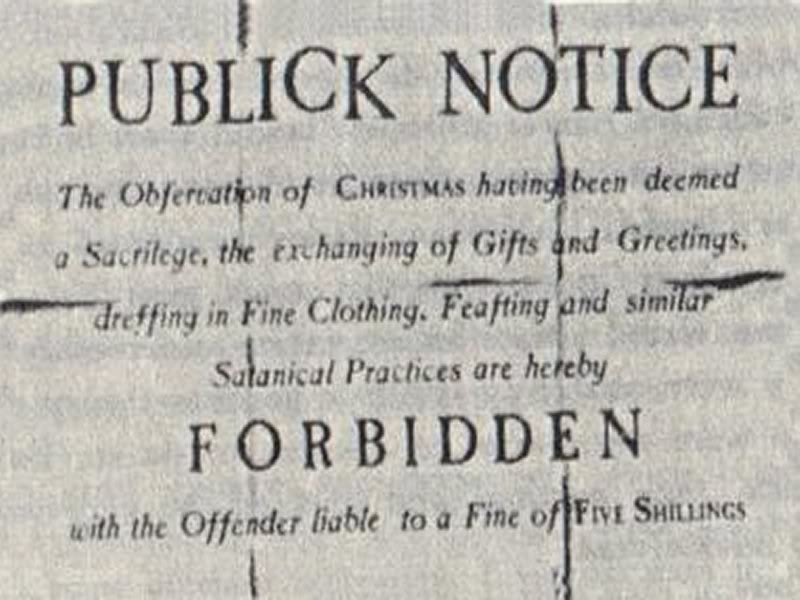
By mid-century, the Puritan “City on a Hill” was already losing its spiritual homogeneity and the combination of new settlers and a new generation less committed to Puritan strictures forced the Massachusetts General Court to take action. On May 11, 1659, the following was entered into the General Court’s records:[4]
For preventing disorders, arising in several places within this jurisdiction by reason of some still observing such festivals as were superstitiously kept in other communities, to the great dishonor of God and offense of others: it is therefore ordered by this court and the authority thereof that whosoever shall be found observing any such day as Christmas or the like, either by forbearing of labor, feasting, or any other way, upon any such account as aforesaid, every such person so offending shall pay for every such offence five shilling as a fine to the county.
Mather, “A Testimony…” (click to see full-size page)
Despite being told to repeal the “penalty for keeping Christmas” as early as May of 1665 for its “being directly against the lawe of England,” the law was not stricken until 1681, followed by renewed pressure from Charles II.[5] But even though the legal war was over, the cultural war on Christmas continued. In 1686, the unpopular royal governor of the new Dominion of New England, Sir Edmund Andros, required an armed escort at a Christmas service he sponsored (somewhat brazenly) in Boston. Indeed, Christmas was not celebrated widely in New England through the eighteenth century, and, when it was, it was done privately. All this is not to imply that Christmas was celebrated broadly outside of New England. Even after the Revolution, the Congress was known to meet on Christmas Day, if they were in session. Throughout the nineteenth century, as well, there are numerous reports from all over the United States attesting to the lack Christmas observance, particularly by various Protestant and German Pietist sects.
A few days ago, Bill O’Reilly claimed that—thanks to him and Fox News—the “War on Christmas” had been won and Christmas had been saved for all the true Americans out there wishing to celebrate the “traditional American Christmas.” However, the history shows that waging a “war on Christmas” is one of the very oldest of all American traditions and is a far more American tradition than the current twentieth-century, commercial capitalist version of Christmas that Bill O’Reilly claims to have saved.
____________________
[1] This tradition had its roots in a Saturnalian custom of Masters exchanging roles with their servants.
[2] If there could be said to have been a war “over” Christmas, it would have been in the 1640s and 1650s as Oliver Cromwell and Parliament tried to enforce their ban on Christmas by attempting to stop public celebrations by Anglicans (and the few remaining Catholics) and force shop keepers to remain open. In many localities, the result was fighting in the street between the authorities and those intent on celebrating the holiday in its traditional manner. For more on the English context, see Chris Durston, “The Lords of Misrule: The Puritan War on Christmas, 1642-60” History Today 35, no. 12 (1985).
In this month’s episode of “The JuntoCast,” Ken Owen, Michael Hattem, Roy Rogers, and Mark Boonshoft discuss the Great Awakening, including its historiography, its relationship to the American Revolution, and its contemporary significance.
You can click here to listen to the mp3 in a new window or right-click to download and save for later. You can also subscribe to the podcast in iTunes. We would greatly appreciate it if our listeners could take a moment to rate or, better yet, review the podcast in iTunes. As always, any and all feedback from our listeners is greatly welcomed and appreciated. Continue reading →
The following is an interview with Ted Andrews, an assistant professor of history at Providence College in Rhode Island. Yesterday, Christopher Jones reviewed his book, Native Apostles: Black and Indian Missionaries in the British Atlantic World(Cambridge: Harvard University Press, 2013), and now Ted is speaking with The Junto about the process of writing it. Ted teaches early American, Atlantic, and Native American history, and he was recently awarded a grant from the National Endowment for the Humanities to explore his next project on global missionary connections among early modern Protestants. Native Apostles is his first book. Continue reading →
On the eve of the American Revolution, an unlikely band of ministers and benefactors devised a plan to send John Quamine, a free black man, and Bristol Yamma, a slave, as missionaries to Africa. The project was conceived by the two would-be missionaries themselves, and supported by controversial Congregationalist minister Samuel Hopkins and his more moderate colleague Ezra Stiles. In 1774, Stiles and Hopkins arranged for the duo to be sent to the College of New Jersey, where Presbyterian minister (and president of the College) John Witherspoon would train them. Their proposed mission gained some notoriety, and a diverse lot of supporters championed their cause, including Quaker abolitionist Anthony Benezet, New Jersey lawyer and politician Elias Boudinot, Scottish theologian John Erskine the noted black poet Phyllis Wheatley, Eleazar Wheelock and his Mohegan pupil-turned-preacher Samson Occum, and black Anglican missionary to Africa Phillip Quaque (though his endorsement came with serious reservations). The outbreak of war in 1775 and the subsequent death of Quamine in 1779 ultimately thwarted the planned mission. In spite of its failure, though, it remains an important but oft-ignored episode in what Edward E. Andrews calls “the tangled history of cultural encounter between Europe, Africa, and the Americas” (188). Continue reading →
 In my work at The Joseph Smith Papers, I have recently been examining dozens of documents surrounding the trip Joseph Smith made to Washington D.C. in 1839. As I have prepared these documents for publication in one of the project’s future volumes, they have drawn my mind to the way men and women living in rural America during the nineteenth century perceived the federal government and what they thought occurred in its different branches. Though Smith’s experience in this regard is but one example, I think that it is a telling one. Continue reading
  We begin this Week in Early American History with James Oakes’ powerful and timely reflection on white abolitionism. “
 Here’s our fall preview of new titles—share your finds in the comments!
  In 1740, during George Whitefield’s first visit to New England, Connecticut minister Reverend Daniel Wadsworth wrote in his diary: “met with the famous life of Whitefield: but what is it?”[1] Wadsworth’s comments no doubt reflected both the excitement and the unease that Whitefield’s visit provoked among New England clergy, who both looked to him as a man who could renew piety and New England, but also feared his potential for exacerbating existing religious tensions. Nonetheless, it is a poignant question, and one anyone who is familiar with “the Grand Itinerant” might ask.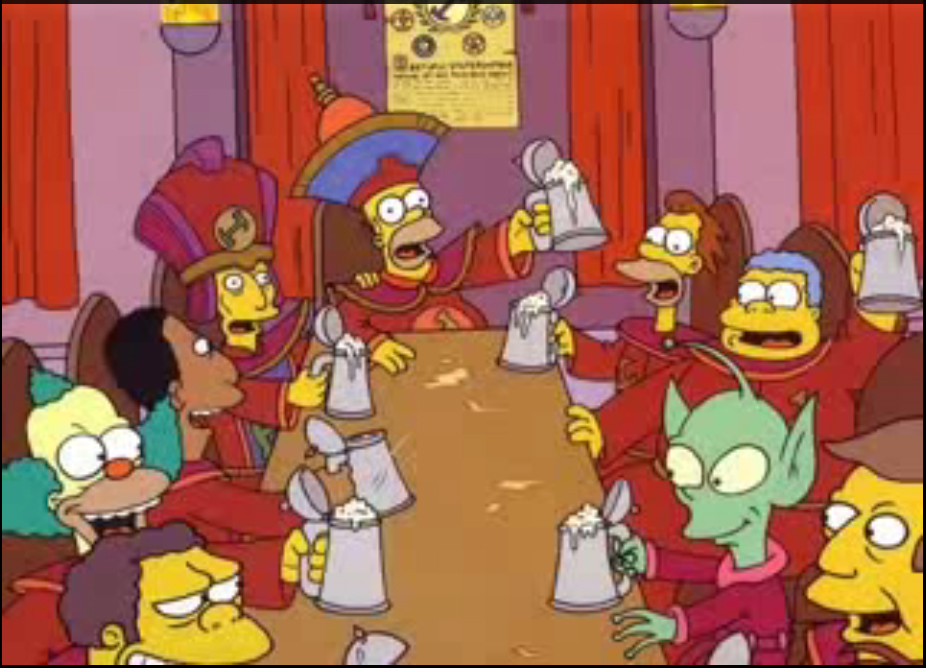



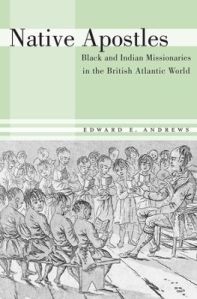 On the eve of the American Revolution, an unlikely band of ministers and benefactors devised a plan to send John Quamine, a free black man, and Bristol Yamma, a slave, as missionaries to Africa. The project was conceived by the two would-be missionaries themselves, and supported by controversial Congregationalist minister Samuel Hopkins and his more moderate colleague Ezra Stiles. In 1774, Stiles and Hopkins arranged for the duo to be sent to the College of New Jersey, where Presbyterian minister (and president of the College) John Witherspoon would train them. Their proposed mission gained some notoriety, and a diverse lot of supporters championed their cause, including Quaker abolitionist Anthony Benezet, New Jersey lawyer and politician Elias Boudinot, Scottish theologian John Erskine the noted black poet Phyllis Wheatley, Eleazar Wheelock and his Mohegan pupil-turned-preacher Samson Occum, and black Anglican missionary to Africa Phillip Quaque (though his endorsement came with serious reservations). The outbreak of war in 1775 and the subsequent death of Quamine in 1779 ultimately thwarted the planned mission. In spite of its failure, though, it remains an important but oft-ignored episode in what Edward E. Andrews calls “the tangled history of cultural encounter between Europe, Africa, and the Americas” (188).
  The Junto