This review is cross-posted from Ben Park’s own blog, “Professor Park’s Blog: Musings of a Professor of American Politics, Culture, and Religion.”
Matthew Karp, This Vast Southern Empire: Slaveholders at the Helm of American Foreign Policy (Cambridge: Harvard University Press, 2016).
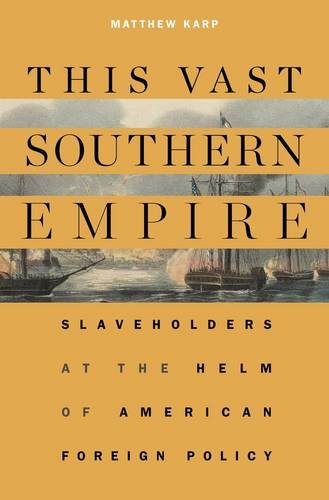 This isn’t your grandparents’ antebellum South. A generation ago it was common for historians to talk about the “regressing” southern states in the decades preceding Civil War. The advent of democracy, the spread of enlightenment, and the triumph of free labor left slaveholders reeling and the slave institution crumbling. Secession, this narrative emphasized, was the last-ditch effort of a flailing boxer on the ropes. But scholarship from the past couple decades have put that myth to rest. Michael O’Brien demonstrated that southerners were intellectuals who contemplated the most sophisticated issues of modernity. Edward Baptist showed how the slave institution increased in strength as the financial staple in America’s capitalistic order. Walter Johnson and Sven Beckert displayed how slaveholders were at the forefront of an increasingly global economy. These and many other works all point to the same crucial revision: slaveholding southerners were “modern,” and their ideas and actions cannot be merely dismissed as remnants of an antiquated age. Continue reading
 If you haven’t noticed, the blog has been a bit, well, quiet lately. We promise that wasn’t all a hiccup! Well, most of it, anyway. About halfway through the summer we realized our productivity was lagging so we decided to call it a summer sabbatical—we are academics, after all.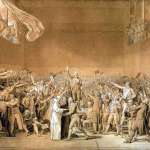
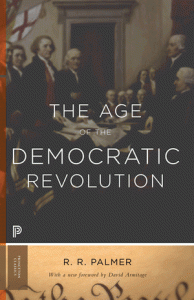 This past semester I taught a course on “18th Century Atlantic Revolutions: America, France, and Haiti,” which included both undergraduate and graduate students. (I wrote about the assigned readings at
  The Kinder Institute is currently inviting submissions for presenters at the 2016-17 meetings of the Missouri Regional Seminar on Early American History (MRSEAH), which will be held on October 7, 2016, and April 21, 2017, in Columbia, MO, and on November 4, 2016, and February 17, 2017, in St. Louis. We welcome work on all aspects of early American history, broadly defined to extend throughout the Americas geographically and forward in time through the 19th century, and we are especially eager for submissions relating to political development, political thought, constitutionalism, and democratization. All MRSEAH submissions will also automatically be considered for the Kinder Institute’s Friday History Colloquium Series, held on campus during the academic year. Please visit the link below for complete instructions on submitting a proposal to present at the MRSEAH.
  Revolutions:
  I often have a goal to write a substantive post that addresses crucial historiographical topics. I really do. But then, I’m also lazy. Further, I love book lists. So let me put on my salesman’s voice and offer a gift guide for all of you who are searching for books for your overspecialized-early-American-history-nerd-friends. These are, in other words, some of my favorite books from the past twelve months in early American history.