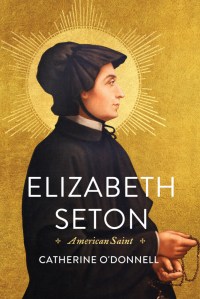
 Today’s guest post is authored by Catherine O’Donnell. Her book, Elizabeth Seton: American Saint was published this month by Cornell University Press. She is also the author of Men of Letters in the Early Republic (UNC Press, 2008) and is an associate professor of history at Arizona State University.
When I arrived at the archive in Emmitsburg, Maryland, my heart sank. My subject was Elizabeth Seton, woman of the early American republic and saint in the Roman Catholic Church, and the archives to which I’d traveled are held on the grounds of her shrine. In order to be at the archives first thing Monday, I’d arrived on a Sunday and decided to see what was happening nearby. The building adjacent to the archives is a minor basilica, so what was happening was Mass. When a guide asked whether I’d visited the Altar of Relics, I winced. I felt oddly guilty about bring my historian’s purposes and questions into this reverent world. I also knew that biographers pride themselves on not writing hagiographies, and that many academic historians pride themselves on not being biographers at all. I felt I was blaspheming both a faith and a profession. Continue reading

 I recently spoke at an event for Early Career Researchers hosted jointly by the British Group in Early American History, the British American Nineteenth Century Historians, and the Institute of Historical Research about funding initiatives for Americanists based in the UK.
 BGEAH (British Group of Early American Historians), BrANCH (British American Nineteenth Century Historians) and HOTCUS (Historians of the Twentieth Century United States) are pleased to invite participation in a new survey exploring the conditions of study, recruitment and employment within the field of American history as practiced in the UK.
  I’ve had a blog, in one place or another, since 2002, and thus the distinction between “a blog” and “a blog post” is a hill on which I am willing to die. But before Ben Park approached me to be one of The Junto’s founding members, I hadn’t blogged extensively about history. Five years later, I still want to write about other topics in addition to history, but I firmly believe that my history teaching and history scholarship have benefitted from my membership here. That said, I think my role as a blogger for The Junto has changed since 2012, and will continue to transform in the future. Today, I want to reflect on some of these changes.
 As an undergraduate, I didn’t take many large survey classes, and apart from one class, even the surveys that I took were taught by one faculty member. Larger U.S. universities do have more survey classes (I know, because I was a TA for several of them), but most that I taught on were also taught by one person. That model seems to be less usual in the United Kingdom, so I thought I’d talk about monster team-taught classes, the role of convener in bringing (and then holding) these classes together, and what you need to know about them if you’re considering the British job market.
 Today Coll Thrush speaks with The Junto about his most recent book,
  The Junto