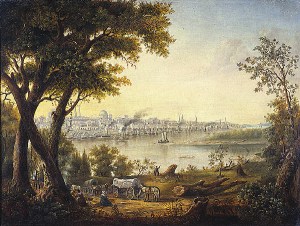
This week, The Junto spoke with Lea VanderVelde, the Josephine R. Witte Professor of Law at the University of Iowa College of Law, a Guggenheim Fellow in Constitutional Studies, and principal investigator of the Law of the Antebellum Frontier project, which “seeks to digitally analyze the legal and economic mechanisms at work on the American frontier in the early 1800s.” She kindly took our questions on her work-in-progress, and why digital research transforms the early American legal history of how the West was run. Continue reading
Author Archives: Sara Georgini
Summer Reads

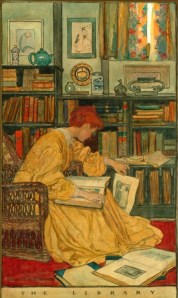
Elizabeth Shippen Green
Happily, summer revives that treasured list of must-reads that we shoved aside for coursework, research, grading, and gaming. Here are a few new releases in early American history that I plan to check out. What’s on your summer reading list? What can you recommend for us to review here at The Junto? Continue reading
Art & Soul
I’ve always thought that John Adams knew the enduring value of a good museum trip, and the power of art to sharpen the mind while refreshing a work-weary soul. How else would he have known to share this insight with wife Abigail, written at just about this time in another May spring, that of 1780: “I must study Politicks and War that my sons may have liberty to study Mathematicks and Philosophy. My sons ought to study Mathematicks and Philosophy, Geography, natural History, Naval Architecture, navigation, Commerce and Agriculture, in order to give their Children a right to study Painting, Poetry, Musick, Architecture, Statuary, Tapestry and Porcelaine.” With those words in mind, here’s a quick survey of early American art currently on special exhibit throughout the country. Please share more links in the comments. Continue reading
The Future of the Past Is Now: Digital Humanities Resource Guide
Inspired by the work of colleagues @ the new Digital Public Library of America and others we’ve interviewed here at The Junto, here are some bookmark-worthy links to what’s going on in the ever-evolving field of the digital humanities. We’ll update this list as projects develop, so if you’re working on a digital history initiative, please let us know so we can add it to the Resources page.
If you use new media in the classroom, how effective do you find it to be in communicating historical content/class themes? Please share your views on digital pedagogy in the comments. Continue reading
Digital Dissertation Workshop
Amid the whirl of data visualization, digital pedagogy, network analysis, text mining projects, and big data vs. small data debates that energized Boston’s inaugural “Days of Digital Humanities” conference last week, The Junto caught up with three early Americanists using new media to complete traditional dissertation work: Erin Bartram (University of Connecticut), Jean Bauer (University of Virginia), and Lincoln Mullen (Brandeis University). Here’s what they had to say about the process, and how digital research will shape their work after the dissertation. Continue reading
Spring at the “History Harvest”
This week, we talk to University of Nebraska-Lincoln historians William Thomas and Patrick Jones, co-directors of History Harvest, a community-based approach to creating a new people’s history of America online using the real “stuff” of our past.
JUNTO: How did you get the idea (and support) for History Harvest? What are the goals of “community-based history,” and how is it a model for the profession?
THOMAS: The original idea for me goes all the way back to my work on The Valley of the Shadow Project in the mid-1990s with Ed Ayers and Anne Rubin. We ran a small community history harvest in that project, but neither the public awareness of digitization nor the technical infrastructure to do large scale digitization on site were available. Still ever since then, I have been interested in expanding the idea. And we have seen in every digital history project that the community often comes forward with materials to contribute. So in 2010 we started The History Harvest Project here at the University of Nebraska. Continue reading
Tracing the Path of “American Journeys”

Edwin James, “An Account of an Expedition from Pittsburgh to the Rocky Mountains, Performed in the Years 1819, 1820.”
Still searching for new sources to use in your survey, or maybe a new midwinter project to research? The Wisconsin Historical Society’s American Journeys site is a hub for 18,000 pages’ worth of diaries, eyewitness accounts, manuscripts, images, and travel narratives of exploration and settlement in North America– all set in a timeline that stretches from the Vikings to the Rockies. Michael Edmonds, Head of Digital Collections & Web Services in the Library-Archives Division of WHS, told us how the site has transformed the research process, on both sides of the library desk. Continue reading
The “Extra-Illustrated” Man: NYPL’s Emmet Archive
When more than 10,000 early American documents find new life in the digital world, we at The Junto want to know more about the challenges and opportunities of the project. Thomas Lannon, Assistant Curator of the Manuscripts and Archives Division at the New York Public Library, kindly took our questions on Thomas Addis Emmet’s extra-illustrated archive. Continue reading
Forgotten Giant: Restoring Simms

“Washington Irving and His Literary Friends at Sunnyside.” Simms is seated at the left end of the table, shown in full profile.
(Christian Schussele, Oil on canvas, National Portrait Gallery, Smithsonian Institution, 1864)
Meet a Southern man of letters, William Gilmore Simms, through his life’s work of literature—much of it now available in the form of free, digital editions thanks to the Simms Intitiatives at the University of South Carolina. A well-known editor, critic, poet and historian of Southern life and culture in his day, Simms (1806-1870) occupies a unique position in early American literature, and (re)introducing him to modern readers has presented new challenges for scholars. The Junto asked the Initiatives’ Todd Hagstette, Simms Curator, to talk about creating a digital portrait of the author, and why Simms’s work belongs on the syllabus. Continue reading
Early America, with a Brooklyn Accent
Last week, we asked how digital projects are transforming our study of early American life and culture. Here’s the first in a series of interviews with historians who tell us what worked, how digital tools shaped the narrative, and where they want to go next on the digital frontier. This week, we asked the Brooklyn Historical Society for a peek at the making of a special digital exhibit on the Lefferts family of New York. As Breuckelen becomes Brooklyn, readers can link to local sites where the Lefferts family lived and worked, including the Lefferts Historic Homestead in Prospect Park (shown here: Historical re-enactors gathering on the front steps in 1938). The Leffertses were influential landowners, politicians, historians, financiers—and also one of the county’s biggest slaveholding families. Their letters, farm accounts, and recipe books offer a new and very personal window on New York’s development.Our thanks to Jacob Nadal, the Director of Library and Archives, and Julie Golia, Public Historian and Curator, who kindly took our questions on bringing nearly four centuries of Brooklyn to digital life. Continue reading