We are thrilled to have another guest post from Spencer McBride, a historian and editor with the Joseph Smith Papers Project. You can read Spencer’s previous two posts here and here. More importantly, you can order his hot-off-the-press book, Pulpit & Nation: Clergymen and the Politics of Revolutionary America (UVA Press) here. You can look forward to a review and Q&A later this month. -BP
 In researching and writing my book, Pulpit & Nation, I became keenly interested in the religious language employed by participants in the ratification debates of 1787-88. Not only did it illuminate the role of religion and clergymen in the politics of Revolutionary America, but it seemed particularly relevant to the almost canonical way in which so many twenty-first century politicians and pundits view the Constitution. Of course, when—or if—these individuals ever consult that document’s history, they rarely bother to question what political motivations drove so many of the seemingly religious expressions made by early national leaders. And there are many such statements. Yet, amid the numerous examples of Federalists and Anti-Federalists employing (and exploiting) providential language and Old Testament Biblicism in arguing for ratification, one example stands out as particularly complex in its motives and implications: the argument Benjamin Rush made for ratification in the Pennsylvania ratifying convention. Continue reading


 I am fortunate that in graduate school, I had quite a bit of guidance in writing across the curriculum pedagogy. I have since taught approximately a dozen designated writing-intensive courses. Most history courses are writing-intensive by default, and many history faculty do find themselves teaching writing and research techniques. Here, I am focusing primarily on the strategies I use in survey courses, with a short list of monographs that I have found work well for this purpose.
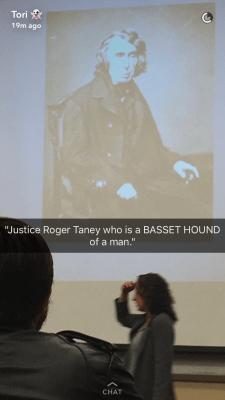 Several years ago, I attended a seminar on digital pedagogy. I thought it might be worthwhile to explore new opportunities out there for social media in the classroom. It was indeed an eye-opening experience, though not in the way I had hoped. Seminar leaders regaled us with software package after software package filled with whistles, bells, alerts, gimmicks, everything, they claimed, one would need to connect with this generation of “digital natives” (their term, not mine.) Students these days spend so much time on social media, they claimed, that faculty need to learn to connect with them online in order to really
  Last spring, I blogged about how I used the song “Farmer Refuted” from
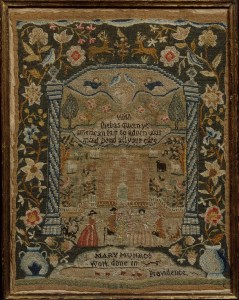 This weekend, Mark Lilla, a historian of ideas at Columbia University, published a New York Times op-ed on
  The inaugural Digital Humanities + Data Journalism Symposium recently took place at the University of Miami, from September 29 to October 1st, drawing together a diverse crowd of academics, journalists, and many in between. As conference convener and Knight Chair in Visual Journalism at UM Alberto Cairo informed the audience in his opening remarks, the somewhat speculative event topic was inspired by a February 2012 tweet by Digital Public Library of America Executive Director Dan Cohen, which hopefully conjectured that “digital journalism and digital humanities are kindred spirits, and that more commerce between the two could be mutually beneficial.” Delivering the first keynote of the weekend-long proceedings, Cohen drew equal inspiration from Thucydides and Reese’s Peanut Butter Cups, lightheartedly suggesting the latter as a metaphor for the symbiotic (and potentially delicious?) roles digital humanists and data journalists could play in our increasingly informational world. In referencing Thucydides, he developed one of the salient themes of the weekend, the notion that digital scholars and journalists alike were primarily motivated by the quest to rise up from data to understanding, to construct knowledge from the complicated and overwhelming.
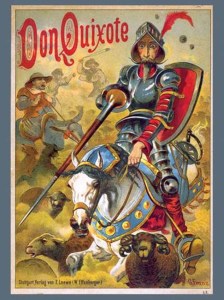 In a certain village of vast early America, whose name I do not recall, a book fell open. Then another. And another. By 1860, many generations’ worth of American readers had imbibed the two-volume work of Spain’s early modern master, Miguel de
 The Junto