Hidden Bureaucratic Forget-me-nots and What to Make of Ubiquity

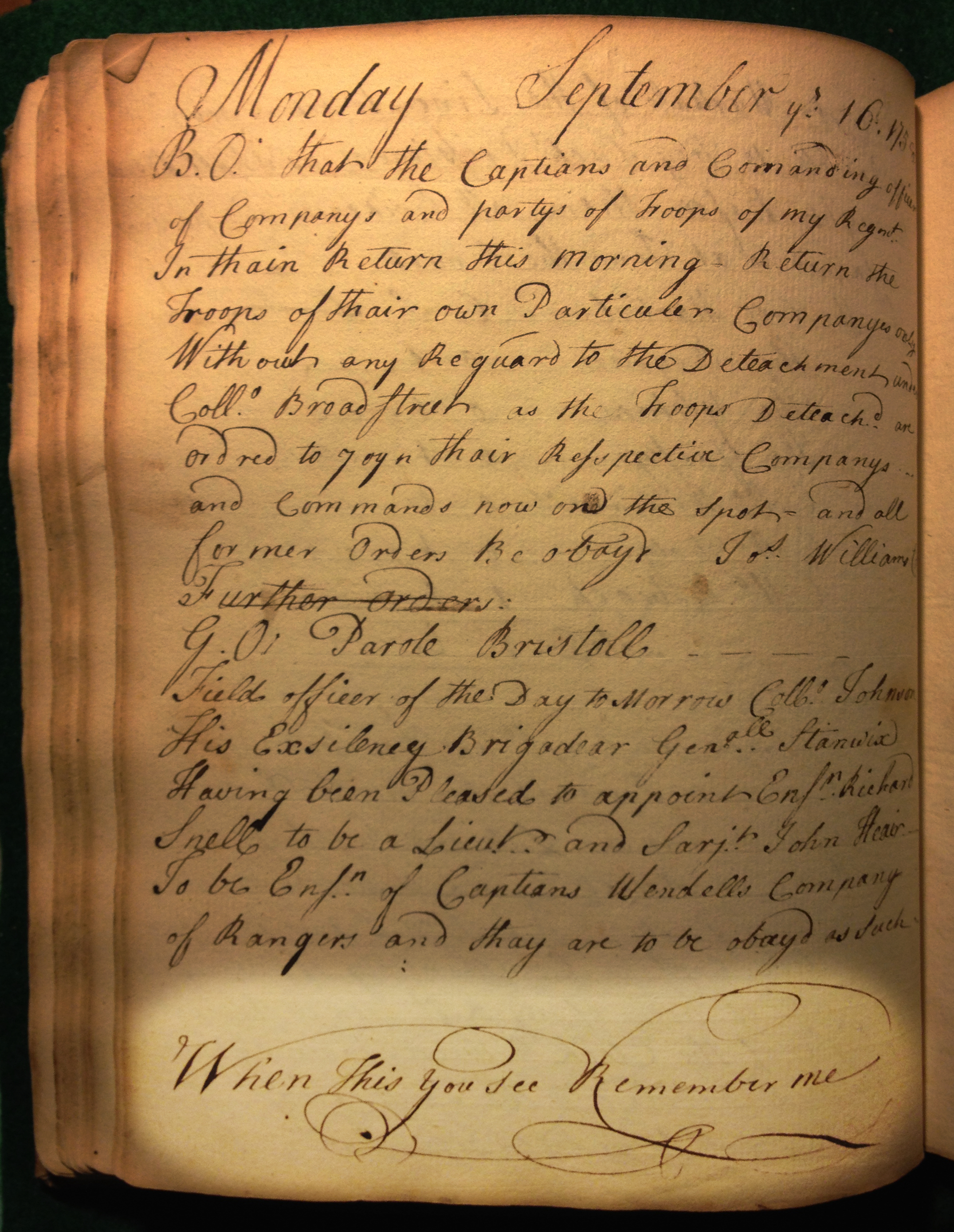
2015-01-07 15.49.56When wading through account books, muster rolls, and other dry military records, I don’t usually get a sense of the author—there might be a name jotted down, or maybe some distinctive handwriting, but hardly any evidence of personality. Reading through a 1758 orderly book from the Oneida Carry was much the same: a recounting of paroles, provisions, parades, and troop preparations. And then, curiously, tucked between the routine orders and work details, on the bottom of the 51st page:

When This You See Remember me.[1]

An—abruptly elegant—personal appeal hidden in the middle of a bureaucratic record, a record covering the various minutiae of one regiment of the vast British military apparatus but containing no information (other than a name) about the man who had chronicled them all. What on earth was it doing here?

This post began as a simple question about the meaning of private voices in the state record and quickly became something a little more meandering—tracing a phrase, finding its ubiquity in the British Atlantic, and then, in that broader context, pondering how and why it came to be on the page of an official military document. Continue reading
The Mormon National Convention, 1844

Given that we just witnessed the Democrat and Republican national conventions a few weeks ago, I thought I’d draw from a current research project and take a look back at an earlier moment in the development of presidential politics. And if you think Donald Trump’s convention was quixotic, you ain’t seen nothing yet!

maudsleyjosephinunifolglds9

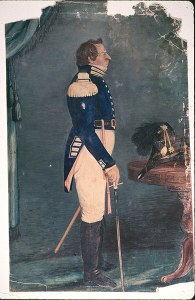
Sutcliffe Maudsley, “Lt. General Joseph Smith In Nauvoo Legion Uniform,” gouache on paper.

Whatever your feelings concerning Joseph Smith, Mormonism’s founder, you have to admit the guy was confident. The first decade of his church’s existence was mired in societal and political problems, and the final year of his life was spent trying to find novel and, to some, outlandish solutions. One of his most audacious proposals was his own candidacy for the United States presidency in 1844.

Smith’s presidential run mostly strikes modern readers as amusing. Though the Church of Jesus Christ of Latter-day Saints had already drawn around thirty thousand converts since its founding in 1830, a majority of them were located on the banks of the Mississippi River in an Illinois town called Nauvoo. They could hardly manipulate the politics within their own state, let alone those of the nation. How then could the controversial leader of this marginalized sect have such delusions of grandeur? Continue reading

The 1904 Olympics: The American Future and the American Past

International pageants such as World’s Fairs or Olympic Games are strange beasts of their very nature. While trying to project an image of a modern, vibrant place, they must necessarily also draw on the familiar in order to reach a wide audience. Sometimes this can be done in eye-catching and engaging fashion—think of the 2012 London Olympics, and their juxtaposition of Horse Guard’s Parade with beach volleyball. Thus these international pageants provide a curious mix of looking to the future at the same time as looking at the past. Continue reading
Women and the History of Capitalism

Women and the History of Capitalism

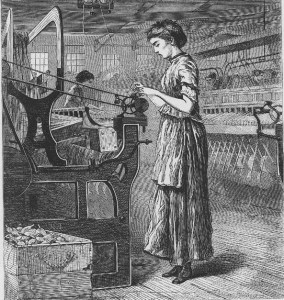
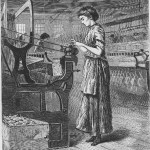
Cartoon or Sketch of Mill Woman_0One of the best questions a historian can ask is, “what am I missing?” Whatever you’re investigating, and whatever stage you’re at, it’s always worth your while to step back and look around. If you’ve been focusing on something, using a particular lens, it can be pretty hard to pan out. That’s where setting aside time for more eclectic reading really helps—journals and blogs are convenient ways to keep your field of vision broad. Sometimes, they can give you a kick. That’s how I felt about the forum on women’s history in this summer’s issue of the Journal of the Early Republic.[1] Continue reading
What Do Early Americanists Offer the Liberal Arts?—Part II

What Do Early Americanists Offer the Liberal Arts?—Part II

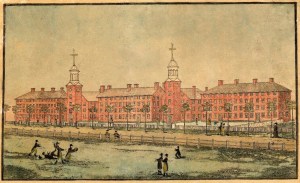
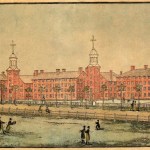
Yale College, 1807Last week, in the first part of this post, I argued that we tend to justify the liberal arts in two potentially contradictory ways. First, we assert that the liberal arts offer tools for citizenship. Second, we claim they point our way to human values that transcend any community. I argued that both of these justifications or approaches are necessary. I also suggested that early Americanists have not found it easy to explain what we contribute to the second approach.

Today, therefore, I am taking up the question I posed last week. Does early American scholarship offer anything distinctive to the liberal arts as a way of understanding humanity at large? Continue reading

What Happened to the “Democratic” in the “Age of Democratic Revolutions”?

What Happened to the “Democratic” in the “Age of Democratic Revolutions”?

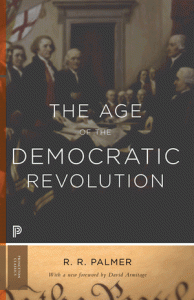
PalmerThis past semester I taught a course on “18th Century Atlantic Revolutions: America, France, and Haiti,” which included both undergraduate and graduate students. (I wrote about the assigned readings at my personal blog.) I’d like to highlight a central theme that I emphasized throughout the course as a way to discuss historiographical and pedagogical questions.
To give my grad students a sense of the field’s starting point, I had them read R. R. Palmer’s classic 2-volume The Age of Democratic Revolution: A Political History of Europe and America, 1760-1800 (1959, 1964; 2014), recently combined and re-published by Princeton University Press. Advancing through the semester and reading much more recent books, the dated nature of Palmer’s book is readily apparent. Most obvious is its avoidance of Haiti. (At an AHA panel on the Age of Revolutions last January, Nathaniel Perl-Rosenthal mention that it’s basically an academic ritual to mention this whenever discussing Age of Democratic Revolution.) Palmer also focuses on high-end (and male-centric) intellectual history, ignores economic interests and intersections, and only engages the nations whose revolutions “succeeded.” This last point is obviously problematic, of course, given what happens in France after their Revolution. But as Janet Polasky’s recent book shows, a more comprehensive view can be gleaned through looking at revolutionary moments that did not have successful outcomes. Like any book published over a half-century ago, even a classic book like Palmer’s, there are plenty of holes to acknowledge. Continue reading

What Do Early Americanists Offer the Liberal Arts?

What Do Early Americanists Offer the Liberal Arts?

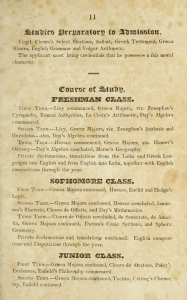
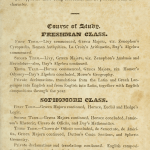
Course of Study, Amherst College, 1824

Perhaps because the traditional academic year has ended, and probably in part because of the tides and undertows of the current election, we seem to be awash just now in excellent essays about the purposes and state of the humanities.

To do my part to put a stop to that, I am here to ask what the liberal arts have to do with early American studies.

I suspect we tend to take the relationship too much for granted.

Continue reading

The Sacred and the Secular in Early National Virginia

Is revolutionary Virginia the birthplace of American secularism?

My attention was returned to this critical question by a recent twitter exchange between Annette Gordon-Reed and Sam Haselby (and others) along side a recent piece by Haselby in Aeon.[1] The scuffle between Gordon-Reed and Haselby focuses on the time-is-a-flat-circle question of Thomas Jefferson’s religious beliefs. Was he a secularist? Some variant of Christian? A Unitarian? An atheist? Haselby’s Aeon piece takes a different tack, arguing that the American founding represented a “rogue wave of rationality in a centuries-long sea of Protestant evangelising, sectarianism and God-talk.” Haselby marks out the Founders—particularly Jefferson and James Madison—as “visionary secularists” who created a secular republic, which was eventually co-opt by decidedly non-secular political and cultural forces. He singles out late eighteenth-century Virginia as the primary canvas upon which the great artists of American secularism worked.[2] Continue reading

Regional Remembering and Joseph Warren—America’s First President?

84d0ce12a90e35ce54a3240f904a426a-micdrop09Since moving to Massachusetts, in September 2015, I’ve taken great pleasure in visiting some of Boston’s historic sites. I’ve walked (part of) the Freedom Trail and visited the Old State House, Faneuil Hall, the Granary Burying Ground, the Old South Church, and the Adams crypt in Quincy. A few weeks ago, I took it a step further: I went on a duck boat tour. While on the tour, the on-board historian told passengers that Joseph Warren would have been America’s first president if he was not killed at the Battle of Bunker Hill. *MIC DROP* Continue reading

Historians in an Age of Revolution

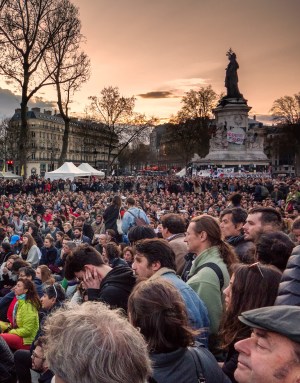
Nuit_Debout_-_Paris_-_41_mars_01Do we live in revolutionary times? It’s tempting to imagine so. Bernie Sanders’ promise of “a political revolution” resonated with surprising numbers of Americans, especially the young. The Nuit Debout has captured some of the same spirit in France. Dramatic moments like the Oxi vote in Greece and the Umbrella Revolution in Hong Kong have followed the so-called Arab Spring and global Occupy movement. In spite of their failures and betrayals, those movements seemed to reveal revolutionary sentiment in east and west.

Yet in a recent interview for Dissent, David A. Bell, a historian of the French Revolution, put something of a counterpoint. “If we look at the broad sweep of modern history from the eighteenth century to the present,” he said, “we see that revolution has lost its salience as a political concept.” Continue reading