Guest Post: “Early Modern France and the Americas” Conference Recap

Craig Gallagher is a PhD candidate in History at Boston College. His dissertation analyzes Scots and their religious and economic networks in the late seventeenth century British Atlantic World.
1396010110570-031dbAtlantic history has always had at its heart a simple enough goal: to connect the histories of Europe, Africa, and the Americas so that historians can better understand each in relation to the others. Scholars have disagreed about how best to realize this goal, and about whether it is a goal worth realizing at all, but few have denied that Atlantic history as a pursuit has enriched our understanding of the early modern world. Although this has been particularly true for historians of the British and Spanish empires in the Americas, it is a more recent development among scholars of the French empire. By convening the “Early Modern France and the Americas: Connected Histories” Symposium (Program#FrenchAtlantic on Twitter) at Boston College on May 2-3 – an event co-sponsored by the Institut des Amériques – the organizers, Owen Stanwood (Boston College) and Bertrand van Ruymbeke (Université de Paris VIII), sought to showcase those historians of France and French North America whose work, either in print or in progress, has extended an Atlantic perspective to the history of France and its early modern empire in the Americas.
Continue reading

The Revolution is Reborn at Common-place

home_revolutionLast summer, Philadelphia witnessed a gathering of many delegates who discussed British tyranny and American liberty. Though none of the resulting documents may be as influential as Thomas Jefferson’s Declaration of Independence, the proceedings of “The American Revolution Reborn: New Perspectives for the Twenty-First Century” should at least instigate some debate. The conference itself was a product of generosity from Frank Fox, the American Philosophical Society, the David Library of the American Revolution, the McNeil Center for Early American Studies, Samuel Adams® (the beer, who aptly supplied refreshments for the reception), and the Museum of the American Revolution (who provided an expansive—and sweltering!—location for the closing activities). A good number of Juntoists were in attendance—there is even photographic evidence!—and the excellent speakers sparked good discussion. Patrick Spero and Michael Zuckerman should be commended for organizing the event. Continue reading

How Did Democracy Become a Good Thing?

Re-imagining Democracy in the Age of RevolutionsI spent yesterday afternoon at “a celebration and critical evaluation” of the work of political theorist and historian Mark Philp. My role was to talk about his involvement in a big, ongoing project being done here at Oxford—and around the world—called Re-imagining Democracy. That project has already produced one book, Re-imagining Democracy in the Age of Revolutions: America, France, Britain, Ireland 1750-1850 (OUP, 2013), with contributions on the early American republic by Seth Cotlar, Adam I. P. Smith, and Laura Edwards. It’s a book that may not yet be well known among American historians, but it should be, because the question it’s trying to answer is a very interesting and difficult one: how did “democracy” go from something feared and reviled even as late as the 1780s, to something very different by the mid-nineteenth century, and even to become the quintessential value of American politics that we know today? Continue reading

Yes, Virginia, there was an American Enlightenment

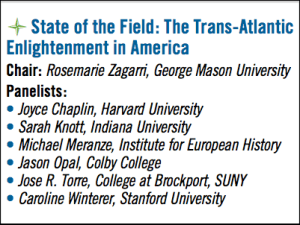
State of the Field PanelThanks to John Fea’s live-tweeting and subsequent reflections on OAH panels this past weekend, I would like to address some of the points and comments made during the panel entitled, “State of the Field: The Trans-Atlantic Enlightenment in America.” Since Twitter is problematic in getting across complex ideas due to its 140-character limitation, I have chosen a few of the tweets in which the comments seemed to me to be common arguments or perceptions that I have previously encountered.

Continue reading

Is Blogging Scholarship? Reflections on the OAH Panel

On Sunday, at the 2014 OAH Annual Meeting, I was part of a roundtable discussion entitled “Is Blogging Scholarship?” Several other participants have posted their thoughts on the subject; there was also a great deal of live-tweeting, and our own Joe Adelman has also joined (and developed!) the conversation. The discussion itself was fantastic, and was videotaped for later broadcasting. But in reflecting on the panel, I’ve found there are some points I wish to re-emphasize, and some problems I have with the way the entire roundtable was framed. Continue reading

Guest Post: “Libraries in the Atlantic World” Conference Recap

Today’s guest poster, Aaron M. Brunmeier, recaps the recent conference in Liverpool, England. He is a Ph.D. student at Loyola University-Chicago, where he studies print culture, gender, and the public sphere in revolutionary New York City. He is the social media assistant for the Community Libraries Network.

g3library

Last week, I finished my minor field exams, lesson-planned for my substitute teacher, and then hopped on a plane headed toward Liverpool for a conference on library history. It was the first of three colloquia organized by the Community Libraries Network and funded by the AHRC. This colloquium, “Libraries in the Atlantic World,” brought scholars of different disciplines from all around the world to share their research and discuss the newest trends in the field at the University of Liverpool, 24-25 Jan. 2014.

Continue reading

On to Washington!

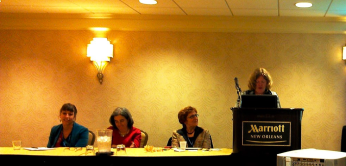
Happy New Year! Like the British Army two centuries ago, historians are descending on Washington this week in massive numbers (though likely with somewhat better results for the White House and Library of Congress) for the annual meeting of the American Historical Association. It’s an exciting time for the profession overall as discussions and meetings take place, and a harrowing time for those attending for job interviews. And apparently we’ll all get to see how badly the region handles winter weather.[1]
Continue reading

Conference Panels and Intellectual Connections

AHA PanelFor early Americanists, fall is conference-planning season. Proposals for the Omohundro Institute Conference were due in mid-September, SHEAR is accepting proposals until December 1, and a bevy of other conferences have posted CFPs in recent months. Watching this flurry of activity has led me to think about the intellectual goals that structure the formation of conference panels.

Of course, the conference panels we form—and whom we invite to participate in them—are partly functions of pragmatism. Each of us wants to find our way onto the program of our desired meeting, and mobilizing our networks is one way to do this. We scramble to find friends, colleagues, friends-of-friends, and acquaintances from research trips and prior conferences to join us on our panels. But if one of the goals of conferences is to enter into scholarly conversations, rather than simply to share our work with academic audiences, then it is essential to think about the kinds of questions our panels are asking and answering. Continue reading

American Studies Association: A Preview for Early Americanists

ASAlogoThis coming weekend the American Studies Association descends on Washington, D.C. for the annual conference. The theme this year is “Beyond the Logic of Debt, Toward an Ethics of Collective Dissent,” and with thirteen concurrent sessions it promises to be a busy weekend. The ASA is not exactly a bastion of early Americanist work these days, but many of the overriding themes in current scholarship have their roots in early American history. Investigating the ramifications of colonialism and colonialist attitudes? check. Wrestling with (the legacy of) slavery? check. Questioning the role of gender in society? check.
For ten years, the Early American Matters Caucus has been sponsoring panels, and thanks to scrupulous program combing by Dennis Moore and the Working Committee, we can provide a guide to early (meaning, pre-1900) events at the conference.

Continue reading

Guest Post: On the Anvil of Labor History in the Revolutionary Era

Today’s guest post comes from Peter Kotowski, a Dissertation Fellow at the McNeil Center for Early American Studies and a Ph.D. candidate at Loyola University Chicago.  His research uses the lived experiences of indentured servants to explore Pennsylvania’s development within the Atlantic economy and the extent to which the colony was “the best poor man’s country.”

BillySmith2In the introduction to their 2008 edited collection, Class Matters, Simon Middleton and Billy G. Smith make the bold proclamation that “as a mode of historical analysis of early North America and the Atlantic World, class is dead – or so it has been reported for the last two decades.”[1]  The subsequent collection of essays makes a convincing case that class is not, in fact, dead.  For Smith, this volume was merely a continuation of a decades-long commitment to class as a primary mode of analysis.  It was in the spirit of Smith’s work that dozens of scholars converged on the McNeil Center for Early American Studies in Philadelphia from November 7-9 for what was affectionately dubbed “Billyfest.”
Continue reading