Today’s guest post comes from Andrew M. Schocket, Professor of History and American Culture Studies and Director of American Culture Studies at Bowling Green State University, and Billy G. Smith, the Michael P. Malone Professor of History, & Distinguished Professor of Letters and Science at Montana State University.
 Data. Before postmodernism, or environmental history, or the cultural turn, or the geographic turn, and even before the character on the old Star Trek series, historians began to gather and analyze quantitative evidence to understand the past. As computers became common during the 1970s and 1980s, scholars responded by painstakingly compiling and analyzing datasets, using that evidence to propose powerful new historical interpretations. Today, much of that information (as well as data compiled since) is in danger of disappearing. For that and other reasons, we have developed a website designed to preserve and share the datasets permanently (or at least until aliens destroy our planet). We appeal to all early American historians (not only the mature ones from earlier decades) to take the time both to preserve and to share their statistical evidence with present and future scholars. It will not only be a legacy to the profession but also will encourage historians to share their data more openly and to provide a foundation on which scholars can build. Continue reading
 Back in April, I had a rather surreal teaching experience. A class project, focusing on tweeting the assassination and funeral train of Abraham Lincoln, attracted a good deal of media attention in central Illinois. My class ended up appearancing in local newspapers, radio, and even with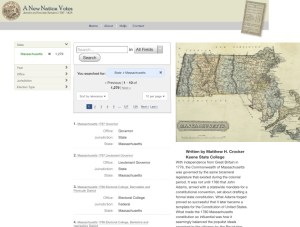
 Today, The Junto interviews
  Over the past couple years, friends have asked me a lot about
  The
The 
 Last night, I had a dream about waking up at some indeterminate time in the future, not too distant but not very close either. It was one of those kinds of dreams where you find yourself in a world that is so clearly different from your own, yet at the same time seems strikingly familiar. I was still my same-old early Americanist self. But where was I? Well, that was part of the beauty of it. It didn’t matter. I found myself in an early Americanist digital universe of the future. Not just a blogosphere. Not just various social media platforms. Not just online magazines. But an integrated digital universe, one in which access and participation in all the appurtenances of the institutional life of the profession—conferences, working groups, publishing—had been prioritized and maximized and the restraints of distance and resources minimized. And here’s what it looked like…
 The Junto