Why A Brit Should Teach American Revolutionary History

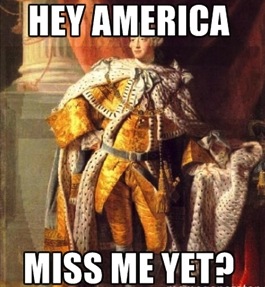
George III“There’s just one question I have to ask,” said the pleasant young man at the US Embassy, reviewing my visa application. “You are aware that we won, right?”

As a Brit teaching early American history in the U.S., I get some version of this question quite a lot. And it’s something I play up to in my own classes, as well. Many of my courses begin with the warning: “If you learn nothing else over the next 15 weeks, you will understand what it is like to be subject to arbitrary British despotism.” When teaching the Boston Massacre, I jest that I’m worried to give too much information, just in case my students get ideas. And in teaching colonial history, I remind my students that the history we cover is as British as it is American.
Continue reading

Promised Land

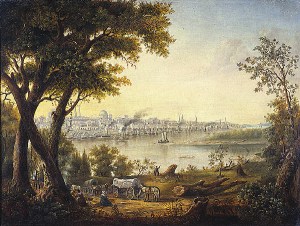
Henry_Lewis_-_Saint_Louis_in_1846

“Saint Louis in 1846”
Henry Lewis

This week, The Junto spoke with Lea VanderVelde, the Josephine R. Witte Professor of Law at the University of Iowa College of Law, a Guggenheim Fellow in Constitutional Studies, and principal investigator of the Law of the Antebellum Frontier project, which “seeks to digitally analyze the legal and economic mechanisms at work on the American frontier in the early 1800s.” She kindly took our questions on her work-in-progress, and why digital research transforms the early American legal history of how the West was run. Continue reading

The 10,000 B.C. Question: How to Start the Survey

Today’s post is in the vein of ProfHacker, which is to say that it’s part descriptive of my practices in the classroom, and part a request for others to help work through a common problem.

Having just completed two consecutive semesters teaching the first half of the U.S. survey, I’m hoping to spend a little time this summer mulling how to improve the design of the course. At Framingham State, it runs “from the Age of Discovery to Reconstruction,” according to the course catalog. For our Europeanist readers and colleagues, that may seem like a mere drop in the bucket, but it’s quite a lot of ground to cover in just fifteen weeks. As a survey, everything feels like it gets short shrift. This much I knew going in, but I’m looking forward to the opportunity to reflect. Continue reading

An Alt Canon of Early American Primary Texts?

davidwalkersappeal-uncdocsouthWe hear a lot about the “canon wars” of the 1980s and 1990s, when conservative (and neoconservative, and Straussian anti-anti-liberal, and pre-New-Left liberal) critics raised the hue and cry against relativizing multiculturalism, which was replacing War and Peace and The Scarlet Letter on college reading lists with just any random thing that wasn’t written by a wealthy straight white man. Or, if you prefer, when left-wing critics advanced the radical notion that women, homosexuals, minorities, and the poor are conscious human beings too. Or when cynical politicians and self-important idealists conspired together to undermine public confidence in higher education and the humanities. Or whatever.

Continue reading

Teaching Narrative in Graduate School

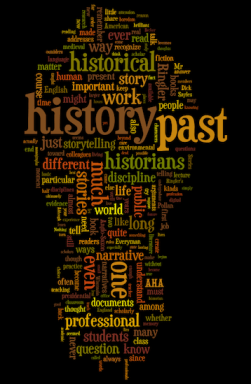
Word Cloud of Cronon's 2013 Presidential Address

This past Monday I turned in my final paper in a graduate seminar given by John Demos entitled, “Narrative and Other Histories.” I initially registered for the class not long after watching Bill Cronon’s Presidential Address at this year’s AHA Annual Meeting and engaging in conversation about it on Twitter as well as in a piece for The Junto. With all the focus on “storytelling” and narrative as a means for carving out a twenty-first-century model of the historical profession, the course offering appeared quite timely. Continue reading

Plagiarism, Cheating, and Craigslist

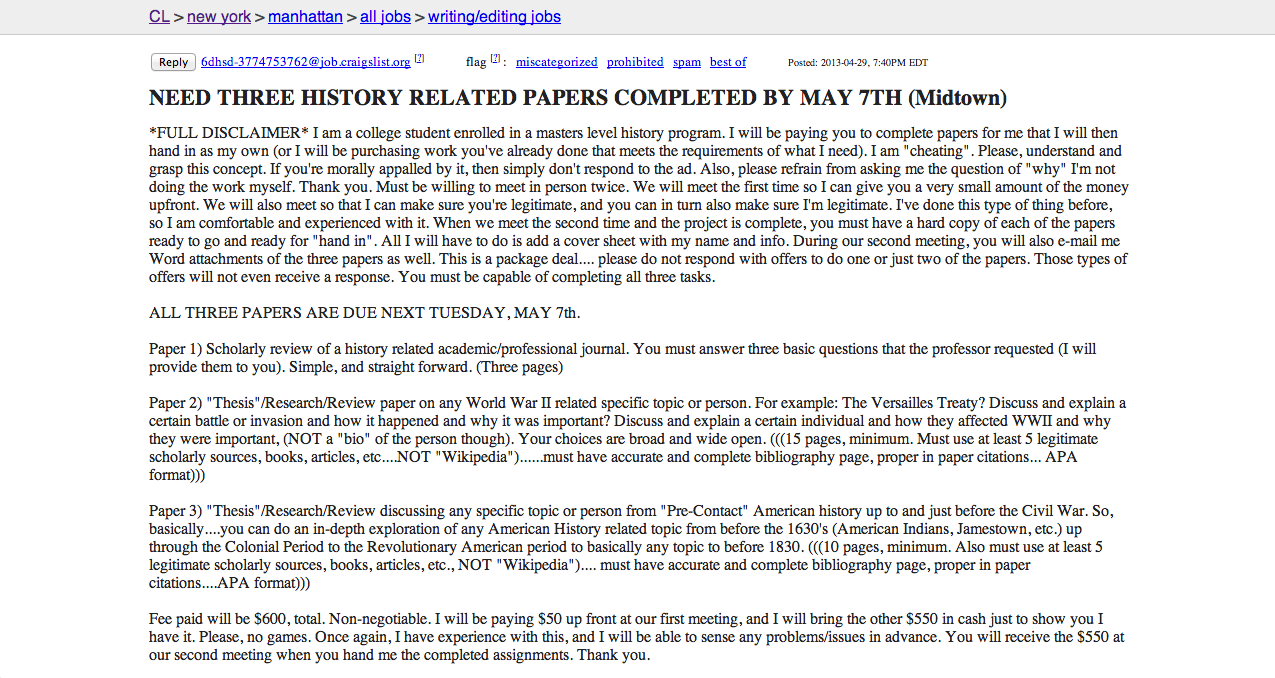
Craigslist adBefore reading this post, take a moment to read this genuine, recent ad from Craigslist (click picture for full size). It is from a student in New York and the assignment(s) are due today, one of which is an early American history paper.

As I wrote last week, I am currently finishing up my coursework and in the fall will begin my first teaching assistantship. Because teaching has been on my mind anyway, the ad above struck me a bit harder than I imagine it would have done before. I’ve heard stories of cheating and plagiarism from my professors and my peers in my own program now in their teaching years, but the ad above really “takes the cake” for me. Continue reading

Democratizing Pedagogy: The Just Teach One Project

Last week when the Junto hosted the History Carnival we noted the creation of the “Just Teach One” project, co-sponsored by the American Antiquarian Society and Common-place. Today we’d like to take a closer look at what promises to be an exciting addition to thinking about how to teach early American studies (for both literary scholars and historians).

Continue reading

Gaming In The Classroom: Washington’s War

One of the key difficulties of teaching the American Revolution is the seeming inevitability of it all. Why did Britain even bother pursuing its bothersome colonists? After all, the patriot cause was so noble and glorious that there was surely no way that such perfidious villains as the redcoats could possibly have triumphed. And yet within that myth, there is a persistent paradox: the patriot cause is often “proven” by the victory of such an inferior force against the strongest military power in the world in the late 18th century. But for this narrative to make any sense at all, there must have been a real risk of defeat; unless Britain could realistically have defeated their colonists, why would the morality of the patriots be of any consequence whatsoever? Continue reading

Favorite Sources in the Survey

Teaching the survey, I have found, can be a blur. Events, people, and places zip by—on Monday, you’re at Jamestown in 1607, on Wednesday, Plymouth in 1620, and by Friday Cotton and Increase Mather are angling for a new charter for Massachusetts. (Okay, I don’t move quite that fast, but it’s still quick.) And in the meantime students deal mostly with brief snippets of texts in a document reader. Someday I may ditch it, but for now, it does the job.

One of my favorite parts of the course, therefore, is working with students a little more deeply on select texts, and getting to practice the craft of the historian more fully. So today I’ll share one or two of my favorites with you, offering no claims to originality.

I’ll start with my absolute favorite, which will come as no surprise to my friends: Benjamin Franklin’s Autobiography. Continue reading

Some Thoughts on Teaching: An Interview with James H. Merrell

I first met Jim Merrell in the spring of my sophomore year at Vassar College, when I registered for his Revolutionary America class. Over the next two and a half years I took several more courses with Mr. Merrell (professors at Vassar go by “Mr.” or “Ms.,” rather than “Dr.” or “Professor”), where I received multi-page responses to my essays, and comments on my research papers with words like “Huzza!”

Eventually, I began work on my senior thesis, which he kindly agreed to supervise. During the course of that year he met with me weekly to check on my progress with research and writing. His feedback was thoughtful but tough—after receiving his comments on the first full draft, I recall needing to go to the gym to run, lift, and then swim before being able to read them calmly. His assurance “that the draft gets critical treatment that is closer to graduate school than to first or second year college. (Huzza, sez you!)” should indicate the substance of his remarks [1]. Continue reading