 This past semester I taught a course on “18th Century Atlantic Revolutions: America, France, and Haiti,” which included both undergraduate and graduate students. (I wrote about the assigned readings at my personal blog.) I’d like to highlight a central theme that I emphasized throughout the course as a way to discuss historiographical and pedagogical questions.
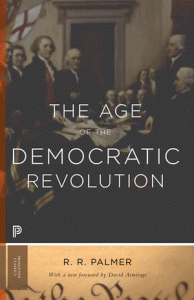
To give my grad students a sense of the field’s starting point, I had them read R. R. Palmer’s classic 2-volume The Age of Democratic Revolution: A Political History of Europe and America, 1760-1800 (1959, 1964; 2014), recently combined and re-published by Princeton University Press. Advancing through the semester and reading much more recent books, the dated nature of Palmer’s book is readily apparent. Most obvious is its avoidance of Haiti. (At an AHA panel on the Age of Revolutions last January, Nathaniel Perl-Rosenthal mention that it’s basically an academic ritual to mention this whenever discussing Age of Democratic Revolution.) Palmer also focuses on high-end (and male-centric) intellectual history, ignores economic interests and intersections, and only engages the nations whose revolutions “succeeded.” This last point is obviously problematic, of course, given what happens in France after their Revolution. But as Janet Polasky’s recent book shows, a more comprehensive view can be gleaned through looking at revolutionary moments that did not have successful outcomes. Like any book published over a half-century ago, even a classic book like Palmer’s, there are plenty of holes to acknowledge. Continue reading
 When I first listened to the Hamilton soundtrack last fall, the song “Farmer Refuted” caught my attention. The song stages a pamphlet war that began in November 1774 between Samuel Seabury, an Anglican minister in Westchester County, New York, and Alexander Hamilton, then an upstart New York college student. Their war of words over the First Continental Congress carried on for nearly four months and encompassed several tracts.[1]



 Most history courses follow a relatively simple formula: take a geographic space X, select a time span from A to B, add topics, and you’ve got yourself a course. It varies, of course, but works for both introductory courses, where you might survey the political, social, and cultural development of the people living in a geographic area, to upper-level courses with topical focuses. As a field whose primary concern is change over time, that formula makes sense. That consistency also means that students expect it from their high school and college history courses. And how else would you organize a history course?
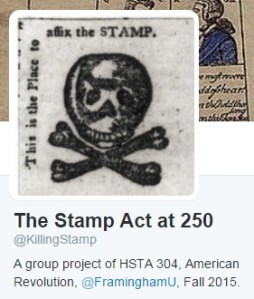 As many of our readers already know, this fall has marked the 250th anniversary since the protests against the Stamp Act, one of the earliest major actions of the imperial crisis that resulted in the American Revolution. Over the course of a year—from the first arrival of the Act in May 1765 until news of its repeal arrived in May 1766—colonists in the “thirteen original” colonies (as well as the “other thirteen”) passed resolutions, argued in essays, marched in the streets, forced resignations, and otherwise made clear their displeasure with paying a tax on their printed goods.


 The Junto