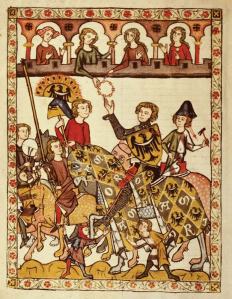
 The baker’s nod, the knight’s blade, the king’s touch: These are three of the main and mostly medieval reasons why I read and write American history. Over the past few days, we’ve lauded new writing blueprints, parsed the definition of an academic book, and even made good sport of the whole reading selection process. So, in the last, spooling print loop of Academic Book Week, let’s rewind the too-short life of Marc Bloch for tradecraft’s sake. Continue reading
Category Archives: Special Features
Roundtable: Academic Book Week: Alternative Entries To Familiar Topics
 When I consider the non-early-American history books that have had the greatest impact on the way I think, two stand out in particular. One is Ross McKibbin’s The Evolution of the Labour Party, 1910-1924; the other, CLR James’s Beyond A Boundary. The former is the most obviously “academic” of the two; the opportunity to write a Junto post primarily concerned with cricket, however, means that today I’ll focus on the latter.[1]
Both books influenced me for their creativity in approaching politics and society. McKibbin’s insight that “political action is the result of social and cultural attitudes which are not primarily political” has remained with me ever since; a useful reminder that in writing political history, we have to try and find ways of recovering political mindsets not only by looking at what political actors say, but also the many and varied ways they actually do things. James, too, calls for an approach to studying the past that looks beyond a narrow scope of inquiry, in his famous question ‘What do they know of cricket, who only cricket know?’ Continue reading
Roundtable: Academic Book Week—What’s an Academic Book Anyway?
 Is Rachel Carson’s Silent Spring an academic book? Is Mary Wollestonecraft’s Vindication of the Rights of Woman? The list of twenty nominees for “the academic book that has most changed the world,” part of the UK’s Academic Book Week, is a pretty confusing collection. Plato’s Republic is a product of the academy, sure, but is George Orwell’s 1984? In the US, we’re in the middle of University Press Week, which is a much more easily-identifiable category. We should all celebrate the important role of university presses in preserving scholarly endeavour from the rapacious maw of the market. In the face of ever-deeper cuts, they deserve our vigilant support. Continue reading
Roundtable: Academic Book Week—How Should We Write History?
 This week is Academic Book Week—“A celebration of the diversity, innovation and influence of academic books.” There are events, special promotions, and competitions running in Britain between November 9 and 16, 2015. Perhaps the most provocative and interesting competition #AcBookWeek is running is a public vote on “the academic book that has most changed the world.” The entrants include Mary Wollstonecraft’s A Vindication of the Rights of Women, George Orwell’s Nineteen Eighty-Four, E. P. Thompson’s The Making of the English Working Class, and Thomas Paine’s The Rights of Man. There are sixteen other entries, which are equally wide-ranging.[1] Although the list makes for interesting reading, voting is closed. But do not fret, Junto readers, we are running a roundtable on a similar, yet distinct, topic. This week, several Juntoists will discuss an academic book that has shaped their work. Continue reading
Guest Post: Correcting an Incorrect “Corrective”
Edward E. Baptist is the author of The Half Has Never Been Told: Slavery and the Making of American Capitalism. He would like to “thank Joshua Rothman, Jefferson Cowie, Louis Hyman, and David Silbey for advice on this piece of writing, and The Junto for letting me publish in their space.”
 How was an immense increase in the “efficiency” of cotton production achieved in the nineteenth century? The question cuts to the heart of the debates over the history of U.S. slavery.
Last week, The Junto linked to sociologist John Clegg’s review in Critical Historical Studies, which considered several recent books on slavery and capitalism. This blog reported Clegg’s take on The Half Has Never Been Told as a “corrective.” Clegg attacks my argument that intense coercion drove a 400% increase in the efficiency of cotton-picking slave labor in the U.S. South between 1800 and 1860. His critiques directly build on the work of economists Alan Olmstead and Paul Rhode. In a series of essays, they asserted that efficiency actually increased because of improved seeds. In a recent issue of the Journal of Economic History, Olmstead appears somewhat displeased that I disagree with their assertions. Continue reading
Guest Post: The “Scotch War”: Scotophobia and the War of American Independence
Today’s post is a guest post from Tim Worth, a PhD candidate at the University of Southampton. His thesis examines transatlantic Scotophobia during the late eighteenth century, and how ideas of ethnicity affected British and American images of empire.
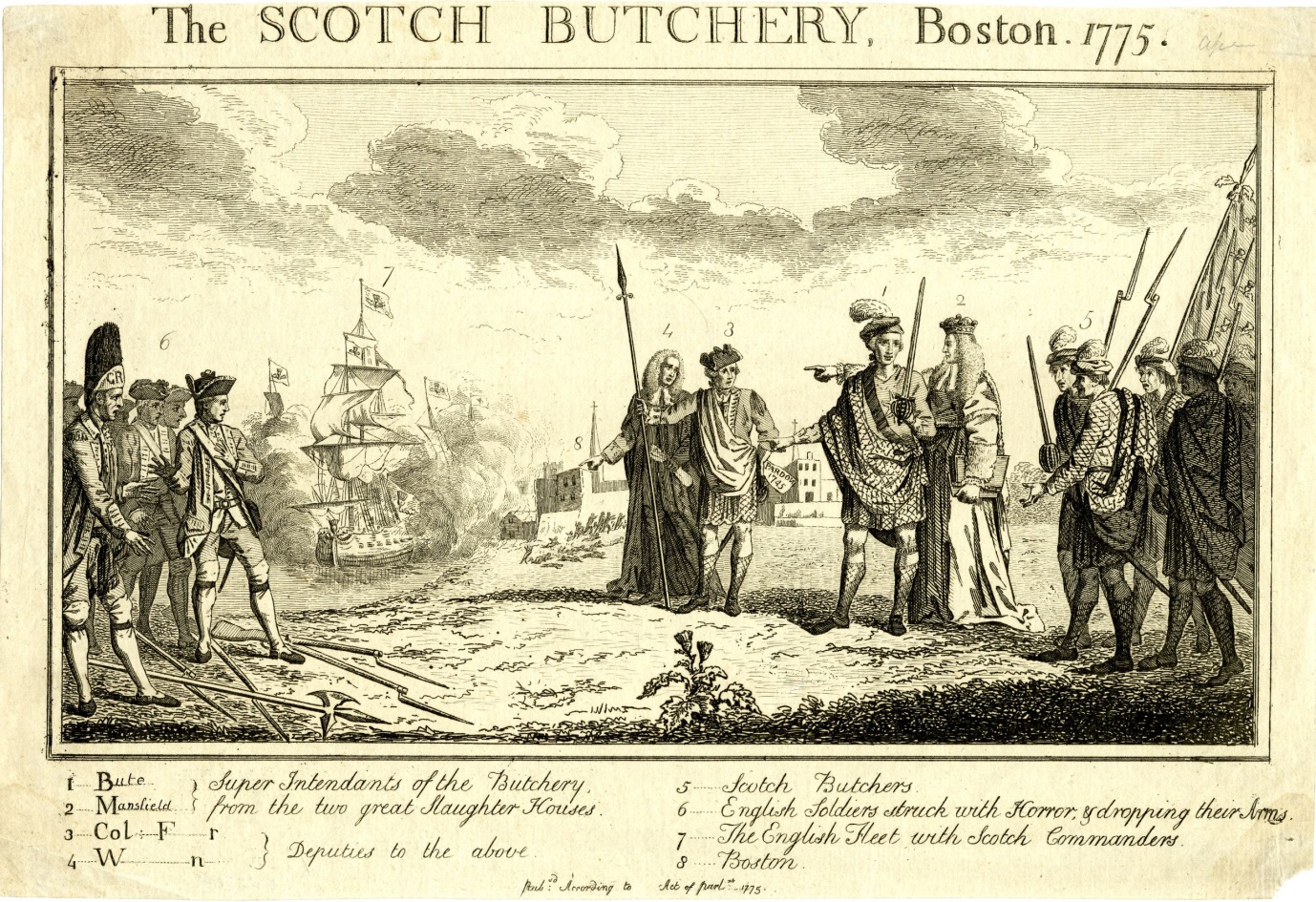
The Scotch Butchery, Boston 1775, (London, 1775). Lord Bute and the Scotch Junto instruct Highland soldiers to slaughter the inhabitants of Boston. On the left, a group of English riflemen drop their muskets in horror. © The Trustees of the British Museum.
Over the past couple of years I’ve followed the fascinating Junto debate about whether or not we can see the War of American Independence as a civil war. Tom Cutterham and Christopher F. Minty have both put forward some excellent arguments outlining the strengths and weaknesses of this model. Whether or not we should use the term “civil war,” a great many contemporary writers often described the conflict as a tragic war fought between Britons. Today, I want to add a little more to this debate by breaking these Britons down into their component parts, and briefly examining how popular attitudes towards one of the ethnic groups we’re left with, the Scots, affected English and American ideas of the war during its early years. Continue reading
Guest Post: Emerging Histories of the French Atlantic
Robert Taber, a postdoctoral associate with the University of Florida Writing Program, wrote his dissertation on the connection between family life and grassroots politics in colonial Saint-Domingue and is the author of Navigating Haiti’s History: Saint-Domingue and the Haitian Revolution.
 More than 30 scholars from three continents gathered at the Williamsburg Inn from October 16th through the 18th to present emerging histories of the French Atlantic. Sponsored by the Omohundro Institute, and made possible through considerable labor and financial investment, one hundred scholars were able to enjoy a great conference atmosphere. Three days of panels, workshops, and roundtables pushed for our collective knowledge of the French Atlantic to be wider, deeper, and better integrated, fulfilling a plan first sketched out in the summer of 2010.
Q&A: Cassandra Good, Author of Founding Friendships
 In April, Tom Cutterham reviewed Cassandra Good’s new book, Founding Friendships: Friendships Between Women and Men in the Early American Republic (New York: Oxford University Press, 2015). Good received her PhD from the University of Pennsylvania and is now the Associate Editor of the Papers of James Monroe at the University of Mary Washington. Today, she speaks with The Junto about Founding Friendships and her next project.
Continue reading
Guest Post: Law and Sexual Misconduct in New England, 1650-1750
Abby Chandler is Assistant Professor of History at the University of Massachusetts, Lowell. She received her PhD from the University of Maine at Orono. Her first book, Law and Sexual Misconduct in New England, 1650-1750: Steering Towards England is due to be released by Ashgate in November.
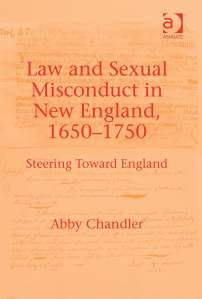 My forthcoming book, Law and Sexual Misconduct in New England, 1650-1750: Steering Toward England, uses sexual misconduct trials to examine the ways in which the growing Anglicization of the New England colonies played a role in the daily lives of ordinary colonists. Such trials may seem an unusual source base for studying broader political change, but their frequency and consistency allowed me to track the often subtle shifts toward more Anglicized legal systems. Likewise, both men and women were routinely charged with sexual misconduct, which allowed me to examine these shifts from male and female perspectives. This is the story of two widows in Essex County, Massachusetts, and their very different experiences with the Puritan dominated legal system of the seventeenth century and the Anglicized legal system of the eighteenth century.
Guest Post: John Adams–Attorney and Barrister
Today’s guest post comes from Craig Hanlon, a Ph.D. candidate at the University of Stirling. He holds a B.A. (Hons.) and a M.Res., both from Stirling. His dissertation focuses on John Adams’s legal career.
 John Adams is a familiar figure to early American historians. His public service before, during, and after the Revolution has received considerable attention over the years, and quite rightly so. But there are gaps in Adams-related scholarship. Perhaps most prominently, Adams’s legal career prior to the American Revolution has been heretofore underappreciated. From 1758 until his appointment to the Continental Congress, in 1774, Adams was an attorney and barrister. He practiced in the courts of Massachusetts. My research examines Adams’s legal career in detail, particularly his professional and intellectual development between 1758 and 1774. I start from the premise that Adams’s knowledge and understanding of the law related to, and indeed influenced, his political ideology.[1] Continue reading
 The Junto