 We begin this week with topography and geography, both literal and figurative. Continue reading
Call for Links: History Carnival on May 1
 We’re proud to note that the 121st monthly History Carnival, featuring the best recent blogging about all fields of history, will be hosted by Michael Hattem here at The Junto on May 1. We need your help to make it a success. What fascinating, scintillating, disturbing, provoking, amusing, and illuminating things have you seen in history blogs this month? Please let us know using this form. This friendly little form right here. It’s easy and quick to nominate your favorite blogposts.
If you’re not familiar with the History Carnival, more information is available at the main website. The most recent edition of the Carnival was hosted brilliantly on April 1 by Debs Wiles at Got Soil?
Charles Beard: A Conference Recap
 In spite of the unrestful Beardian ghost recently invoked by Saul Cornell, with which I introduced the topic of the Charles Beard, Economic Interpretation and History Conference here a few months ago, not every participant was convinced, going in, that Beard was really worth the trouble of a two-day international conference. By the end, we were able to say that whatever we thought of Beard himself, his work could certainly provoke plenty of insight and discussion. It would be wrong to say the event was a celebration of Beard, or held in his honour. Instead, like his vision of history, it was characterised more by conflict than consensus–at least, if friendly scholarly disagreement really counts as conflict. Continue reading
The Comprehensive Exam: A Reflection, with Qualifiers
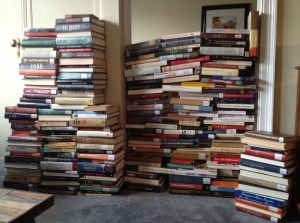 The three or four minutes between when my qualifying exam ended and when I found out I had passed rank among the weirdest of my life. Not because I feared I had failed. In fact, immediately following the exam, which I took last Tuesday and which consisted solely of a two-hour oral interrogation, I encountered a calm and a confidence that I hadn’t known in months. Instead, the moment’s weirdness stemmed from a sort of whiplash. Ideas, arguments, and anxieties had been cramming themselves into every corner of my brain for over a year. Suddenly, they were free—unleashed and dissipated in the space a two-hour conversation. It felt more than a bit anticlimactic. A disappointing question seemed to cloud out any sense of accomplishment or pride: “That was it?” A week later, I’m feeling prouder—and still celebrating—but the question remains. Continue reading
Shadows of History in the Boston Marathon Manhunt
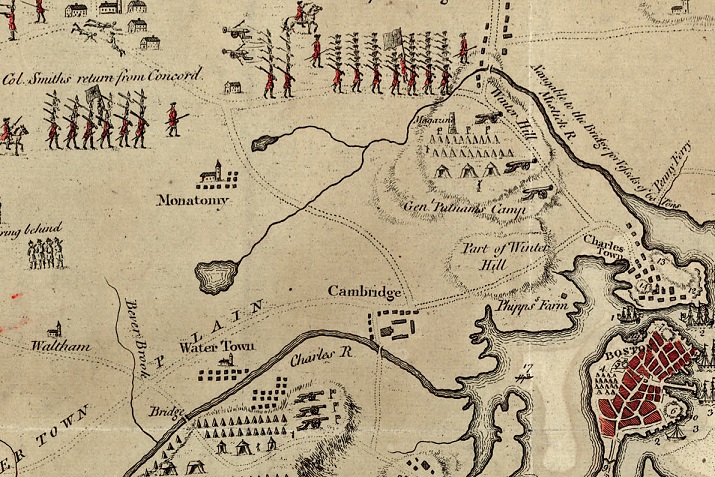 Public radio station WHYY in Philadelphia airs BBC World Update at 5 a.m. on weekdays. So on Friday morning, oddly enough, it was from the British Broadcasting Corporation rather than any domestic service that I heard surprising news from Boston.
During the night, police had chased two bombing (and robbery) suspects through the labyrinthine streets of Cambridge and Watertown, engaging in at least one major firefight along the way. Now the police seemed to be laying siege to a Watertown neighborhood. The reports at that hour were confused and confusing–not to mention frequently wrong. But as the hunt for the surviving terrorist suspect continued during the day, it became clear that the story was also, in several different ways, strangely familiar.
The Future of the Past Is Now: Digital Humanities Resource Guide
Inspired by the work of colleagues @ the new Digital Public Library of America and others we’ve interviewed here at The Junto, here are some bookmark-worthy links to what’s going on in the ever-evolving field of the digital humanities. We’ll update this list as projects develop, so if you’re working on a digital history initiative, please let us know so we can add it to the Resources page.
If you use new media in the classroom, how effective do you find it to be in communicating historical content/class themes? Please share your views on digital pedagogy in the comments. Continue reading
The Week in Early American History
It’s that time of the week and it’s my turn to do the roundup, so let’s just get started with some links from the past week or so… Continue reading
A Library for the Digital Republic: The DPLA Is Launched
 Four years ago, Robert Darnton, historian and librarian at Harvard, wrote in the New York Review that “we [had] missed a great opportunity.” Instead of digitizing America’s print heritage in a public project, perhaps managed by “a grand alliance of research libraries,” the United States had allowed a private corporation to control the scanning and storing of books. Depending on the outcome of federal lawsuits, Google Books would enjoy a virtual monopoly on books still in copyright.
“We could have created a National Digital Library—the twenty-first-century equivalent of the Library of Alexandria,” Darnton wrote. “It is too late now. Not only have we failed to realize that possibility, but, even worse, we are allowing a question of public policy—the control of access to information—to be determined by private lawsuit.”
Historians and Documentary Editing
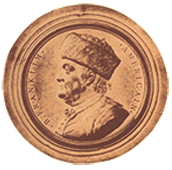 On this—the 223rd anniversary of the death of Benjamin Franklin—I thought I would use this space to say a few words about my experience over the last year working at the Papers of Benjamin Franklin here at Yale University from the perspective of a graduate student. Last June, I was fortunate enough to be given a regular (part-time) position at the Franklin Papers. Officially, I am a Research Assistant and have done a number of small research projects designed to provide the editors with reference materials on Pennsylvania in the 1780s as they finish up the volumes covering Franklin’s stay in Paris. I have also been given the opportunity to tackle more editorial-type duties including fact-checking, drafting annotations, and proofreading transcriptions. Through these experiences and my innumerable conversations with the chief Editor, Ellen Cohn, I have gotten an inside look at scholarly editing, which often goes either unnoticed or under-appreciated by academic historians. Continue reading
Gaming In The Classroom: Washington’s War
 One of the key difficulties of teaching the American Revolution is the seeming inevitability of it all. Why did Britain even bother pursuing its bothersome colonists? After all, the patriot cause was so noble and glorious that there was surely no way that such perfidious villains as the redcoats could possibly have triumphed. And yet within that myth, there is a persistent paradox: the patriot cause is often “proven” by the victory of such an inferior force against the strongest military power in the world in the late 18th century. But for this narrative to make any sense at all, there must have been a real risk of defeat; unless Britain could realistically have defeated their colonists, why would the morality of the patriots be of any consequence whatsoever? Continue reading
 The Junto