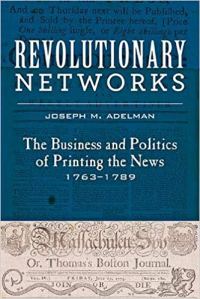
 Today, The Junto interviews our own Joseph Adelman about his new book Revolutionary Networks: The Business and Politics of Printing the News, 1763–1789. Jordan Taylor’s review of the book appeared yesterday.
Junto: Let’s start off on a hostile note: Why should anyone care about early American newspaper printers?
JMA: Well if you’re going to be hostile, I’m tempted to just say “because I said so.” But assuming that will work about as well here as it does with my kids, let me make the case as best I can. At its core, Revolutionary Networksargues that the material realities of texts matters, and that scholars have tended to elide or simply stipulate their importance. Or, to put it in historiographic terms, we need to integrate book history methods more fully into our understanding of politics in Revolutionary America. So when I started doing research for the book when it was a dissertation, I focused on the production and circulation of texts and the impact those processes had on how American colonists and British officials made political decisions.
Continue reading
 Joseph M. Adelman,
  THE AGE OF REVOLUTIONS
 Liz Covart is the Digital Projects Editor at the
  Following up yesterday’s
 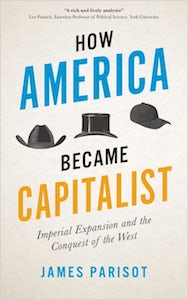 In just under 200 pages, Parisot traces the intertwined expansion of white settler colonialism in British North America and the transition to capitalism from the seventeenth through the nineteenth centuries. A historical sociologist, Parisot synthesizes a great deal of historical scholarship in order to offer a framework for “how a society with capitalism became a capitalist society” while embracing “multi-linear complexity” (2, 6). He argues that both capitalist and “not-so-capitalist” relations drove American Indian dispossession and westward imperial expansion. Inspired by the work of W.E.B. Du Bois, Parisot’s framework seeks to take race and gender into account “to explain capitalism, imperialism, and empire as processes reaching down into daily life and stretching back to broad historical structures which they in turn co-shape” (16).
  Today, Rachel Herrmann concludes our food roundtable. You can read Carla Cevasco’s introduction
  The Junto