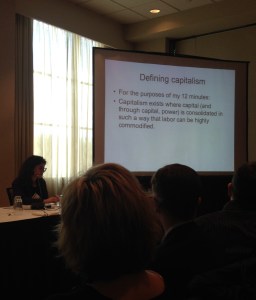
This post is the first part of a two-part report on a roundtable session at this year’s Organization of American Historians annual meeting in Providence, Rhode Island, entitled, “Open Question: What’s the Relationship Between Slavery and Capitalism?” The panelists were James Oakes, Craig Wilder, Sven Beckert, and Caitlin Rosenthal (Ed Baptist was sadly unable to be there). My first post will focus on Beckert’s comments, my second on Rosenthal’s.
 As a protagonist in the debate over slavery and capitalism, Sven Beckert’s principal aim seems to be to show just how crucial violence was to the emergence and success of capitalism. This violence is not something standard, mainstream, or traditional accounts—the kind we see in economics textbooks or breezy historical surveys—are willing to acknowledge. Rather, the role of violence and slavery in the history of capitalism was erased, Beckert noted in his roundtable comments, by a “process of mystification,” an “active act of forgetting,” that took place from the late nineteenth through the twentieth centuries. Especially after the Russian Revolution and the beginning of the Cold War, he argued, American scholars and public intellectuals transformed the story of capitalism into a story of the spread of freedom. In this narrative, the nineteenth-century Civil War took on the role of a violent clearing of the decks, eliminating slavery as a remnant of the past, and opening the way for capitalist modernization. Continue reading →
 Students of the early American republic: I urge you to apply to SHEAR 2016’s Graduate Research Seminars!

 How does a crony capitalist son of a whore, and a militarist pumped up by delusional aspirations of honor, grow up to be feted by liberal scholars? [*]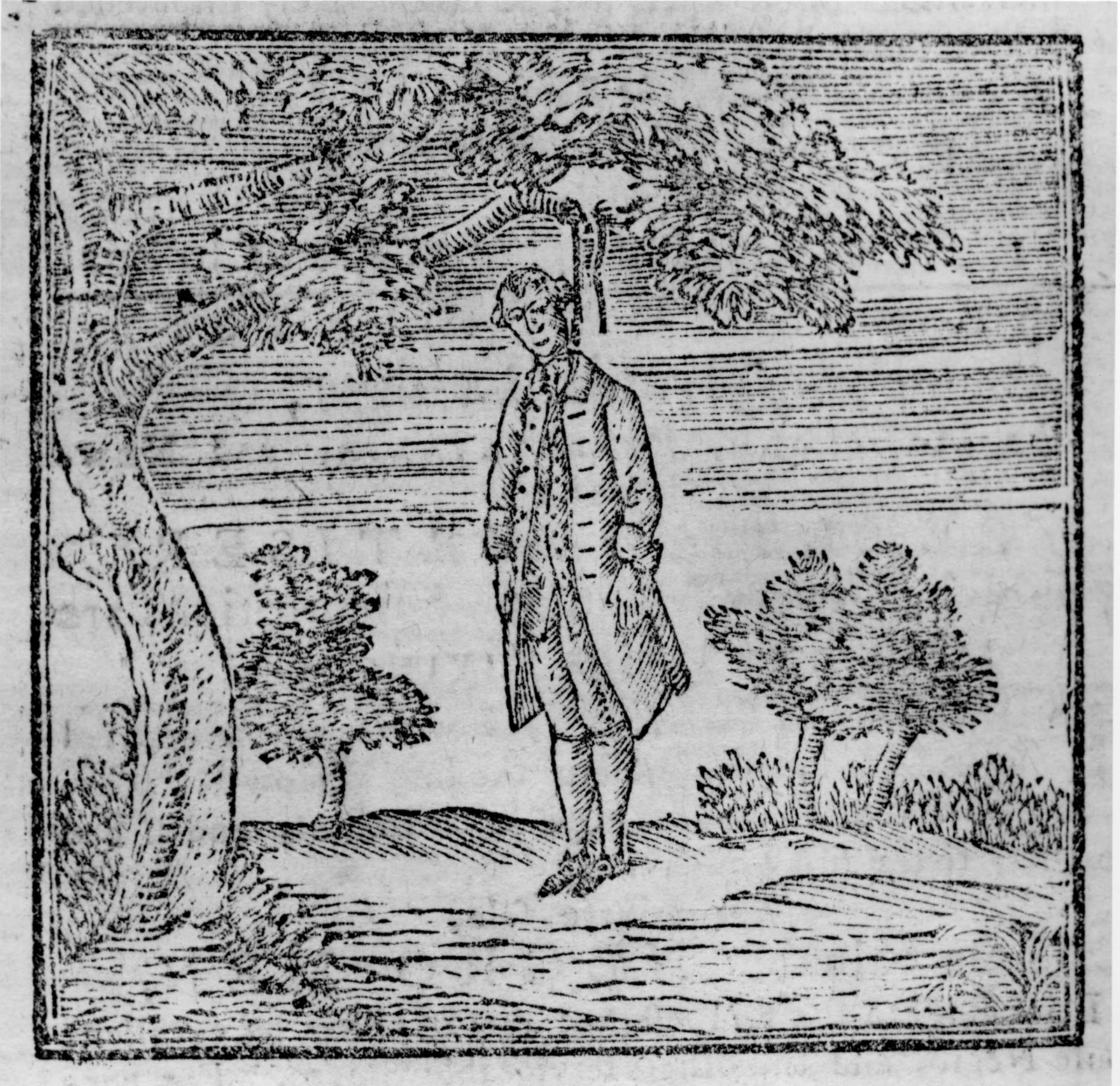
 “Slavery and Freedom” is an article about Puritans, even though it doesn’t mention them at all; it’s about what happens when you try to colonize a place without them.
 “Historians treat theory the way rattlesnakes approach small mammals. They either strike to kill or swallow whole. The latter often amounts to death by citation.”[1] David Waldstreicher’s statement on the problematic status of critical theory in Early American Studies appeared in a 2005 WMQ forum reconsidering the public sphere as a category for analysis. Must historians always view theoretical work through an antagonistic empiricism, or, just as unreflectively, swallow theory whole? Perhaps the tide is turning towards new theoretical engagements, as historians and literary scholars recognize that theories are themselves continually subject to refinement in relation to historical research. A recent conference at the McNeil Center for Early American Studies, entitled
  The Junto