Today’s guest poster is Bryan Rindfleisch, Assistant Professor of History at Marquette University.
Andrew Lipman, The Saltwater Frontier: Indians and the Contest for the American Coast (New Haven: Yale University Press, 2015).
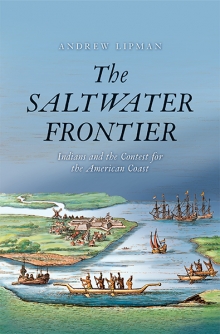 When most people think of European colonization in New England and New Netherland, we think in very terrestrial terms. This familiar narrative includes the fur and wampum trades, treaties and the negotiations over land, and conflicts such as the Pequot War, Kieft’s War, King Philip’s War, and so on. But Andrew Lipman, an assistant professor of history at Barnard College, flips this entire terrestrial story upon its head. He does this with one simple question: “What if we considered this contested region not just as a part of the continent but also as part of the ocean?” In doing so, Lipman recovers the astonishing maritime contexts of seventeenth-century America, where both Indigenous and European peoples encountered, collaborated with, and fought against one another on the water just as much as they did on the land. This, then, is the provocative beginning to Lipman’s Bancroft Prize-winning The Saltwater Frontier: Indians and the Contest for the American Coast (Yale University Press, 2015).[1] Continue reading

 After nearly three-and-a-half years, we are preparing to move on to the next level.
 Between 1650 and 1750, the courts of Maine, Rhode Island, and Essex County, Massachusetts heard 1,843 cases concerning sexual misconduct. These suits, which concerned matters including rape, sodomy, adultery, and sex outside of marriage, are the subject of
 The Junto