Damming Fish and Indians: Starvation and Dispossession in Colonial Massachusetts

Today’s post in the Roundtable on Food and Hunger in Vast Early America is by Zachary M. Bennett, who is Visiting Assistant Professor of History at Connecticut College this autumn. He is a Ph.D. candidate at Rutgers University-New Brunswick. His dissertation, “Flowing Power: Rivers, Energy, and the Making of New England,” examines the political ecology of waterpower before the industrial revolution.

Compared to other Native Americans in southern New England, the Ninnimissinuok community of Natick, Massachusetts seemed to have secure footing going into the eighteenth century. Located only fifteen miles outside of Boston on the Charles River, Natick was the largest community of Native American converts to Christianity—or “Praying Indians”—in mainland New England with a population exceeding two hundred persons. These Praying Indians owned their land in corporation to safeguard their enclave against land hungry colonists. To passersby, Natick residents farmed like their English neighbors, dressed like them, and even worshipped like them too. Yet, in contrast to their English neighbors, this community steadily declined over the course of the eighteenth century. Continue reading

Roundtable: Food and Hunger in Vast Early America

Dams that powered grain mills but choked off fish migrations. Cassava bread that replaced wheat. A breakfast that turned into an ambush. The lenses of food and scarcity can transform our views of familiar places in early American history—Massachusetts, Virginia, the Caribbean. Continue reading

Q&A with Christopher Parsons

Today Rachel Herrmann interviews Christopher Parsons about his book, A Not-So-New World, which Carla Cevasco reviewed yesterday. Parsons is an interdisciplinary historian of science and the environment in the French Atlantic World. He has a longstanding interest in highlighting the contribution of indigenous peoples to the evolution of European and Euro-American environmental sciences. He has published articles in the William & Mary Quarterly, Environmental History, Early American Studies, and several edited collections. He tweets as @cm_parsons. 

 JUNTO: A Not-So-New World includes a discussion about fraught vocabulary, including the word sauvage and your decision to leave it untranslated. Early Americanists have been thinking for a while now about the language we use when we write about the past, but many of us are just starting to think about the French sources that inform your book. Could you say a little bit more about other word choices you made, and some of the words in translation that non-French Atlanticists might want to use with more care?

Christopher Parsons: Word choice is so important when you are working between subdisciplines such as the history of science and environmental history and across national historiographies such as, here, early Canada and early America. These are such powerful markers of investments in particular fields or the influence of particular works. I was conscious for example, of the Canadian preference for indigenous over native and the familiarity of early Americanists with terms such as the pays d’en haut.

Yet there were real intellectual reasons for leaving key terms untranslated as well. Continue reading

Review: Christopher M. Parsons, A Not-So-New World

Christopher M. Parsons, A Not-So-New World: Empire and Environment in French Colonial North America (Philadelphia: University of Pennsylvania Press, 2018). 

parsons

Today, Carla Cevasco reviews A Not-So-New World: Empire and Environment in French Colonial North America by Christopher M. Parsons, Assistant Professor of History at Northeastern University. Tomorrow, the author will discuss the book in a Q&A with Rachel Herrmann.

When the French first invaded northeastern North America in the seventeenth century, they aspired to make wine from the indigenous grapes of the region. By the eighteenth century, however, they faced the disappointing reality that wine produced with French techniques from these grapes was acrid and viscous, and, moreover, that wine grapes native to France did not necessarily thrive in such a cold climate. The dream of Canadian wine proved a failure to early French colonists.[1]

Continue reading

Q&A: Kate Egner Gruber, Curator of “Tenacity: Women in Jamestown and Early Virginia”

kateheadshotToday at The Junto, Philippe Halbert interviews Katherine Egner Gruber, who is Special Exhibition Curator at the Jamestown-Yorktown Foundation, a state agency that operates two living history museums in Virginia. This Q&A focuses on her most recent exhibition, Tenacity: Women in Jamestown and Early Virginia, which opened at Jamestown Settlement in November of 2018 and runs through January of 2020. She was also responsible for content oversight of the Yorktown American Revolution Museum‘s award-winning introductory film, Liberty Fever, and contributed to the development of new galleries that opened there in 2015. Kate earned a bachelor’s degree in historic preservation and classical humanities from the University of Mary Washington and a master’s degree in American history from the College of William and Mary. Continue reading
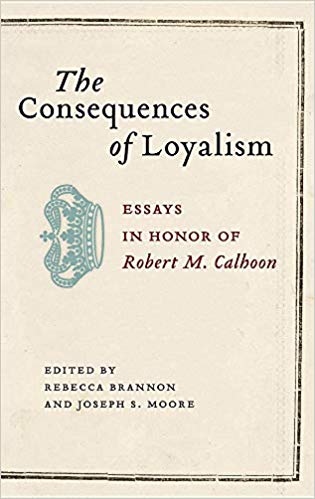
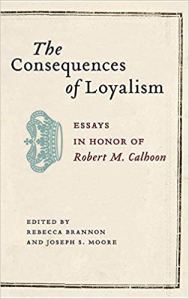
Q&A with Rebecca Brannon and Joseph S. Moore, editors of The Consequences of Loyalism

Following on from Emily Yankowitz’s review of The Consequences of Loyalism: Essays in Honor of Robert M. Calhoon (Columbia: University of South Carolina Press, 2019), we continue our Review/Q&A format with an interview with the editors, Rebecca Brannon and Joseph S. Moore. Brannon is associate professor of history at James Madison University and the author of From Revolution to Reunion: The Reintegration of the South Carolina Loyalists (Columbia: University of South Carolina Press, 2016), which was reviewed on The Junto in 2017. Moore is associate professor of history and department chair at Gardner-Webb University. He is the author of Founding Sins: How a Group of Antislavery Radicals Fought to Put Christ into the Constitution (New York: Oxford University Press, 2015). Continue reading

Review, Rebecca Brannon and Joseph Moore, eds. The Consequences of Loyalism

Brannon, Rebecca, and Joseph S. Moore, eds. The Consequences of Loyalism: Essays in Honor of Robert M. Calhoon. (Columbia: University of South Carolina Press, 2019).

If you are studying or researching Loyalists in some way, Robert M. Calhoon’s name is bound to come up. The “dean of American Loyalist studies,” as Joseph Moore terms him, is a well-esteemed scholar, writer, and mentor who has been the leading voice in American Loyalists historiography for decades.”[1] By engaging Loyalists in a multi-dimensional fashion, Calhoon’s work elucidated the now-incontrovertible inference: that Loyalists were multi-dimensional figures who were not too different from their revolutionary counterparts. In fact, the irrefutability of this idea is no doubt due in part to his work. In honor of him, Rebecca Brannon and Joseph Moore edited a Festschrift titled The Consequences of Loyalism. Continue reading

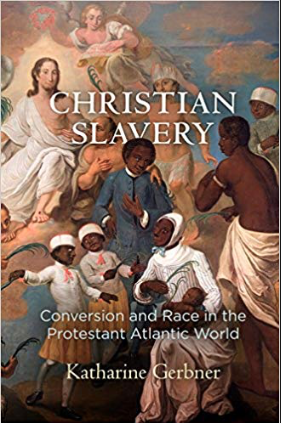
Q&A with Katharine Gerbner, author of Christian Slavery: Conversion and Race in the Protestant Atlantic World

Today the Junto features a Q&A with Assistant Professor of History at the University of Minnesota, Katherine Gerbner conducted by Kristen Beales. Gerbner teaches courses on Atlantic History, History of Religions, Magic & Medicine, and The Early Modern Archive. Her work has been featured in Atlantic Studies, New England Studies, and Early American Studies. She received her PhD from Harvard University in 2013 and received fellowships and awards from the University of Minnesota, the American Philosophical Society, the Library Company of Philadelphia, Haverford College, and the John Carter Brown Library.

Kristen Beales is a PhD Candidate at the College of William and Mary finishing a dissertation titled “Thy Will Be Done: Merchants and Religion in Early America, 1720-1815,” which explores how merchants from different Protestant backgrounds in Boston, Philadelphia, and Charleston navigated economic debates between 1720 and 1815. Her project is structured around four case studies: reactions to the South Sea Bubble in 1720, discussions about the relationship between religion and business practice prompted by the revivals of the so-called “Great Awakening” between 1739 and 1746, debates over nonimportation and nonconsumption between 1765 and 1776, and the controversy surrounding the Embargo Act of 1807. Kristen’s research has been supported by a number of institutions, including grants and fellowships from the American Antiquarian Society, the American Philosophical Society, the Clements Library, the David Library of the American Revolution, Haverford College Quaker and Special Collections, the Huntington Library, the Historical Society of Pennsylvania, and the Library Company of Philadelphia. Continue reading

Review: Katharine Gerbner, Christian Slavery: Conversion and Race in the Protestant Atlantic World

On the heels of its recent release in paperback, today The Junto features a review of Christian Slavery: Conversion and Race in the Protestant Atlantic World (University of Pennsylvania Press, 2018). Stay tuned tomorrow for an interview with the author, Assistant Professor of History at the University of Minnesota, Katharine Gerbner.

Scholarship on the Anglo-Caribbean has tended to minimize the role of the Anglican Church in Caribbean society through an emphasis on the greed and irreligiosity of the English colonists who profited from the exploitation of enslaved labor. This tendency is especially striking when compared to the historical work on Catholic institutions in neighboring French and Spanish territories. In the Anglo-Atlantic, missionary work among free and enslaved Africans and Afro-Caribbean people tends to be equated with antislavery thought and activism. Katharine Gerbner’s new book, Christian Slavery: Conversion and Race in the Protestant Atlantic World, challenges these historiographic tendencies and presents a welcome reinterpretation of the relationship between race, religion, and slavery in the Protestant Atlantic. Continue reading

Ben Wright: Thomas Paine and the Conflicting Ideologies of the Digital Revolution

This post is part of a joint series entitled “Digital Research, Digital Age: Blogging New Approaches to Early American Studies,” hosted at the Panorama and the Junto. This joint series stems from  stemming from a conference entitled “Revolutionary Texts in a Digital Age: Thomas Paine’s Publishing Networks, Past and Present,” organized by Nora Slonimsky at Iona College in October 2018. This series will feature one post every day this week, hosted by both the Panorama and the Junto, and Dr. Slonimsky’s introductory post is found here. You can read previous posts by Lindsay Chervinsky, Joseph Adelman, and the Johnson/Pellissier/Schmidt trio.

Writing in 1995, media critic Jon Katz christened Thomas Paine “the moral father of the internet,” musing that “nearly two centuries after his death, in a form Paine couldn’t have imagined but would have plunged into with joyous passion, the internet is, in many ways, the embodiment of everything he believed.”[i] Katz is correct in more ways than he intended. That very same year, media theorists Richard Barbrook and Andy Cameron framed the animating spirit of the digital revolution as a collision of the New Left and libertarianism. “The Californian Ideology,” as they called it, offers an “optimistic vision of the future [that] has been enthusiastically embraced by computer nerds, slacker students, innovative capitalists, social activists, trendy academics, futurist bureaucrats and opportunistic politicians across the USA.”[ii] More than two centuries earlier, Thomas Paine presaged this curious ideological blending,  articulating the tensions between libertarianism and the left with the same soaring revolutionary rhetoric that suffuses the digital humanities. Continue reading