Tag Archives: Civil War
The Week in Early American History

I may be imagining things, but it seems that every time I take a turn with TWEAH there’s a major weather event going on outside my window. That may not be the case, but this edition comes to you with the first New England snow of the season. So if you’re stuck inside this morning, or just back from shoveling, take a few minutes to make a hot drink and see where The Junto may lead you.
Godly Heritage and Plantation Chic: The Case of Vision Forum
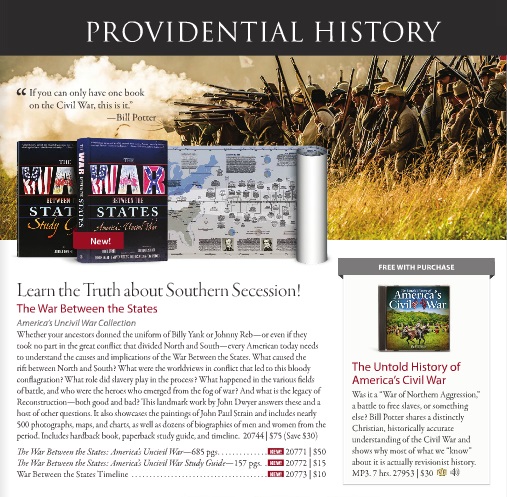 A recent news story has me thinking about the weird enduring appeal of the Lost Cause. It seems to me that this news story about a contemporary religious organization might lead us into an interesting case study. Why, at this late date, do so many Americans still want to see the antebellum South as a tragically vanished world of nobility and grace?
Most early Americanists are familiar with David Barton, a conservative activist who argues that the United States was founded as a Christian nation. He’s been mentioned here several times as the most visible proponent of a view that’s common among members of the “Religious Right.”[1] What’s less widely understood is how often his Christian-founding ideology overlaps with a claim advanced by a few other evangelical conservatives: that the Confederacy—and antebellum southern culture, if not slavery itself—are also part of “America’s Godly heritage.”[2] In these circles, in other words, the Founding is sometimes wrapped up with the Old South.
The Week in Early American History
 It’s been a busy week of headlines for early Americanists: to the links! Continue reading
The Week in Early American History
Happy weekend, all…to the links! Continue reading
The Week in Early American History
We’ll start the roundup this week by pointing readers to the recently revamped Teaching United States History blog, which featured a slew of posts over the last seven days. Be sure and check out Ben Wright’s post on teaching students the differences between academic, public and popular history and Blake Ellis’s thoughts on teaching US history in a diverse classroom. Of particular interest to (at least some) readers of The Junto will be Drew Bledsoe’s taxonomy of Civil War history students. Continue reading
The Week in Early American History
It’s hard to believe that the end of June is already upon us. This week features one of the biggest events of the Civil War sesquicentennial with the 150th anniversary of the Battle of Gettysburg. Look for more on that event (both 150 years ago and today) in next week’s edition. Meanwhile, on to this week’s links!
The Week in Early American History
Happy Summer to all of our readers. Another week has come and gone, and we’re back with the latest installment of This Week in Early American History. Feel free to weigh in on posted links or share any interesting stories and newsworthy items we might’ve missed. Let’s jump right into it:
Revolution Not Dead
If “The American Revolution Reborn” conference proved anything, it’s that the Revolution is in no danger of getting old. So much is still left to be told. Topics that few Revolutionary narratives have fully considered—ambivalence, religious dissent, hindsight connections to Scotland’s union with England in 1707, and future links to the Latin Americas—beg for further research. And those are only the issues that were discussed on the first day.
The Week in Early American History
Happy Mother’s Day! Go call your Mom, then come back and take a look at our weekly round-up.
First, in honor of the holiday, one above-the-fold link: Heather Cox Richardson, writing at the Historical Society blog, looks at the origins of Mother’s Day. Hint: it’s not about “people be[ing] nice to their mothers.”
 The Junto