Just in time for your holiday shopping list, here’s our preview of new titles—share your finds in the comments! Continue reading
Winter Reads
December 3, 2014 By Sara Georgini in News, Recent Scholarship, Uncategorized Tags: 19th Century, Abraham Lincoln, American Revolution, Atlantic World, capitalism, Civil War, Constitution, cultural history, Early Republic, Gender, George Washington, Native Americans, Politics, Popular History, Print Culture, Publishing, race, religion, Slavery 8 Comments
 Constitution Day Edition.
 Carol Berkin is Presidential Professor Emerita at Baruch College and the CUNY Graduate Center. She received her bachelor’s degree at Barnard College. In 1972, she received her PhD at Columbia University, where she also worked on the Papers of John Jay and Alexander Hamilton. Her dissertation on Jonathan Sewall won the Bancroft Award for Outstanding Dissertation and the subsequent book,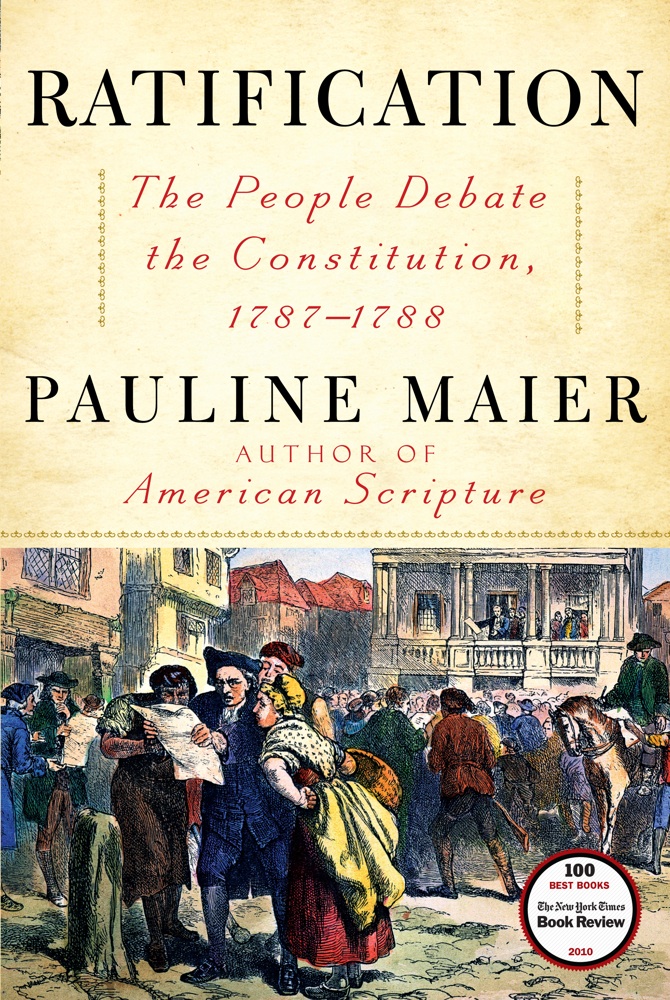

 Was the purpose of the constitution to protect democracy from being ruined by the people or to protect commerce from being ruined by democracy? This was one of the questions put to Gordon Wood and Woody Holton in a debate held a few weeks ago at the University of South Carolina. A full video of the event has just been released on YouTube, and is embedded below. For anyone familiar with the work of these two historians, the debate will constitute a useful recap of the distinction between their two interpretations of the origins of the federal constitution. And for others, I hope it might be a kind of teaser for their excellent books!
  On October 14, Columbia University’s Center for American Studies sponsored the “Charles Beard at 100” roundtable to commemorate the centennial of Beard’s An Economic Interpretation of the Constitution of the United States. The event, organized by Columbia Historian and Director of the American Studies program Casey Blake, featured Eric Foner (Columbia), Jan Lewis (Rutgers), and David Waldstreicher (Temple) as panelists, with Herb Sloan (Barnard) as moderator. The following blog post synthesizes some of the main themes of the roundtable. I hope that many of the excellent points raised by the panelists can serve as a basis for discussion here on The Junto.
 Welcome to another of The Junto‘s weekly round-ups of things that caught our eye in the rest of the Internet this week. Find the links after the jump!
  The Junto