 The Junto is happy to present the fifth episode of “The JuntoCast,” a monthly podcast in which members of The Junto discuss issues of both academic and general interest related to early American history, pedagogy, and public history. Continue reading
Tag Archives: Constitution
The Week in Early American History

In looking at the weeks ahead, I note with some chagrin
That my work remains unfinished though my lectures must begin.
And so instead of planning class, which should engage my time,
I present the Week in History, to YOU! Today! In rhyme!
The Week in Early American History
 It’s hard to believe that the end of June is already upon us. This week features one of the biggest events of the Civil War sesquicentennial with the 150th anniversary of the Battle of Gettysburg. Look for more on that event (both 150 years ago and today) in next week’s edition. Meanwhile, on to this week’s links!
The JuntoCast, Episode 2: The American Revolution
 The Junto is happy to present the second episode of “The JuntoCast,” our new monthly podcast featuring Juntoists discussing issues related to early American history, academia, pedagogy, and public history.
In our second episode, Kenneth Owen, Michael D. Hattem, Roy Rogers, and Eric Herschthal use the recent MCEAS conference, “The American Revolution Reborn,” as a springboard to launch into a discussion on questions of periodization, Atlantic and global contexts, the limits of “republicanism,” and the value of recovering “lived experience.”
You can click here to listen to the mp3 in a new window or right-click to download and save for later. You can also subscribe to the podcast in iTunes. Continue reading
The Week in Early American History
Happy Summer to all of our readers. Another week has come and gone, and we’re back with the latest installment of This Week in Early American History. Feel free to weigh in on posted links or share any interesting stories and newsworthy items we might’ve missed. Let’s jump right into it:
Promised Land
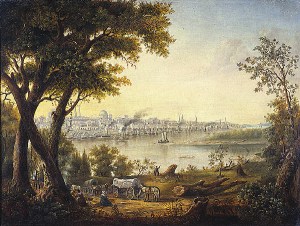
“Saint Louis in 1846”
Henry Lewis
This week, The Junto spoke with Lea VanderVelde, the Josephine R. Witte Professor of Law at the University of Iowa College of Law, a Guggenheim Fellow in Constitutional Studies, and principal investigator of the Law of the Antebellum Frontier project, which “seeks to digitally analyze the legal and economic mechanisms at work on the American frontier in the early 1800s.” She kindly took our questions on her work-in-progress, and why digital research transforms the early American legal history of how the West was run. Continue reading
The Week in Early American History
Happy Sunday! Let’s get right to the links.
Constitutional Interpretation and Historians
Yesterday I learned that some Republican state legislators in North Carolina have sponsored a bill to declare an established religion—or at least, to declare that the federal Constitution wouldn’t prohibit such a declaration. In doing so, of course, they disregard a mainstream of constitutional jurisprudence on the issue that goes back into the ninteenth century but was really firmly established in the middle of the twentieth century. I’m not here to talk about that question, but I found it particularly interesting in light of the conversation I’ve been having by email over the last few weeks with Dr. Sean Wilson, an assistant professor of law at Wright State University, about his new book The Flexible Constitution. Continue reading
Policy and Constitutional Principle
As a Brit teaching early American history in the US, I’m often asked how I came to be fascinated by the American Revolution. My answer is generally some version of the following: I’m fascinated by the American Revolution because there are so many reasons why it shouldn’t have ended with the creation of an American republic. Not only was the notion of independence from Britain a daring and risky move, but there were many reasons why the North American colonies could not cohere once they had broken with the mother country. Investigating the ways in which Americans tried to bridge the many gaps between themselves to create powerful and lasting governmental structures is one of the key themes of my research.
A large part of the answer to that conundrum, at least once historical focus shifts to the early republic, is the Constitution. Though, as I have written elsewhere, the mechanics of writing and ratifying the Constitution were scarcely the pristine and perfect process of popular imagination, the longevity of the Constitution must rank as one of the most significant achievements of the revolutionary era. Yet a close look at pretty much any period of American history sees the Constitution wielded as a partisan weapon as often as it is venerated as a ligature holding the separate states together. That is a curious paradox, for there is an implicit and serious criticism in describing a governmental act as “unconstitutional.” It suggests a lack of patriotism and a lack of common feeling; it implies mistrust, rather than emphasizing shared responsibility. Continue reading
The Week in Early American History
It seems to have become a tradition to open this post with a weather report for New England. This morning we’re looking at a slushy Sunday, which while annoying is quite an improvement over the snowpocalypse of a few weeks ago. In any case, a little sleet/snow won’t stand any longer between you and your weekly supply of links. On we go!
 The Junto