
We continue “The Ideological Origins of the American Revolution at 50,” our joint roundtable with the S-USIH blog. Today’s post is by Jonathan Wilson, an adjunct faculty member at the University of Scranton and Marywood University. He studies ways that intellectuals—elite and otherwise—articulated American national identity in eastern cities during the early nineteenth century.

Upon first reading The Ideological Origins of the American Revolution, I found it liberating. (That places me alongside Michael and Sara more than Ken this week.) True, Bernard Bailyn’s book was yet another attempt to credit elite white men for an idealistic national founding. From my perspective at the time, however, it modeled a way to study the ideas of relatively ordinary people. Bailyn depicted revolutionary thoughts as the work of communities, not individuals. He showed me that the life of the mind can encompass the inarticulate, the half-said, even the irrational, in ways that historians can analyze. This was powerful.
 1966 was a transformative year in popular music. The Beatles released Revolver; Dylan put out Blonde on Blonde; and the Beach Boys dropped Pet Sounds. Even fifty years later, those three albums sit atop many respectable lists of the best all time albums. 1966 was also a transformative year in early American history. Fifty years later, it gets my vote for one of the top 5 most historiographically innovative years the field ever had.
  Two weeks ago, 175 historians descended upon the Massachusetts Historical Society (MHS) in Boston for a three-day conference that considered the political, social, economic, and global parameters of the American Revolution. The conference consisted of eight panels (with pre-circulated papers), two keynotes, and some special presentations on digital projects. The conference proceedings were live-tweeted under #RevReborn2, and fellow Juntoist Joseph Adelman provided some
 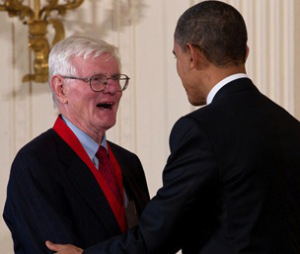 Gordon Wood riled up the #twitterstorians with a
  It is not often that historiographical essays have a hero. But, in Al Young’s essay, “American Historians Confront ‘The Transforming Hand of Revolution’,” it’s hard not to see J. Franklin Jameson that way. Jameson was a New Englander by birth and character who helped found the American Historical Association in 1884. Never a prolific historian (or teacher, for that matter), Jameson’s greatest impact—beyond the important structural role he played in the emergence of History as a modern academic and professional discipline in the United States—came in the form of a small collection of four lectures originally written in 1895 but published largely in the form they were given at Princeton 30 years later. That small book, The American Revolution Considered as a Social Movement, is not just the starting point for Young’s assessment of the historiography of the American Revolution in the twentieth century, it is quite literally its genesis.
  “By 1990,” wrote Daniel Rodgers, the concept of republicanism in American historiography “was everywhere and organizing everything, though perceptibly thinning out, like a nova entering its red giant phase.” A quarter of a century later, it can seem barely more than a dull glow—and in part, we have Rodgers’ essay to thank for dimming the lights. If republicanism’s 1970s high-water-mark was followed by a decade of furious debate over republicanism-versus-liberalism, scholarship after 1990 often framed itself as moving beyond precisely that anachronistic question. There was, apparently, no such conflict in the minds of revolutionary-era Americans. The problems that troubled them were different ones entirely.[1]
 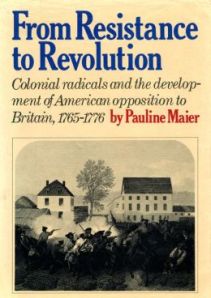 One of the things that set Pauline Maier apart was the exuberance she brought to the work of history. That joyful zeal is charmingly expressed in the metaphor she used to evoke the intellectual atmosphere in which she wrote her dissertation and first book, From Resistance to Revolution (1972).
 Was the purpose of the constitution to protect democracy from being ruined by the people or to protect commerce from being ruined by democracy? This was one of the questions put to Gordon Wood and Woody Holton in a debate held a few weeks ago at the University of South Carolina. A full video of the event has just been released on YouTube, and is embedded below. For anyone familiar with the work of these two historians, the debate will constitute a useful recap of the distinction between their two interpretations of the origins of the federal constitution. And for others, I hope it might be a kind of teaser for their excellent books!
  Happy Sunday! Let’s head straight to the weekly highlights.
  The Junto