 Another week comes to a close and, as usual, The Junto‘s got links…
Tag Archives: museums
Buy, Sell, Read

How did eighteenth-century print networks really operate? This week, The Junto asked Jordan Goffin, Special Collections Librarian at the Providence Public Library, how mapping Rhode Island’s early book trade led to the creation of a new digital atlas. Continue reading
The Week in Early American History
Here at The Junto, we’ve spent the last week with our noses buried in one really, really good book. But there’s been much afoot elsewhere, both on the web and beyond.
Colonial Adventures in England: The Benjamin Franklin House
 On a cold and wet May Friday in London, I decided to take refuge from the weather by stepping back into the eighteenth century. While serving as agent for the colony of Pennsylvania (and others), Benjamin Franklin lodged in a small dwelling on Craven Street, now just behind Charing Cross station and a short walk from Parliament. Though Franklin’s lodgings were originally misidentified (to the extent that a commemorative plaque was placed on the wrong house!), the original building still stands. Now the only surviving Franklin home in the world, the house is the home of the “Benjamin Franklin Historical Experience,” dedicated to telling the story of “the first American embassy.” Continue reading
Art & Soul
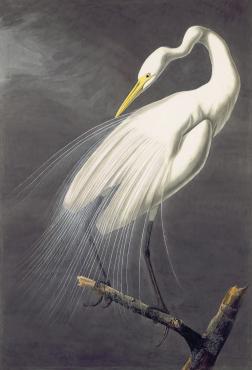
“Great Egret,” John James Audubon
I’ve always thought that John Adams knew the enduring value of a good museum trip, and the power of art to sharpen the mind while refreshing a work-weary soul. How else would he have known to share this insight with wife Abigail, written at just about this time in another May spring, that of 1780: “I must study Politicks and War that my sons may have liberty to study Mathematicks and Philosophy. My sons ought to study Mathematicks and Philosophy, Geography, natural History, Naval Architecture, navigation, Commerce and Agriculture, in order to give their Children a right to study Painting, Poetry, Musick, Architecture, Statuary, Tapestry and Porcelaine.” With those words in mind, here’s a quick survey of early American art currently on special exhibit throughout the country. Please share more links in the comments. Continue reading
Guest Post: Things Colloquial: Material Culture at the 2013 Conference of the Society of Early Americanists
Today’s guest poster, Zara Anishanslin, is Assistant Professor of History at the College of Staten Island/City University of New York. She received her PhD in the History of American Civilization at the University of Delaware in 2009, and from 2009-2010 was the Patrick Henry Postdoctoral Fellow in the Department of History at Johns Hopkins University. She’s at work on her first book, Embedded Empire: Hidden Histories of Labor, Landscape, and Luxury in the British Atlantic World (Yale University Press, forthcoming). Embedded Empire uses a single object—the portrait of a woman in a silk dress—and the four people who made it (the textile designer, the silk weaver, the colonial merchant’s wife, and the painter), to tell transatlantic material histories that challenge traditional narratives of emulative consumption. She also serves as Co-Chair of the Seminar in Early American History and Culture at Columbia University.
 Savannah is one of those southern cities where historic atmosphere and charm drape over everything like Spanish moss on live oaks. But amidst all this atmospheric charm, one of the sights I remember most was a distinctly uncharming thing: the desiccated body of a dead squirrel on a tray, tucked away in the attic of the Davenport House. I visited iconic Davenport House because it was the site of the Material Culture Colloquium at this year’s Society of Early Americanists’ conference. (For a report on the conference, see Rachel Herrmann’s blog post).
The Week in Early American History
Mail service was suspended in New England on Saturday (sadly, a possible harbinger of things to come), but a massive snowstorm (and the pain of shoveling) cannot stop the Junto’s week-in-review post.
It seems odd that the day is passing with relatively little fanfare, but today is actually the 250th anniversary of the Treaty of Paris ending the Seven Years’ War. A momentous occasion with enormous consequences (that were, as often happens, largely unforeseen at the time).
In any event, on with the links!
Early America, with a Brooklyn Accent
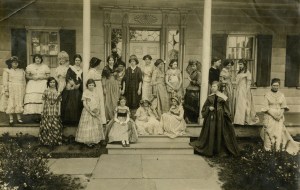
Last week, we asked how digital projects are transforming our study of early American life and culture. Here’s the first in a series of interviews with historians who tell us what worked, how digital tools shaped the narrative, and where they want to go next on the digital frontier. This week, we asked the Brooklyn Historical Society for a peek at the making of a special digital exhibit on the Lefferts family of New York. As Breuckelen becomes Brooklyn, readers can link to local sites where the Lefferts family lived and worked, including the Lefferts Historic Homestead in Prospect Park (shown here: Historical re-enactors gathering on the front steps in 1938). The Leffertses were influential landowners, politicians, historians, financiers—and also one of the county’s biggest slaveholding families. Their letters, farm accounts, and recipe books offer a new and very personal window on New York’s development.Our thanks to Jacob Nadal, the Director of Library and Archives, and Julie Golia, Public Historian and Curator, who kindly took our questions on bringing nearly four centuries of Brooklyn to digital life. Continue reading
Edutainment and the Boston Tea Party
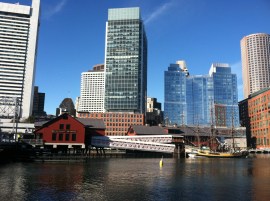
In recent years, the museum world has become inundated with edutainment sites and exhibits that hope to entice younger, more tech-savvy visitors, as well as people who do not tend to frequent museums, with all the bells and whistles of electronics and media. Videos, audio recordings, touch screens, and smart phone apps attempt to make history relevant to modern-day audiences by drawing them in with high-resolution graphics and multi-sensory experiences. At a time when funding for cultural institutions often takes a back seat, and when technology is everywhere and impossible to ignore, this push to increase revenue, visitation, and visitor interaction is unavoidable and understandable.
I recently ventured to the Boston Tea Party Museum—Historic Tours of America’s updated and expanded building (to the tune of $28 million) along the Boston waterfront, and one of the most extreme examples of edutainment that I’ve seen. My visit got me thinking about the ways in which history museums use technology and media to attract visitors, and the ways in which this technology can both clarify and obscure the historical information that is presented to the public. After touring the Boston Tea Party Museum I couldn’t help but wonder, when does a museum stop being a museum and become something else entirely? Continue reading
Then, Thenceforward, and Forever Free
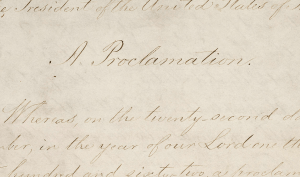 We can’t let 2013 begin without marking the 150th anniversary of the Emancipation Proclamation, which Abraham Lincoln issued on January 1, 1863.
Harold Holzer describes the anxiety many Americans felt on that day as they waited for confirmation of the act. Allen Guelzo weighs Lincoln’s legal options. Annette Gordon-Reed discusses the document’s significance. Eric Foner discusses what it did–and did not do. Continue reading
 The Junto