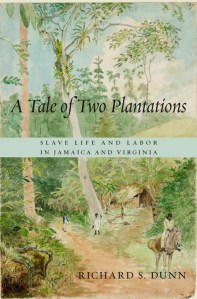
 Wrapping up our roundtable review of A Tale of Two Plantations, The Junto chats with Richard S. Dunn about microhistory as a “healthy antidote to top-down history,” and the archival surprises that reshaped his work. If you are near Harvard University on February 5th, come and hear more about the project. Continue reading
Tag Archives: Slavery
A Tale of the Classroom: Introducing Richard Dunn’s Book to Undergraduates
Richard Dunn has written a big book. Normally, big books like Dunn’s are primarily meant for fellow academics, grad students who need to pad their comps list, and the super-interested general public. (That category still exists, right? Right?) For academics, these types of books influence two aspects of our scholarly life: our own academic projects and our classroom instruction. The previous participants in the roundtable have focused on A Tale of Two Plantations’s contribution to the former category, while I would like to focus my remarks on the latter. So I am going to skip the basic parameters of a book review—namely, identifying the key arguments and weaknesses of the volume—and focus on how this book can work with undergraduate students. Continue reading
In Media Res
The most interesting thing about Richard Dunn’s “intergenerational study” of slave life in Mount Airy and Mesopotamia plantations of Virginia and Jamaica is its incompleteness. As Dunn notes, A Tale of Two Plantations is a narrative without “a proper opening or a proper conclusion.”[1] His source base begins relatively arbitrarily with a pair of masters who sought to improve their record keeping and ends with the institution of slavery itself. This is tragic, of course, for our knowledge of the lives of the enslaved persons of Mesopotamia and Mount Airy are circumscribed by the ability of whites to track them. In Jamaica, that proves troubling in freedom while in Virginia and Alabama, thanks to better census taking, the lives of the families of Mount Airy are much easier to recover. These sources, of course, mirror the experience of slavery itself.
Archives, Representativeness, and the Inner Life of Slaves
When Walter Johnson published Soul by Soul in 2001, he unleashed a critical analysis of the inner life of slavery.[1] More than just an exploration of the plantation complex, or even the indignities and tragedies of slavery, Johnson elucidated how the buying and selling of black bodies affected (in Johnson’s argument, corrupted) the participants in slavery. Johnson had identified a critical hole in the historiography. And now, Richard S. Dunn’s newest contribution to the scholarly discourse, A Tale of Two Plantations, compares life at two plantations—Mt. Airy (MD) and Mesopotamia (Jamaica)—to understand how slavery affected these two plantations, and conversely, how conditions on these plantations affected the enslaved.
Roundtable: Richard S. Dunn, A Tale of Two Plantations
This week The Junto is dedicated to a roundtable review of Richard S. Dunn’s A Tale of Two Plantations: Slave Life and Labor in Jamaica and Virginia (Cambridge: Harvard University Press, 2014). Professor Emeritus at the University of Pennsylvania, Dunn’s previous publications include one of the seminal texts on Caribbean slavery and sugar plantation agriculture, Sugar and Slaves: The Rise of the Planter Class in the English West Indies, 1624-1713 (Chapel Hill: University of North Carolina Press, 1972). Dunn’s newest book is an unflinching study of Afro-Caribbean and antebellum U.S. slavery in the final decades of both systems. Continue reading
Reviewing Digital History
 Today, The Junto interviews Dr. Jeffrey W. McClurken, Professor of History and American Studies & Special Assistant to the Provost for Teaching, Technology, and Innovation at University of Mary Washington. McClurken (Ph.D., John Hopkins University, 2003) is Contributing Editor for Digital History Reviews, Journal of American History. Continue reading
The Week in Early American History
 On to the links! Continue reading
Deadline approaching for Cannibalism in the Early Modern Atlantic
 Do you like cannibalism? As a topic, obviously, not a personal preference. Of course you do! If research travels will take you to England this summer (or if you reside in the UK or nearby), please consider submitting a proposal for a conference I’m organizing at the University of Southampton this June. Continue reading
The Junto Guide to Early America at #AHA2015
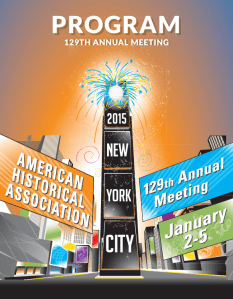 Happy New Year from all of us at The Junto! We hope you had a restful and enjoyable holiday break. For historians, the turn of the calendar to 2015 means that many of us are en route to the AHA Annual Meeting in New York City. Having grown up in the area, I’d like to welcome you all to New York, where the bagels and pizza are really just better, and we stand “on line” for coffee, not “in line.”
The Spy Who Came in from the Confederacy
![1862_LON_14_1862_NPL_P385[SVC1]](https://earlyamericanists.com/wp-content/uploads/2014/12/1862_lon_14_1862_npl_p385svc1.jpg?w=550) He was, at first, another young shadow hurrying through Westminster Hall. He carried flimsier credentials than most, papers hastily sent by a new nation called the Confederate States of America. It was November 1862, and, since spring, he had stretched expenses to accommodate the bare $750 granted to fund his secretive mission. Still, regular sightings of the worn, 29 year-old Swiss-American stranger, who had shipped to London via the fiery newsrooms of Richmond and Mobile, caused a flutter of concern among British peers. Within weeks, the constant American shadow near Parliament became a very real worry. “He is but a private gentleman, it is true,” one M.P. fretted, “yet he may leave his card at the Foreign Office, and possibly find his way upstairs.” Continue reading
He was, at first, another young shadow hurrying through Westminster Hall. He carried flimsier credentials than most, papers hastily sent by a new nation called the Confederate States of America. It was November 1862, and, since spring, he had stretched expenses to accommodate the bare $750 granted to fund his secretive mission. Still, regular sightings of the worn, 29 year-old Swiss-American stranger, who had shipped to London via the fiery newsrooms of Richmond and Mobile, caused a flutter of concern among British peers. Within weeks, the constant American shadow near Parliament became a very real worry. “He is but a private gentleman, it is true,” one M.P. fretted, “yet he may leave his card at the Foreign Office, and possibly find his way upstairs.” Continue reading
 The Junto