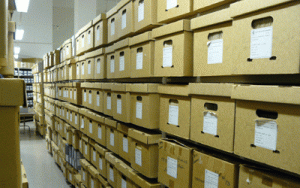
 As funding budgets shrink, many historians face increased pressure to make the most of their time in distant archives. For a number of years now, a lot of researchers have favored a good digital camera, which (theoretically) allows for a faster gathering of primary source materials than traditional note-taking methods. Of course, as historian Larry Cebula humorously observed, failure to exercise good digital stewardship with your own personal archives can have disastrous consequences.
Category Archives: Academia
Seriously, though, was the American Revolution a Civil War?
 On February 18, 2014, Tom Cutterham asked, “Was the American Revolution a Civil War?” According to Cutterham, understanding the Revolution that way might be useful. If we did, he suggested, “we’d better understand the way the modern world—the nexus of state, citizen, and property—was born in and determined by violence.”[1] Continue reading
The Week in Early American History
 Welcome to another edition of This Week in American History. It has been a busy, yet troubling two weeks.
We would like to begin by offering our condolences to the family, friends, and colleagues of Christopher Schmidt-Nowara, of Tufts University. Dr. Schmidt-Nowara died suddenly in Paris on June 27th. Continue reading
Guest Post: On Publishing Journal Articles
Update: The Junto is sorry to report that C. Dallett Hemphill passed away on Friday, 3 July, after a brief illness. Hemphill received her BA from Princeton, and her PhD in American Civilization from Brandeis University. Through her own scholarly work, contributions to the McNeil Center for Early American Studies, and her position as Editor of Early American Studies, she was a big supporter of junior scholars. She is remembered both for her contributions to the field and profession and as a warm and generous scholar. This was her recent guest post for The Junto, in which she offered advice to junior scholars on publishing journal articles.
Guest Poster C. Dallett Hemphill is Professor of History at Ursinus College. She is also Editor of Early American Studies, which is published by the University of Pennsylvania Press for the McNeil Center for Early American Studies.
 I’m grateful to The Junto blog for inviting me to discuss how to publish a journal article. Although the views that follow are my own and the details of the process vary somewhat from journal to journal, I know from conversations with other editors that there is consensus on the essentials.
The Early American Digital World
This post builds on the conversation begun by Joseph Adelman’s post on early American history blogging the other day, and a panel on the topic at the OIEAHC/SEA conference yesterday. A version of these remarks were delivered at a panel entitled, “Early American Worlds: A State-of-the-Field Conversation” at the 2015 Organization of American Historians Annual Meeting on April 17, 2015 in St. Louis, MO.
 For longer than I’ve been alive, our field in a structural sense has been organized through the efforts of the main institutions in the field, i.e., the Omohundro Institute of Early American History and Culture and, later, the McNeil Center for Early American Studies and the Society for Historians of the Early American Republic. From fellowships to seminars to conferences, these institutions gave to the field the significant sense of community it had. And I would argue that the new early American “digital world” is not changing that but expanding upon (or around) it. Social media and blogs are adding an additional layer of social infrastructure within the field itself, creating spaces that foster an even broader and more inclusive sense of community in the field, largely through the ability to include people who for whatever reason don’t have access to or are outside the immediate orbit of those institutions and the field’s traditional channels of community-building. Continue reading
The Week in Early American History
Welcome to another addition of The Week in Early American History! Continue reading
Guest Post: Writing the Book Proposal
Today’s guest poster, Craig W. Gill, is the Editor-in-Chief and Assistant Director of the University Press of Mississippi. He has worked at the Press for more than 17 years and has served in publishing for almost 25 years. He acquires primarily in American history, Southern history, Caribbean history, folklore, and music, as well as regional books on Mississippi, Louisiana, and the Gulf South.
 Almost all university presses prefer to first receive a proposal from a potential author, rather than a full manuscript. Alas, no editor anywhere has the time to read the huge number of manuscripts that come our way, and the situation would be even worse if we attempted to read manuscripts from every potential author seeking a publisher. This makes the proposal an ideal introduction to a topic and a crucial step in the process towards publication. Although an author may have chatted with an editor prior to submitting a proposal (if not then I urge you to get to an academic conference and chat up editors in the exhibit hall), the proposal is the first formal representation of a book project from the author to the publisher. Continue reading
Guest Post: William Black, Gordon Wood’s Notecards and the Two Presentisms
Today we are pleased to have a guest post from William R. Black (@w_r_black), a PhD student of history at Rice University. His research examines how Cumberland Presbyterians dealt with slavery, sectionalism, theological controversy, and professionalization in the nineteenth century.
 Gordon Wood riled up the #twitterstorians with a review of his advisor Bernard Bailyn’s latest book, Sometimes an Art: Nine Essays on History. Much of the review is not so much about Bailyn as it is about later generations of historians, who (according to Wood) have abandoned narrative history for “fragmentary,” obscure monographs on subaltern peoples. Wood attacks these historians for being “anachronistic—condemning the past for not being more like the present.” He continues: Continue reading
Guest Post: Barton Price on Academic Support in the Survey Course
Today’s guest post comes from Barton Price. Barton is the Director of the Centers for Academic Success and Achievement at Indiana University – Purdue University Fort Wayne (IPFW). He has taught courses in American history, religious studies, and history of rock and roll at IPFW. Price has a Ph.D. in American religious history from Florida State University. His research interests vary from religion in the American heartland to the scholarship of teaching and learning in religious studies and history. Here he offers some thoughts on teaching the U.S. History survey course gleaned from his administrative experience in an academic support center.
 The start of another semester is upon us. It is a new opportunity to teach students about America’s past, to correct longstanding inaccurate assumptions about that past, and to introduce students to the ways of thinking like a historian. It is also an opportunity to foster student academic success. The introductory survey course is a venue for such accomplishments. Continue reading
The Week in Early American History
Happy 2015 to our Junto readers! Continue reading
 The Junto