 Since it was founded back in December of 2012, The Junto has had a powerfully transformative—indeed, a creatively disruptive—effect on the early American blogosphere. But lately, we’ve started to wonder, why stop there? Continue reading
Category Archives: Public History
Audiences, Publicity, and Engaged Academics

Town crier, Provincetown, Cape Cod, Mass., courtesy Boston Public Library
Let me start by asking a question: how many people think that a producer, reporter, or intern for CNN, NBC, or any other news organization actually reads full articles in Nature, Science, or the New England Journal of Medicine to find out about the latest scientific and medical breakthroughs for their news reporting?
Yeah, me neither. So what’s really going on when journalists spend two weeks suggesting that journal articles are out of touch and inaccessible? And if there’s a kernel of truth to the claim, is there anything we as scholars can do to address the concern?
Art in Bloom
 Groundhog shadow or no, warmer days lie ahead (really). Here’s a roundup of early American art to check out (indoors) in the coming months. Continue reading
Godly Heritage and Plantation Chic: The Case of Vision Forum
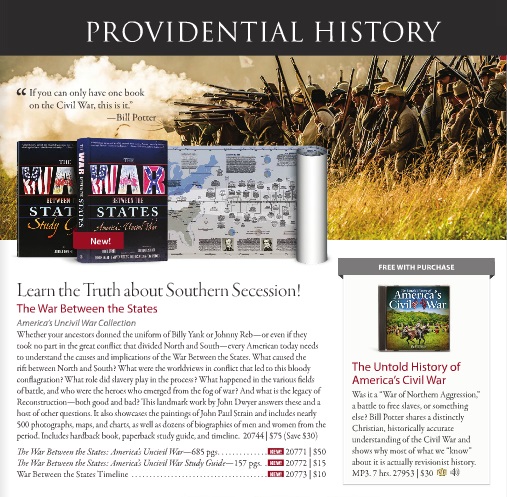 A recent news story has me thinking about the weird enduring appeal of the Lost Cause. It seems to me that this news story about a contemporary religious organization might lead us into an interesting case study. Why, at this late date, do so many Americans still want to see the antebellum South as a tragically vanished world of nobility and grace?
Most early Americanists are familiar with David Barton, a conservative activist who argues that the United States was founded as a Christian nation. He’s been mentioned here several times as the most visible proponent of a view that’s common among members of the “Religious Right.”[1] What’s less widely understood is how often his Christian-founding ideology overlaps with a claim advanced by a few other evangelical conservatives: that the Confederacy—and antebellum southern culture, if not slavery itself—are also part of “America’s Godly heritage.”[2] In these circles, in other words, the Founding is sometimes wrapped up with the Old South.
Wood & Holton on the Constitution
 Was the purpose of the constitution to protect democracy from being ruined by the people or to protect commerce from being ruined by democracy? This was one of the questions put to Gordon Wood and Woody Holton in a debate held a few weeks ago at the University of South Carolina. A full video of the event has just been released on YouTube, and is embedded below. For anyone familiar with the work of these two historians, the debate will constitute a useful recap of the distinction between their two interpretations of the origins of the federal constitution. And for others, I hope it might be a kind of teaser for their excellent books! Continue reading
Guest Post: A New Forum Dedicated to the Study of the Dorr Rebellion and Constitutional Reform in Rhode Island
We at The Junto are thrilled to host this guest post from Erik J. Chaput and Russell J. DeSimone, who are the historians-in-residence on the Dorr Rebellion Project Site sponsored by Providence College. Chaput is the author of The People’s Martyr: Thomas Wilson Dorr and His 1842 Rhode Island Rebellion (University Press of Kansas, 2013). DeSimone is the author of Rhode Island’s Rebellion (Bartlett Press, 2009). Chaput and DeSimone have collaborated on a number of projects, including this article on Common-place.org. Chaput and DeSimone welcome feedback on the site. They can be contacted at: echaput@providence.edu and russbook1@cox.net.
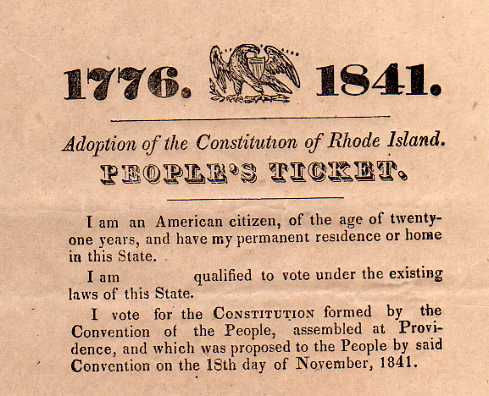
The “People’s Ticket,” with a direct reference to 1776, served as a connection between the American and Dorr Rebellions.
When Rhode Island finally ratified the U.S. Constitution in May 1790, the state sent back to Congress eighteen amendments. These amendments revealed a deep suspicion of the new central establishment, a suspicion that had been increased by the failure to include a bill of rights. The first line of the lengthy third amendment declared that “the powers of government may be reassumed by the people, whensoever it shall become necessary to their happiness.” Continue reading
When Was the Last Time You Loved America?
Few issues trouble historians of all stripes more than the disconnect between “popular” and “academic” history. Somewhere in the mists of the recent past the Age of Hofstadter gave way to, at best, the Age of McCulloch and, at worst, the Age of Barton.[1] The waning influence of professional historians in the public sphere particularly troubles the historical blogosphere. The popular-academic history disconnect is something addressed a lot here at The Junto, including with a podcast.
I am, as I said on the JuntoCast episode, particular dour about the possibility of bridging this gap. Academic historians, public historians, and interested members of the public more often than not talk past each other. How each group defines “good” or “useful” history is often so at cross-purposes that it sounds like one side is speaking English, another French, and another Dothraki.[2] My attention was recently drawn to a series of posts by Peter Feinman at New York History, which deeply entrenched my Eeyore-like-sullenness when it comes to these questions. Continue reading
Collecting Delaware
T his week, Chief Curator Constance Cooper shares what’s next for the past at the Delaware Historical Society. Continue reading
Buy, Sell, Read

How did eighteenth-century print networks really operate? This week, The Junto asked Jordan Goffin, Special Collections Librarian at the Providence Public Library, how mapping Rhode Island’s early book trade led to the creation of a new digital atlas. Continue reading
Guest Post: Thomas Mundy Peterson and the Fifteenth Amendment
Gordon Bond is an independent historian/researcher. He has written an excellent biography of the colonial New York printer, James Parker, entitled James Parker: A Printer on the Eve of Revolution. He is also the author of Hidden History of South Jersey (2013) and North Jersey Legacies (2012). Currently, he is the Founder, Editor-in-Chief & Director of Garden State Legacies .

While a rejection is nothing any writer wants, sometimes it is what we need. Such was the case with my proposals to publishers for a book about Thomas Mundy Peterson. If you’ve heard of Peterson before, chances are it will be for the Wikipedia reason; in 1870, he became the first African-American to vote under the auspices of the Fifteenth Amendment to the United States Constitution. He was, of course, more than that moment.
 The Junto