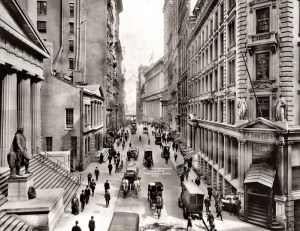
 Seth Rockman begins and ends his recent essay on the “new history of capitalism” by describing capitalism as an economic system; but one of the features of the movement he describes is that it rightly treats capitalism as much more than that. As Rockman admits, “it is difficult to say what exactly it excludes.”[1] What’s most provocative and powerful about the new history of capitalism is precisely the fact that it recognizes and tries to historicize the pervasiveness of capitalism as a system that touches every aspect of our lives—everyone’s lives. Capitalism isn’t just in the workplace and the marketplace; as Jeffrey Sklansky has suggested, it’s in our very ways of being, seeing, and believing. But if the history of capitalism is an empire with no borders, just what kind of claims can it be making?[2] Continue reading
Category Archives: Recent Scholarship
Review: Maura D’Amore, Suburban Plots: Men at Home in Nineteenth-Century American Print Culture
Maura D’Amore, Suburban Plots: Men at Home in Nineteenth-Century American Print Culture. Amherst: University of Massachusetts Press, 2014.
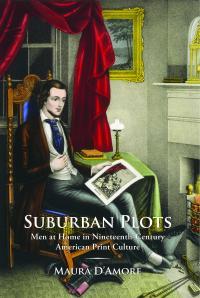 The world was a strange and startling place for Rip Van Winkle when he awoke from a twenty-year nap in New York’s Catskill Mountains. He had ventured to the woods to find a moment’s peace from “the labour of the farm and the clamour of his wife.”[1] Now well rested, bountifully bearded, and slightly disoriented, Van Winkle returned to his village anxious to understand the changes that left him “alone in the world,” but pleased that he was now part of a “more fraternal, organic domestic order.”[2] In the time since his fateful game of ninepins mixed with moonshine, Van Winkle, along with his male village compatriots, was now free to exercise his own masculine alternatives to traditionally female forms of domesticity. Maura D’Amore opens her book Suburban Plots: Men at Home in Nineteenth-Century American Print Culture with this unconventional reading of Washington Irving’s well-known tale. Seeking to understand the emergence of what she terms “male domesticity” in the nineteenth century—defined (somewhat inconsistently) as an ideology of “self-nurture in suburban environments [that provided] an antidote to the malaise of urban life and the strictures of feminine self-sacrifice”—D’Amore presents Rip Van Winkle as a prototype of various middle- and upper-class men who attempted to implement domesticity “on [their] own terms” in the midst of a quickly industrializing and alien world.[3] Continue reading
The OId World of the New Republic
As someone who works on the late colonial period (1730s-1770s) in a field dominated by the “early republic,” it is easy to feel as though I am working on the margins of the field of early American history rather than what is actually the middle or center of what we usually define as early America (i.e., 1607 to somewhere between 1848 and 1861).[1] Yet, in this brief, speculative post, I will suggest that—in terms of my own subfield of political history and political culture—one of the things missing from much of the scholarship on the early republic is the colonial period itself. Continue reading
Interview: Andrew Jackson O’Shaughnessy
 Andrew O’Shaughnessy is the Saunders Director of the Robert H. Smith International Center for Jefferson Studies at Monticello, and a Professor of History at the University of Virginia. His recent book, The Men Who Lost America: British Leadership, the American Revolution, and the Fate of the Empire, won this year’s George Washington Book Prize and several other awards. Tom Cutterham spoke to him for The Junto.
Continue reading
How Did Democracy Become a Good Thing?
 I spent yesterday afternoon at “a celebration and critical evaluation” of the work of political theorist and historian Mark Philp. My role was to talk about his involvement in a big, ongoing project being done here at Oxford—and around the world—called Re-imagining Democracy. That project has already produced one book, Re-imagining Democracy in the Age of Revolutions: America, France, Britain, Ireland 1750-1850 (OUP, 2013), with contributions on the early American republic by Seth Cotlar, Adam I. P. Smith, and Laura Edwards. It’s a book that may not yet be well known among American historians, but it should be, because the question it’s trying to answer is a very interesting and difficult one: how did “democracy” go from something feared and reviled even as late as the 1780s, to something very different by the mid-nineteenth century, and even to become the quintessential value of American politics that we know today? Continue reading
Looking for “a World of Love”: Jonathan Edwards in the Big City
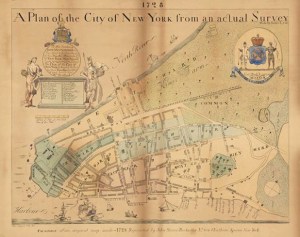 Jonathan Edwards is so strongly identified with Connecticut and Massachusetts that it’s easy to overlook where his pastoral ministry began: near the waterfront of New York City. In 1722, Edwards took a temporary position as the minister to a small Presbyterian congregation in Manhattan. He was about nineteen years old.
Edwards’s months in New York shaped him in at least two ways. First, according to his own account, Edwards developed a stronger desire for personal holiness. In New York, he wished increasingly to be “in everything a complete Christian.” Second, he grew in missionary zeal. Holding long religious conversations with his host family (who were immigrants from England) and observing life in the Atlantic port, he came to a more global awareness of the faith. He put it this way:
Review: The Larder: Food Studies Methods from the American South
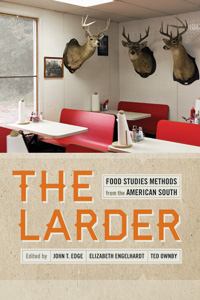 In his concluding remarks to The Larder: Food Studies Methods from the American South, Ted Ownby hopes it “likely that this book will be one of the last collections of academic essays in which any scholars feel the need to explain or defend their choice of foodways as a topic” (363). Ownby and co-editors John T. Edge and Elizabeth Engelhardt have done as much as they can to realize this aspiration; their collection of essays is timely and scholarly rigorous. By assembling a group of scholars who concentrate “not on food but on foodways”—which comprise the production, preparation, or consumption of food—the editors have delved into questions about food studies and southern studies that bridge boundaries between different disciplines and historical time periods (364). Continue reading
Q&A with Edward E. Andrews, Author of Native Apostles
 The following is an interview with Ted Andrews, an assistant professor of history at Providence College in Rhode Island. Yesterday, Christopher Jones reviewed his book, Native Apostles: Black and Indian Missionaries in the British Atlantic World (Cambridge: Harvard University Press, 2013), and now Ted is speaking with The Junto about the process of writing it. Ted teaches early American, Atlantic, and Native American history, and he was recently awarded a grant from the National Endowment for the Humanities to explore his next project on global missionary connections among early modern Protestants. Native Apostles is his first book.
Continue reading
Review: Native Apostles: Black and Indian Missionaries in the British Atlantic World
Edward E. Andrews, Native Apostles: Black and Indian Missionaries in the British Atlantic World. Cambridge: Harvard University Press, 2013.
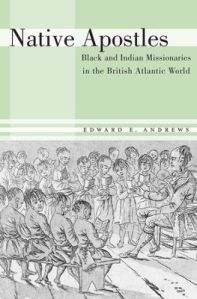 On the eve of the American Revolution, an unlikely band of ministers and benefactors devised a plan to send John Quamine, a free black man, and Bristol Yamma, a slave, as missionaries to Africa. The project was conceived by the two would-be missionaries themselves, and supported by controversial Congregationalist minister Samuel Hopkins and his more moderate colleague Ezra Stiles. In 1774, Stiles and Hopkins arranged for the duo to be sent to the College of New Jersey, where Presbyterian minister (and president of the College) John Witherspoon would train them. Their proposed mission gained some notoriety, and a diverse lot of supporters championed their cause, including Quaker abolitionist Anthony Benezet, New Jersey lawyer and politician Elias Boudinot, Scottish theologian John Erskine the noted black poet Phyllis Wheatley, Eleazar Wheelock and his Mohegan pupil-turned-preacher Samson Occum, and black Anglican missionary to Africa Phillip Quaque (though his endorsement came with serious reservations). The outbreak of war in 1775 and the subsequent death of Quamine in 1779 ultimately thwarted the planned mission. In spite of its failure, though, it remains an important but oft-ignored episode in what Edward E. Andrews calls “the tangled history of cultural encounter between Europe, Africa, and the Americas” (188). Continue reading
Thomas Jefferson’s Qur’an: Islam and the Founders
 I hope that Thomas Jefferson’s Qur’an: Islam and the Founders (New York: A. A. Knopf, 2013) gets picked up for a Fox News segment. Denise A. Spellberg (UT-Austin) has synthesized a large body of scholarship into a readable, teachable, and thoughtful look at the significance of Islam in the American founding era. Conservatives pounced on Spellberg during a dust-up over a novel about Muhammad’s wife a few years ago, and in this book she suggests both that the Founders were occasionally wrong and that some of them believed Islam could have its place in the American polity. So it seems possible to hope that the usual suspects will take notice. She deserves the publicity. Continue reading
 The Junto