 Today, we chat about making digital history with Lauren Klein, Assistant Professor in the School of Literature, Media, and Communication at the Georgia Institute of Technology. Her writing has appeared in Early American Literature and American Quarterly, with a piece forthcoming in 2014 in American Literature. She is currently at work on two book projects: the first on the relationship between eating and aesthetics in the early republic, and a second that provides a cultural history of data visualization from the eighteenth century to the present. Continue reading
Category Archives: Technology
One Year Older and Wiser, Too…: The Junto Turns “1”
A year ago today, I introduced the world to The Junto.
For those who care, chocolate is the official Junto birthday cake flavor. Duh.
Since then, my admittedly lofty goals of success have been dramatically achieved by our cast of bloggers. I aimed to gather some of the brightest young minds in the field, and I have been pleased with the consistent quality and quantity of posts throughout the year. We have had posts nearly every weekday, along with our popular “This Week in Early American History” roundup every Sunday, which totaled 292 posts for the year. It would be impossible and unfair to highlight the “best” posts because there have been so many quality posts that, quite frankly, probably belong in a more professional setting than a blog. Some of our most popular include Michael Hattem’s overview of Assassin’s Creed III (thanks, Reddit!), the multi-author roundtable on Walter Johnson’s River of Dark Dreams, Rachel Herrmann’s response to new(!) cannibalism developments, and Matt Karp’s reviews of Django Unchained and Twelve Years a Slave. And our academia-related posts have also been highly popular, as the response to posts on digital workflow and creating a CV attest. And who can forget our epic March Madness Tournament? Indeed, the quality of the content is reflected in the fact that The Junto has been featured in the American Historical Association’s “What We’re Reading” seven times. Continue reading
Research in Timelines
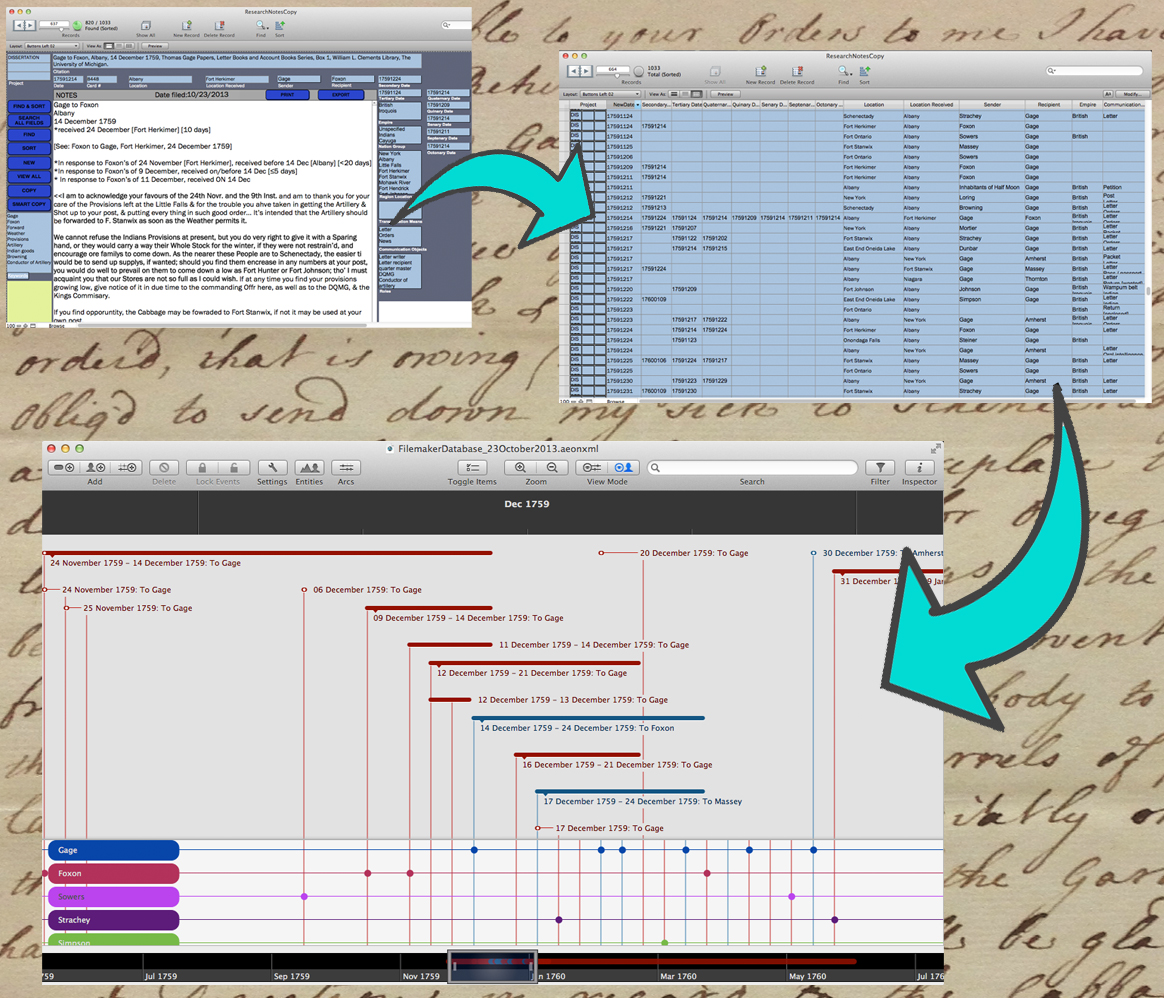 Methodology and note-taking have been popular topics at The Junto, opinions and preferences ranging from Rachel Herrmann’s defense of good-olde-fashioned index cards, to Michael Hattem’s detailed tour of his digital workflow. I’d like to throw my hat into the ring and suggest yet another tool: timeline software.
I’m a visual person, and while a table is technically a “visual,” nothing makes me happier than seeing those rows and columns transform into something a bit more appealing.
Minor admission: I’m years late to the timeline game. But since I began using chronology software this summer—having finally leaped into the archives with little more than a macbook and a dream—my master timeline has become my best friend, my go-to reference guide. Why? Because timelines gives me easy access to, and visualization of, each and every who, what, where, and when of my project. And then some. It’s my very own personalized tool to quickly know (or estimate) where any individual or object in my project is at a given time.
Guest Post: Rediscovering the Pamphlisphere
Today’s guest poster is Ariel Ron, who earned his PhD in history at the University of California, Berkeley, and is currently a visiting research associate at the McNeil Center for Early American Studies.
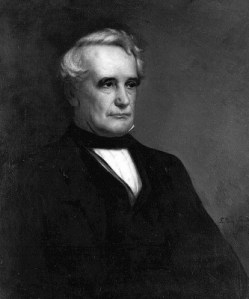
Three or four years ago, while doing research at the University of Pennsylvania’s Rare Book & Manuscript Library, I stumbled upon a lost cache of some ten-thousand pamphlets. I had been browsing the papers of Stephen Colwell, a nineteenth-century ironmaster and writer, when archivist John Pollack called me into the closed stacks behind the reading room. There he showed me Colwell’s personal pamphlet library, neatly bound into hundreds of volumes. The collection also included three thousand works from the library of Colwell’s friend, Henry C. Carey (see picture to right), without question the most important American political economist of the mid-nineteenth century. The sheer size of the corpus floored me. Continue reading
Buy, Sell, Read

How did eighteenth-century print networks really operate? This week, The Junto asked Jordan Goffin, Special Collections Librarian at the Providence Public Library, how mapping Rhode Island’s early book trade led to the creation of a new digital atlas. Continue reading
Digital Workflow for Historians
So much has changed in the last few decades, particularly in terms of digitization, in the ways historians access materials, the level and ease of access to those materials, and the methods of delivery for the work that comes from that access. But access is not the only thing that has changed. Working in the digital realm offers historians new tools with which to approach their task, the core of which remains unaffected by these developments. On that theme, I thought I would talk a little bit about my workflow and the tools that I use which allow the work to flow (sorry, couldn’t help myself). Continue reading
Promised Land
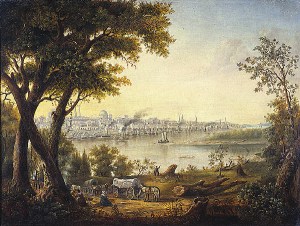
“Saint Louis in 1846”
Henry Lewis
This week, The Junto spoke with Lea VanderVelde, the Josephine R. Witte Professor of Law at the University of Iowa College of Law, a Guggenheim Fellow in Constitutional Studies, and principal investigator of the Law of the Antebellum Frontier project, which “seeks to digitally analyze the legal and economic mechanisms at work on the American frontier in the early 1800s.” She kindly took our questions on her work-in-progress, and why digital research transforms the early American legal history of how the West was run. Continue reading
Democratizing Pedagogy: The Just Teach One Project

Last week when the Junto hosted the History Carnival we noted the creation of the “Just Teach One” project, co-sponsored by the American Antiquarian Society and Common-place. Today we’d like to take a closer look at what promises to be an exciting addition to thinking about how to teach early American studies (for both literary scholars and historians).
Twitter as an Agent of Change
“It’s only about what people eat for breakfast.”
“It caused the Arab Spring, you know.”
“It’s nothing but Justin Bieber fans writing gobbledygook.”
“I saw someone do a wonderful live-tweet of a conference last week.”
“I hate when people livetweet conferences.”
What good is Twitter, anyway? And why should you use it? Inspired by the defense of academic blogging offered in this space last month by Ken Owen, I want to offer a few thoughts on using Twitter as a professional historian. Over the past few months, I’ve had several discussions, both in-person and online, in which I’ve been called on to defend Twitter (it seems that others see me as either an effective or at least irrepressible user). After over three years on the service (@jmadelman, if you’re curious), I’ve certainly developed a theory of Twitter for myself. I would not offer it as universal, but I do think it’s important to highlight what’s good about it, and perhaps one or two things that I don’t like.
The Future of the Past Is Now: Digital Humanities Resource Guide
Inspired by the work of colleagues @ the new Digital Public Library of America and others we’ve interviewed here at The Junto, here are some bookmark-worthy links to what’s going on in the ever-evolving field of the digital humanities. We’ll update this list as projects develop, so if you’re working on a digital history initiative, please let us know so we can add it to the Resources page.
If you use new media in the classroom, how effective do you find it to be in communicating historical content/class themes? Please share your views on digital pedagogy in the comments. Continue reading
 The Junto