An Indian Chintz Gown: Slavery and Fashion

Today’s #ColonialCouture post is by Jennifer Van Horn, assistant professor of art history and history at the University of Delaware. She specializes in the fields of early American art and material culture, and she is the author of   The Power of Objects in Eighteenth-Century British America.
VH1

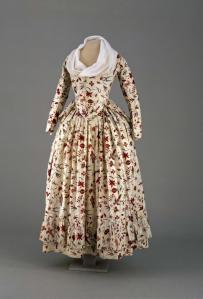
Figure 1. Woman’s Jacket and Petticoat worn by Ann Van Rensselaer, c. 1790. Albany, NY. Textile: India. Cotton chintz, mordant painted and dyed; tabby linen bodice and sleeve linings. The Colonial Williamsburg Foundation. Gift of Mrs. Cora Ginsburg.
Acc. No. 1990-10,1.

Walking down the street in Alexandria, Virginia, in 1786, a white woman spotted a gown that had been stolen from her two years before on the body of an enslaved woman. The gown was a fashionable one: an “Indian Chintz, white Ground, with Stripes and Figures of different Sorts of red, if not other Colours.” It might have resembled the chintz jacket and petticoat worn by Ann Van Rensselaer in New York about 1790 (fig 1), or the more delicately-patterned robe à l’anglaise donned by an unknown American woman around the same time (fig 2). Indian chintz—a light-weight cotton fabric painted or dyed with intricate organic designs and manufactured in India—was popular throughout the Atlantic world for clothing, bed hangings, and upholstery.[1]

The chintz gown’s original owner, Mrs. MacIver, was the wife of an Alexandria ferry owner. She claimed that a white seamstress, to whom she gave “a Night’s Quarters” after hearing “a Tale of feigned Distress,” stole the garment along with two other “elegant, well trimm’d Gowns.” The seamstress sold the Indian chintz to a “Negro of Dr Stewart’s,” who then “sold it to a Negroe Woman belonging to” George Washington. Mrs. MacIver discovered which enslaved woman—Charlotte—when she saw her strolling in Alexandria. Charlotte, then in her early to mid-twenties, was a seamstress for Martha Washington at Mount Vernon.[2] Continue reading
Creole Comforts and French Connections: A Case Study in Caribbean Dress

Today’s #ColonialCouture post is by Philippe Halbert. Follow him @plbhalbert.

1

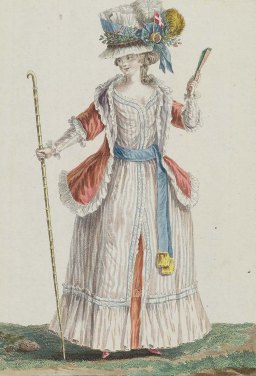
“Vêtement dit à la creole,” Galerie des modes et costumes français, Charles Emmanuel Patas after Pierre Thomas Leclerc, 1779, Museum of Fine Arts, Boston

In 1779, a fashion plate depicting a woman’s garment “in the creole style” was published in Paris. Consisting of a lightweight muslin gown with wrist-length sleeves, the dress was “in the style of a chemise,” the basic female undergarment of the period.[1] Worn over a petticoat, the gown was to be pinned at the bust and loosely closed with a sash or belt. In addition to enumerating its various components, which included a separate caraco jacket, the engraving’s caption remarked that the fantastic ensemble was “of the sort worn by our French Ladies in America.” At the end of the Seven Years’ War in 1763, French colonial possessions in the Americas were largely confined to the Caribbean Basin, a region where interactions between people of indigenous, European, and African descent brought about innovations in everything from architecture to foodways. Although the inhabitants of French-controlled islands like Guadeloupe, Martinique, and Saint-Domingue, or Haiti, were not beyond the reach of Parisian novelty, the heat and humidity necessitated certain sartorial adaptations. Continue reading

“We Are One”: The Confinement and Consent of Colonial American Busks

Busk Photo 1_

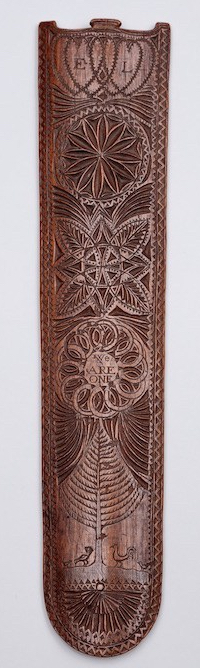
A busk for a woman’s stays, wood, American-made in Canada, 1782. Photo courtesy of the Museum of the American Revolution.


Welcome to #ColonialCouture, our second annual roundtable on fashion in early America and material culture in the Atlantic World, which will run here for the next two weeks.

Today’s post is by Cynthia Chin, a doctoral student at Georgetown University who is researching eighteenth-century material culture, with a particular focus on what Martha Washington’s surviving extant gowns tell us about her, and the world in which she lived. Follow her @cynthiawriter.

Off with that happy busk, which I envy…” John Donne, To His Mistress Going to Bed

While Fashion Week Fall 2018 finds iconic designer John Galliano (ironically, and not so ironically) “liberating men with corsets[1] – the women of eighteenth-century British America were confined and complexly bound by stays and busks. Women during this period wore stays[2], often with a busk inserted inside. A busk is a flat, stiff, oblong object, and in eighteenth-century British America, most frequently carved from wood.[3] Providing additional structure and shaping to a pair of stays, a busk would be slipped inside a vertical channel in the stay’s center-front.[4] The wearing of a busk ensured that a woman achieved the fashionable (and socially prescribed) straight, flat, conical, enlongated torso that dominated the female aesthetic in the long eighteenth century. Continue reading

Guest Post: Elizabeth Seton and Me: Or, How I Almost Wrote a Book about a Saint Without Mentioning God

Today’s guest post is authored by Catherine O’Donnell. Her book, Elizabeth Seton: American Saint was published this month by Cornell University Press. She is also the author of Men of Letters in the Early Republic (UNC Press, 2008) and is an associate professor of history at Arizona State University.
When I arrived at the archive in Emmitsburg, Maryland, my heart sank. My subject was Elizabeth Seton, woman of the early American republic and saint in the Roman Catholic Church, and the archives to which I’d traveled are held on the grounds of her shrine. In order to be at the archives first thing Monday, I’d arrived on a Sunday and decided to see what was happening nearby. The building adjacent to the archives is a minor basilica, so what was happening was Mass. When a guide asked whether I’d visited the Altar of Relics, I winced. I felt oddly guilty about bring my historian’s purposes and questions into this reverent world. I also knew that biographers pride themselves on not writing hagiographies, and that many academic historians pride themselves on not being biographers at all. I felt I was blaspheming both a faith and a profession. Continue reading

Why We Will Not Go

How and why does a group in a society feel affection for the society they live in, despite the constant abuses faced by them? A great case study to help answer the question is through the anti-slavery movement. Boston abolitionist intellectual Maria Stewart, after the loss of both her husband, James Stewart and intellectual mentor, abolitionist David Walker in 1830, refocused her life on Jesus and fighting for her race. From that foundation, she met and collaborated with  upstart white abolitionist newspaper editor William Lloyd Garrison of The Liberator. Garrison was a major influence on Stewart’s public career because Garrison promoted Stewart as a voice of her people, and the Liberator offered her room to publicly debate the best policies for her race’s future. In one of Stewart’s published writings in the Liberator, she wrote about death to the body of the enslaved, that would also free the soul. “The blood of her murdered ones cries to heaven for vengeance against thee. Thou art almost drunken with the blood of her slain.[1]” The plunder of black bodies effectively built the United States, and based upon Stewart’s interpretation, America became drunk from its excess. Continue reading

Frogs and Cats, or, Access and Privilege

I have never heard anything like those frogs. I was crunching along the gravel walkway from Historic Jamestowne back to the bus after the final reception of the Omohundro Institute conference in June. As I walked through the woods, the James River at my back, the calls of frogs and insects hammered at the air, drowning out the chatter of other attendees and the crunch of my own footsteps.

An hour before, I had gazed down into the archaeological dig of a kitchen site, in which researchers had discovered what they argue are cannibalized human remains in 2012. All the hairs on my neck stood up. Continue reading

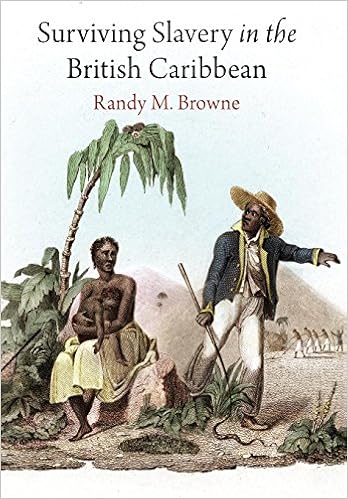
Q&A with Randy M. Browne, author of Surviving Slavery in the British Caribbean

Randy M. Browne is a historian of slavery and colonialism in the Atlantic world, especially the Caribbean. He is an Associate Professor of History at Xaverian University (Cincinnati). Surviving Slavery in the British Caribbean is his first book and he discusses it here with Jessica Parr. Continue reading

From Platform to Publisher: Facebook, the Early American Open Press, and Alex Jones

Yesterday, Apple, Facebook, YouTube, and Spotify removed the content of conspiracy theorist Alex Jones from their services. Jones has gained notoriety for propagating outrageous falsehoods on topics including vaccines, school shootings, and uh, *checks notes* space vampires. These decisions to remove Jones’s content come amid a growing public conversation about the extent to which technology and social media companies should act as stewards of truth. Facebook in particular has come under scrutiny for its role in spreading “fake news” in American politics and anti-Muslim propaganda in Sri Lanka, as well as CEO Mark Zuckerberg’s defense of Holocaust deniers’ ability to share verifiably false content on the site. Continue reading

Making the Personal Historical: Reflections on Pregnancy and Birth

Lady and Children

“A Lady & Children,” 1780 mezzotint, the British Museum.

Human reproduction is simultaneously unchanged and radically different over time and across cultures. This paradox has preoccupied me for over a year as I carried and gave birth to my first child one year ago today, and as I watched my sister follow the same path soon after. Throughout my pregnancy, delivery, and now early motherhood, I’ve found myself thinking often long-dead women and pondering how vastly different our experiences of the same condition must be.

Pregnancy and birth generate intense  feelings. Most parents experience joy, hope, and fear. As a historian, I regularly identify with the women I encounter in the archive. The empathy born of our shared biological and emotional experiences generated two additional emotions that most new parents may not: gratitude, on the one hand, and anger on the other. Continue reading

Guest Post: Writing Alongside Your Students

Return guest poster Mairin Odle is an Assistant Professor of American Studies at the University of Alabama. She is currently writing a book, Skin Deep: Tattoos, Scalps, and the Contested Language of Bodies in Early America.

A few years ago, I was designing a new course, one that would fulfill a writing distribution requirement at my university. I knew I wanted to find ways to engage the class with the creative aspects of writing, not just the mechanics; I wanted to show my students how ideas develop, how revisions matter, and how classrooms could be collaborative spaces where we collectively care about our work rather than churn out assignments. So on the first day of class, I promised them (perhaps rashly) that I would write a final essay alongside them. Continue reading