Roundtable: A Letter to Dear America

Today’s Founding Fiction post is by Lindsay M. Chervinsky, a post-doctoral fellow at the Center for Presidential History at Southern Methodist University. Her manuscript is titled, “The President’s Cabinet: George Washington and the Creation of an American Institution.” Follow her @lmchervinsky.
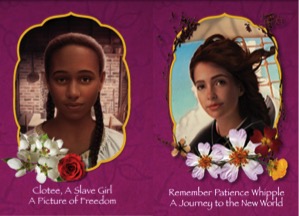
Each book in the Dear America series portrays a diary of a young fictional woman that explores her experience during one specific year in American history. The first-person account shares observations of well-known events or places, as well as the daily struggles of an “average” girl’s life. A number of these diaries take place in #VastEarlyAmerica. A few examples include A Journey to the New World: The Diary of Remember Patience Whipple, which tells the story of the Mayflower crossing in 1620; The Winter of Red Snow: The Revolutionary War Diary of Abigail Jane Stewart, which shares one woman’s experience in Valley Forge in 1777; and Look to the Hills: The Diary of Lozette Moreau, which examines the struggles of a French slave girl in the New York Colony in 1763. The series was discontinued in 2004, but Scholastic republished many of the originals in 2010 and continues to produce new volumes today. Continue reading

Roundtable: Telling the Story of the Declaration

Today’s Founding Fiction post is by Emily Sneff, Research Manager of the Declaration Resources Project at Harvard University. The mission of the Declaration Resources Project is to create innovative and informative resources about the Declaration of Independence. To learn more, follow @declarationres.

How do we get kids to read and comprehend the Declaration of Independence? Great authors and illustrators can transform the characters, events, and text of the Declaration (which, as you may expect, registers at about a 12th grade reading level) into true stories that are both entertaining and educational for younger readers. On the Declaration Resources Project’s blog, Course of Human Events, we recently interviewed authors Barbara Kerley (Those Rebels, John & Tom), Steve Sheinkin (King George: What Was His Problem? The Whole Hilarious Story of the American Revolution), and Gretchen Woelfle (Answering the Cry for Freedom: Stories of African Americans and the American Revolution). Their books, and a few other favorites, form an exciting non-fiction reading list for children and young adults. Continue reading

Roundtable: Making Teen Girls into Women’s Historians

Welcome to Founding Fiction, The Junto’s first roundtable exploring how children’s literature and young adult fiction depicts early American history. Between posts, we’ll compile a shelf of favorites to (re)read. Tweet us at #FoundingFiction or comment with your recommendations for Very Early Americanists. Happy summer, let’s dive in!

Today’s post is by Laura Ansley, Ph.D. candidate in history at the College of William & Mary, and managing editor of the Nursing Clio blog. Her dissertation is titled, “Life Problems: Sex Education in the United States, 1890-1930.” Follow her .

Phillis Wheatley and Abigail Adams and Peggy Shippen and Harriet Hemings: all early American women whom I learned about from Ann Rinaldi’s young adult fiction. I have been fascinated by history for as long as I can remember, but Rinaldi was one of many authors who helped me to better understand what the best kind of historical study is. While school classes covering the Civil War may have talked about generals and battles, Rinaldi introduced me to characters like Osceola, stepdaughter of Wilmer McLean, who moved his family away from Manassas when the war came to the quieter Appomattox Courthouse—meaning the war started and ended on their doorstep. With her focus on teenage heroines, Rinaldi showed that history wasn’t only about important men. Young women experienced these historical events too, and their stories were also worth telling.
Continue reading

Where Historians Work: Q&A with Kenneth Minkema of the Jonathan Edwards Center

“The search for gainful employment drives a willingness to be diverse in your ways of being a historian.” ~ Dr. Kenneth P. Minkema, The Jonathan Edwards Center, Yale University.

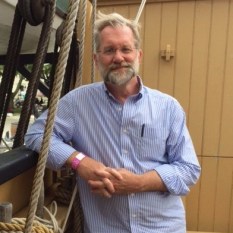
Minkema photo

For this week’s “Where Historians Work: The View from Early America,” The Junto features a Q&A with Dr. Kenneth P. Minkema, the Executive Editor of The Works of Jonathan Edwards, and the Executive Director of The Jonathan Edwards Center at Yale University. Dr. Minkema is also a member of the Research Faculty at the Yale Divinity School.

In today’s Q&A, Katy and Ken chat about many topics, including the role that mentors and advisors can play in shaping career choices in graduate school and beyond, and how finding the right “fit” or “vocation” can be a true source of professional inspiration and purpose. Continue reading

An Early Americanist in Austenland

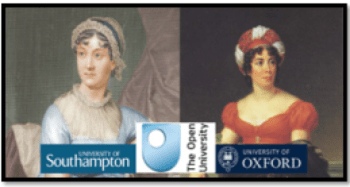
Screen Shot 2017-05-30 at 10.28.06 AMOf course I cannot speak (or type) for everyone, but in the past six years, one specific word has never been far from the forefront of my mind: copyright. While I think that copyright is an incredibly fascinating and complex historical subject —and thus why wouldn’t everyone be talking about it all the time—it is probably because intellectual property was the subject of my dissertation that I spent so much time thinking, reading, and writing about it. I’m now in an exciting, strange, and surreal moment where I’ve defended my dissertation and am conceiving of what the manuscript will look like. And in this window two other words have come up: Austen and de Staël. Continue reading
Where Historians Work: Q&A with Emily Swafford of the AHA

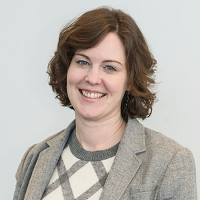
Denver_Swafford_square200x200Welcome to the first installment of our “Where Historians Work: The View from Early America” series. Today, The Junto features a Q&A between Katy Lasdow and Dr. Emily Swafford, Manager of Academic Affairs for the American Historical Association in Washington, D.C.[1] Emily shares her experiences seeking out varied career options after graduate school. She also provides AHA resources for readers who wish to become more involved in the conversation about career diversity, whether as part of their own job searches, or within their graduate history departments.
Continue reading

Where Historians Work: The View from Early America — Welcome to the Series!

PhD graphicIn February 2017, The Junto sent out a call to historians working outside the professoriate to join us in a conversation about career diversity for early American history PhDs.[1] The response was exciting and full of interesting conversations with curators, scholars, archivists, librarians, and public historians who have chosen to pursue their passion for research, writing, and teaching in a variety of settings and occupations.
Starting tomorrow, and over the coming weeks, The Junto will feature Q&A’s between Columbia University PhD candidate and Public Historian Katy Lasdow, and a range of participants.

Continue reading

Q&A, Marisa Fuentes, Dispossessed Lives

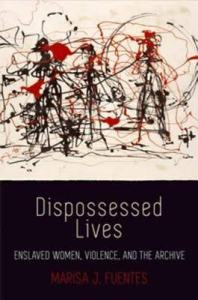
FuentesMarisa J. Fuentes is Associate Professor of Women’s and Gender Studies and History at Rutgers University, New Brunswick. Dispossessed Lives: Enslaved Women, Violence, and the Archives is her first book. Casey Schmitt previously reviewed Dispossessed Lives for The Junto. Continue reading
Good Wives, Nasty Wenches, Jamestown Women

I haven’t yet had the opportunity to watch the new TV series, Jamestown, that recently premiered in the UK. But the television critic Mark Lawson has. Last week he wrote a column that criticised the show, and other recent British period drama, for featuring female characters who were, in his own words, “feisty, cheeky and rebellious.” In the name of historical accuracy, Lawson called out the makers of Jamestown for pandering to 21st-century sensibilities. Apparently, he believes women four hundred years ago raised neither hand nor voice against the patriarchy. Instead, they “willingly accept[ed] sexual and social submission.”

Continue reading

Every Historian Her Own Adventurer

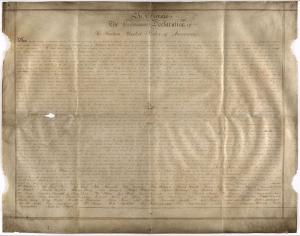
This spring, early Americanists were abuzz about “a bit of real-life archival drama,” as Harvard scholars Danielle Allen and Emily Sneff announced that they had discovered something pretty amazing: an unknown, manuscript, parchment copy of the Declaration of Independence. As friend-of-the-field Jennifer Schuessler playfully reported in the New York Times, it was all a little National Treasure. The apparently random order of the signatures on this manuscript, compared to other versions, points towards some interesting implications, involving Philadelphia Federalist James Wilson and attempts to build a unified American nationhood in the new republic. But reactions to Allen and Sneff’s announcement also, I think, tell us something about how knowledge of the past is structured, presented, and consumed. Continue reading