 In April, Tom Cutterham reviewed Cassandra Good’s new book, Founding Friendships: Friendships Between Women and Men in the Early American Republic (New York: Oxford University Press, 2015). Good received her PhD from the University of Pennsylvania and is now the Associate Editor of the Papers of James Monroe at the University of Mary Washington. Today, she speaks with The Junto about Founding Friendships and her next project.
Continue reading
Tag Archives: Early Republic
CFP: Rethinking Women’s History (Paris, June 2016)
For your Sunday, we present a call for papers for a conference to be held in Paris next June on the history of women in the early United States.
Guest Post: The Art of Absconding: Slave Fugitivity in the Early Republic
Guest Poster Shaun Wallace (@Shaun_Wallace_) is an Economic and Social Research Council-funded Ph.D. candidate at the University of Stirling. His dissertation examines how reading and writing influenced and aided slave decision-making in the early republic. Shaun holds a B.A. (Hons.) and a MRes. from the University of Stirling and is president of Historical Perspectives, a Glasgow-based historical society run by and for graduate students in the United Kingdom.
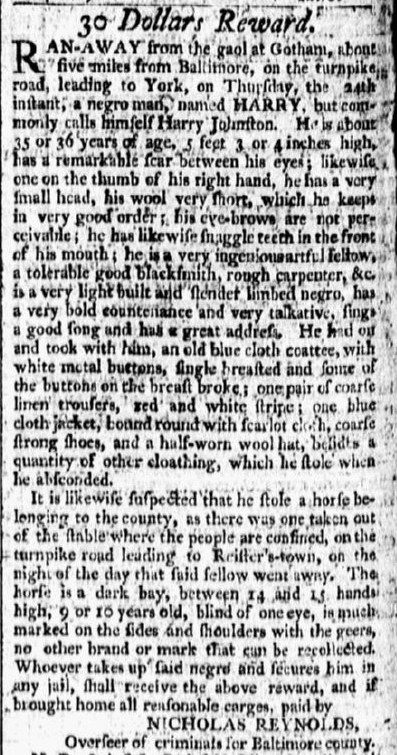 A “very ingenious artful fellow” appears a peculiar description of a runaway advertised for recapture. The advertisement, for Harry or Harry Johnstone, featured in Baltimore’s Federal Gazette newspaper, on May 2, 1800, at the request of Nicholas Reynolds, overseer of criminals for Baltimore County. Harry had absconded from Gotham gaol, near Baltimore. Reynolds described Harry as a “tolerable good blacksmith” and a “rough carpenter.” A “very talkative” slave, he was a man of “great address.” On first impression a relatively congenial description; in actuality, Reynolds’s use of the term “artful” condemned the runaway.[1]
Continue reading
The American Revolution within the British Imagination
 Four months ago, I reviewed Andrew D. M. Beaumont’s Colonial America and the Earl of Halifax. A biography of an often overlooked figure, Beaumont makes a strong case for including Halifax in standard interpretations of the coming of the American Revolution. As Beaumont showed, to enrich our understanding of colonial British America, including the 1760s and early 1770s, we must appreciate the importance of high-ranking British officials. We also need to isolate and account for the behavior of the people underpinning and changing the constitutional relationship between Britain and its colonies in North America. Continue reading
Autumn Reads

“Valley of the Catawissa in Autumn,” Thomas Moran (ca. 1862)
Fall brings new early American titles to explore. Enjoy our Spring Reads 2015 list, too, and share your finds below!
Digital Pedagogy Roundtable, Part 1: Students’ Access to Sources
This week, The Junto will feature a roundtable on digital pedagogy, in which we discuss our different approaches to using digital sources in the classroom. Today, Rachel Herrmann talks about the challenge of access. Jessica Parr, Joseph Adelman, and Ken Owen will also contribute.
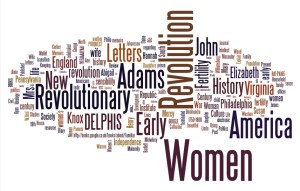
A Wordle made from sources my undergraduates located for our in-class source-finding competition
Let me preface this post by saying that I’d hesitate to call myself a digital humanist; I don’t code or map or mine texts. As Lincoln Mullen pointed out a while back, however, digital practices exist on a spectrum. There are some things I do for my own research and in the classroom—tweeting, running my department’s social media accounts, using Amazon’s “Look Inside” feature to chase up a footnote so as not to use up one of my precious Interlibrary Loan requests, and of course, blogging for The Junto—that digital humanists also do. These approaches have been helpful in my teaching for three problems related to access to sources. Continue reading
SHEAR 2015 Annual Meeting Preview
 The 37th annual meeting of the Society for Historians of the Early American Republic will take place in Raleigh next week (July 16-19). I could not be more excited. To help spread the conference cheer, I’m going to offer a brief preview of a few sessions that caught my eye. Continue reading
Recap: “So Sudden an Alteration” Conference (9-11 April 2015)
 Two weeks ago, 175 historians descended upon the Massachusetts Historical Society (MHS) in Boston for a three-day conference that considered the political, social, economic, and global parameters of the American Revolution. The conference consisted of eight panels (with pre-circulated papers), two keynotes, and some special presentations on digital projects. The conference proceedings were live-tweeted under #RevReborn2, and fellow Juntoist Joseph Adelman provided some live coverage on the blog. The Junto has also had some post-conference commentaries, including “You Say You Want a Revolution” by Joseph Adelman and “The Suddenness of the Alteration: Some Afterthoughts on #RevReborn2” by Michael Hattem.
Spring Reads
 Here’s our seasonal roundup of new and forthcoming titles. Share your finds below! Continue reading
Review: Shelby M. Balik, Rally the Scattered Believers
Shelby M. Balik, Rally the Scattered Believers: Northern New England’s Religious Geography. Bloomington: Indiana University Press, 2014.
 At the beginning of February, Wake Forest University hosted a symposium marking the 25th anniversary of the publication of Nathan Hatch’s The Democratization of American Christianity (Yale University Press). The list of participants was a “who’s-who” of American religious history: Catherine Brekus, Sylvester Johnson, Mark Noll, Amanda Porterfield, Harry Stout, Grant Wacker (on more of a “who’s-that?” note, I was there, too, feeling honored but absurdly under-credentialed in that company). Each offered reflections on the book’s influence and reach, on his or her personal experience with it, on how its arguments have aged. Hatch, now the president of Wake Forest, offered an eloquent response. (Video of the event is available here.) Continue reading
 The Junto