Guest Post: It’s Pronounced “Woo-ster”: The OIEAHC’s 22nd Annual Conference Recap

Andrew Johnson (@dajohnsonii) is a doctoral candidate in history at Rice University. His work explores the social and cultural intersections stemming from the trades in captive peoples, both Native American and trans-Atlantic, who happened to find themselves in colonial South Carolina and situates enslaved Native Americans in the more-studied development of slavery in the colony.

2896085I thought going to Worcester for the OIEAHC 22nd Annual Conference was going to be a reprieve from the oppressive heat and humidity of the Houston summer. New England thankfully came through on the weather front, but I also found my long overdue first trip to the conference to be an almost nonstop barrage of intellectual engagement. My work received much more feedback than I had expected and I found myself thinking through every talk and Q&A I heard, which in my experience isn’t always how conferences typically work out. The luck of having my presentation in the first panel meant I was able to get presenting out of the way, giving those attending I didn’t know something to talk with me about for the rest of the conference, and allowing me to concentrate on thinking about other scholars’ work.   Continue reading

Summer Reading 2016

BEACH READINGSummer! That wonderful, studentless, seminar-free oasis of uninterrupted relaxation, when we can all settle down to some quality time with those alluring new acquisitions on our bookshelves—and maybe even tackle some of the glowering doorstops that have remained there unread for all too long. Yes, we know it’s a complete fantasy, but it’s a pleasant one to indulge in while the last few exam scripts are being marked and three months of self-direction are stretching in front of you (and while we wait for Zara Anishanslin and Alan Taylor‘s books to come out!). In that spirit, I thought I’d share the handful of books I’ve been fantasising about reading this summer . We’d love you to pitch in with your own lists in the comments. Continue reading

#WhatComesNext? Book Ideas for the Hamilton Lover in Your Life

#WhatComesNext? Book Ideas for the Hamilton Lover in Your Life

HamiltonBooksWith Hamilton’s sweep at the Tonys last night, this year’s phenomenal tide of Hamilton-mania has hit the high-water mark. You’ve cheered each much-deserved award and accolade, you’ve memorized every word of the soundtrack, you’ve devoured the #Hamiltome. Perhaps you’ve kept up with professional historianswide range of responses to Lin-Manuel Miranda’s blockbuster. Maybe you’re even one of the lucky few who’ve managed to score tickets to the show itself. But now, fans of the musical (and folks who are simply surrounded by them) might well find themselves asking, #WhatComesNext?
The Junto has the answer! Tomorrow afternoon, when you lose the daily ticket lottery yet again, why not start lookin’ for a mind at work? Grab a great history book and drown your sorrows in a flagon of sweet American Revolution knowledge. Here are some picks, creatively paired with favorite characters from the musical. Continue reading

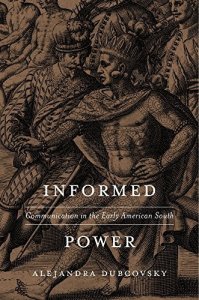
Review: Alejandra Dubcovsky, Informed Power: Communication in the Early American South

Alejandra Dubcovsky, Informed Power: Communication in the Early American South (Cambridge: Harvard University Press, 2016).

61VAwsW64fL._SL500_Alejandra Dubcovsky’s Informed Power: Communication in the Early American South is an ambitious book. She analyzes how information was communicated throughout the early South, a region that was without a regular mail system or print culture prior to 1730. The “early South,” as Dubcovsky acknowledges, is an “ambiguous” term (3). Her “early South” includes much of the lands from the Jamestown settlement south, and from the Mississippi River east. The result is a vibrant blend of Native American peoples, Africans, and European interactions that both complicate and enrich her analysis. Her sources include not only English, French, and Spanish, but also a number of Native American sources, including Timucua. She draws not only on written sources, but linguistic and archaeological evidence as well. This interdisciplinary approach allowed for broader inclusion of non-European networks than appears in many studies. Networks, as Dubcovsky defines them, are a “pattern of ties connecting discrete places or peoples”(4) She discusses a number of different types of networks—economic, political, religious, diplomatic, subaltern—but depicts all nodes as uniform in size. While some might take issue with this approach, the uniformness of the nodes makes sense, given the book’s goal of decentralizing European power structures, and does not detract. Continue reading

The Sacred and the Secular in Early National Virginia

Is revolutionary Virginia the birthplace of American secularism?

My attention was returned to this critical question by a recent twitter exchange between Annette Gordon-Reed and Sam Haselby (and others) along side a recent piece by Haselby in Aeon.[1] The scuffle between Gordon-Reed and Haselby focuses on the time-is-a-flat-circle question of Thomas Jefferson’s religious beliefs. Was he a secularist? Some variant of Christian? A Unitarian? An atheist? Haselby’s Aeon piece takes a different tack, arguing that the American founding represented a “rogue wave of rationality in a centuries-long sea of Protestant evangelising, sectarianism and God-talk.” Haselby marks out the Founders—particularly Jefferson and James Madison—as “visionary secularists” who created a secular republic, which was eventually co-opt by decidedly non-secular political and cultural forces. He singles out late eighteenth-century Virginia as the primary canvas upon which the great artists of American secularism worked.[2] Continue reading

Guest Post: How Do We Find Religion in the American Revolution?

Kate Carté Engel is an associate professor of history at Southern Methodist University.  She is the author of Religion and Profit: Moravians in Early America (Philadelphia: University of Pennsylvania Press, 2009), and she is currently writing a history of international protestantism and the American Revolution.

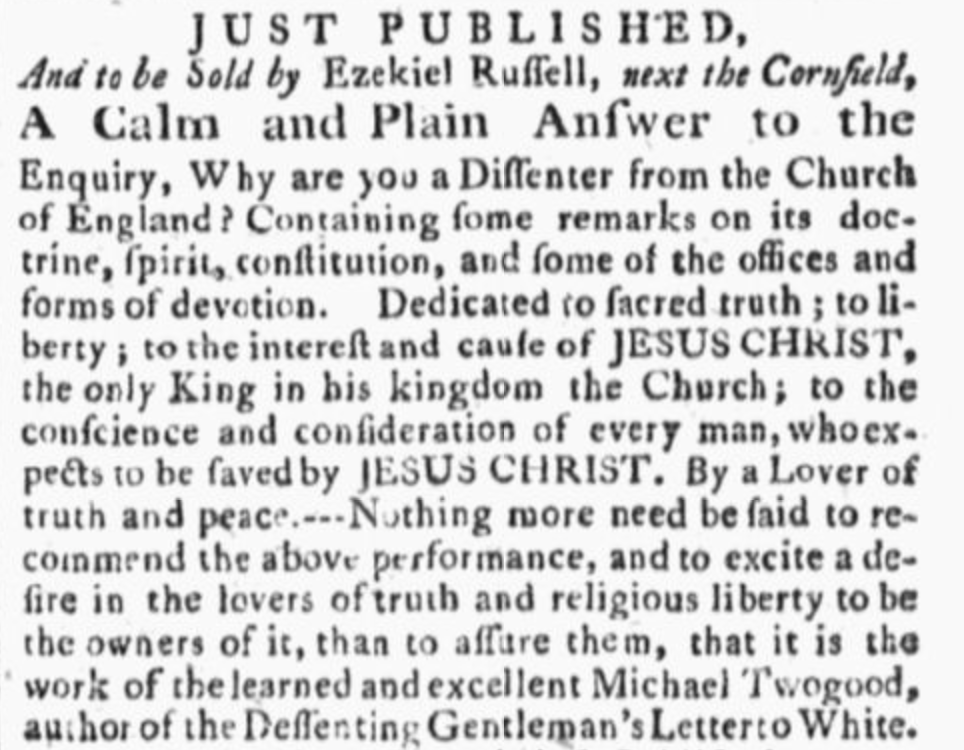
Screenshot 2016-05-17 12.13.52.pngOn May 17, 1773, an advertisement appeared in the Massachusetts Gazette for a new book by English dissenting minister Micaiah Towgood (misidentified in the advertisement as Michael Twogood). The ad is interesting because it is one of only 67 items in that come up in a search of Readex’s American Historical Newspapers database for the period between 1764 and 1789 containing a particular trifecta of terms: “Jesus Christ,” “liberty”, and (to get both religion and cognates like religious and religiously) “religio*”.

Continue reading

Q&A: Zachary Hutchins, editor of Community without Consent: New Perspectives on the Stamp Act

Q&A: Zachary Hutchins, editor of <em>Community without Consent: New Perspectives on the Stamp Act</em>

13274990_10103531179115568_1930581660_oOn Sunday, the United States Postal Service introduced a stamp commemorating the 250th anniversary of the repeal of the Stamp Act. Today we are pleased to present an interview with Zachary Hutchins, editor of a new collection of essays from Dartmouth College Press that challenges traditional understandings of the Stamp Act Crisis as (in the words of the USPS) “setting [the colonists] on a path toward revolution and independence.” Zach is an Assistant Professor of English at Colorado State University. In 2014 he published his first book, Inventing Eden: Primitivism, Millennialism, and the Making of New England. A 2016 Fellow of the National Endowment for the Humanities, Hutchins is currently completing his second monograph, Before Equiano: A Prehistory of the North American Slave Narrative. Continue reading
Guest Post: Reporting from the Edges of Exceptionalism: Early American History in Oceania in 2016

Today’s post is by Taylor Spence, a Lecturer in Monash University’s School of Philosophical, Historical and International Studies and a Research Fellow with the Monash Indigenous Centre. Agricultural History will publish Dr. Spence’s next article, “The Canada Thistle: The Pestilence of North American Colonialisms and the Emergence of an Exceptionalist Identity, 1783-1839” (vol. 90, no.3), this fall. He lives in Melbourne and Brooklyn.

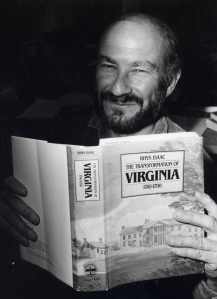
Small_picture_of_Rhys_with_book_1983As a local representative of American Empire in Melbourne, Australia, and fifteen years after Michael McGerr and Ian Tyrrell’s spirited exchange in the pages of the American Historical Review, in which they wrestled with the potential gains and losses of a transnational American history, I thought it was time, in the spirit of Alistair Cooke, to send a “Letter to America,” checking in on the topic of American Exceptionalism and the viability of the transnational historical project in Oceania.[1] Reporting from the front lines of the outward-pression of the exceptionalist frontier, I can report that it has only partially been successful: you in the U.S. have much more work to do if you hope to bring Australians to worship at the altar of Washington, Hamilton, and Lincoln. Perhaps a touring company of Hamilton would be in order? But if, in all seriousness, the continued popularity of American history courses at my Australian university and a similar lack of popularity for Australian history courses attests to the successful mystification of a certain segment of the population, the clear-eyed work of Oceanic Early Americanists demonstrates that the U.S. metanarrative is but grist for the mill. For decades, now, these scholars have produced an unabating stream of masterful transnational studies, which are methodically eroding the exceptionalist juggernaut. Continue reading

Regional Remembering and Joseph Warren—America’s First President?

84d0ce12a90e35ce54a3240f904a426a-micdrop09Since moving to Massachusetts, in September 2015, I’ve taken great pleasure in visiting some of Boston’s historic sites. I’ve walked (part of) the Freedom Trail and visited the Old State House, Faneuil Hall, the Granary Burying Ground, the Old South Church, and the Adams crypt in Quincy. A few weeks ago, I took it a step further: I went on a duck boat tour. While on the tour, the on-board historian told passengers that Joseph Warren would have been America’s first president if he was not killed at the Battle of Bunker Hill. *MIC DROP* Continue reading

The Significance of Old Historiography in American History

Frederick_Jackson_TurnerIn designing courses, professors and teachers face a number of competing claims for time and attention: skill development appropriate to the level of the course, the content described in the course catalog, campus, system, or state requirements for content, the primary sources and scholarship that will promote the best discussions and consideration of the course topic. As many of us have written here at the Junto, not to mention elsewhere, much therefore ends up on the cutting room floor—and some of it painfully so.

Continue reading