Guest Post: Native American History & the Explanatory Potential of Settler Colonialism

Today’s post comes from Bryan Rindfleisch, Assistant Professor of History at Marquette University. Bryan received his Ph.D. from the University of Oklahoma in 2014.  He is currently working on a book that examines the intersections of colonial, Native, imperial, and Atlantic histories, peoples, and places in eighteenth-century North America. This is his second post for The Junto. The first can be found here.
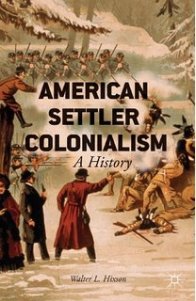
51auvvdbpil-_ac_ul320_sr208320_One of the trending themes in Native American history is “Settler Colonialism.” From Patrick Wolfe’s foundational essay, to recent works by historians and literary scholars—Bethel Saler, Jodi Byrd, Gregory Smithers, David Preston, and Lisa Ford, for instance—this theoretical model has attracted significant attention within the field.[1]

In fact, I’ve deployed this concept as the framework for my upper-division class, “A History of Native America, 1491–Present,” at Marquette. But over the past several weeks it has become evident that settler colonialism is a bit of a minefield. Nevertheless, I find it to be an apt, if not critical, theory for researching and teaching Native American history. But it must be understood, and it must be used responsibly. Continue reading

“UNITE OR DIE”: John Holt’s New-York Journal; or, the General Advertiser and the Imagery of Allegiance

Colonial Williamsburg - reconstruction of Holt's storehouse, sometimes referred to as John Holt's "new store" on lots numbers 49 and 50 that he built in about 1745 .

Colonial Williamsburg—reconstruction of Holt’s storehouse, sometimes referred to as John Holt’s “new store.”

A short while ago, I wrote on the importance of political caricatures within eighteenth-century British America. I called for an increased focus on how caricatures affected, and in some cases represented, politics during the American Revolution. In today’s post, I’d like to do something similarI’d like to call for an increased focus on newspaper mastheads. An increased exploration on what they meant, and how they were used for political mobilization. Continue reading

Roundtable: Academic Book Week: Alternative Entries To Familiar Topics

When I consider the non-early-American history books that have had the greatest impact on the way I think, two stand out in particular. One is Ross McKibbin’s The Evolution of the Labour Party, 1910-1924; the other, CLR James’s Beyond A Boundary. The former is the most obviously “academic” of the two; the opportunity to write a Junto post primarily concerned with cricket, however, means that today I’ll focus on the latter.[1]
Both books influenced me for their creativity in approaching politics and society. McKibbin’s insight that “political action is the result of social and cultural attitudes which are not primarily political” has remained with me ever since; a useful reminder that in writing political history, we have to try and find ways of recovering political mindsets not only by looking at what political actors say, but also the many and varied ways they actually do things. James, too, calls for an approach to studying the past that looks beyond a narrow scope of inquiry, in his famous question ‘What do they know of cricket, who only cricket know?’ Continue reading

Guest Post: Revisiting Women of the Republic with Linda Kerber at the American Antiquarian Society

Carl Robert Keyes is an Associate Professor of History at Assumption College in Worcester, Massachusetts. He recently launched the #Adverts250 Project, featuring advertisements published 250 years ago in colonial American newspapers accompanied by brief commentary, via his Twitter profile (@TradeCardCarl).

CarolChanningMy Revolutionary America class recently visited the American Antiquarian Society for a behind-the-scenes tour followed by a document workshop in the Council Room. As we passed through the closed stacks I remarked to one of the curators, “This still blows me away, yet nothing can compare to the first time I came back here. Taking this all in for the first time is an experience that cannot be re-created.”
Continue reading

The Question of Narrative

borgesdesmazieres2Should historians embrace the art of narrative, or treat it with more suspicion? In his review of Sven Beckert’s Empire of Cotton back in July, USIH’s Kurt Newman argued that “the book-length narrative” is not “the proper form for the presentation of a historical argument.” Narrative, he wrote, involves too much selection, too many authorial choices hidden from the reader. “Most importantly,” Newman suggested, “constructing a narrative is almost always tied up with some telos or end,” a teleology that serves as expression or conduit of ideology, pulling us towards the outcome we imagine fits. Narrative, in other words, is something more than reasoned argument. It enlists desire to shape the way we think. Continue reading

Finding Its Way: Gordon Wood and the William and Mary Quarterly

007Gordon Wood’s essay, “History in Context,” published in The Weekly Standard in February 2015, whirled up a Twitterstorm. His thoughts on twenty-first-century historians’ scholarship were provocative, and many took umbrage at many of his points. One of Wood’s perhaps overlooked arguments was his statement on the William and Mary Quarterly. “The William and Mary Quarterly,” Wood argued, “now publishes articles on mestizos in 16th-century colonial Peru, patriarchal rule in post-revolutionary Montreal, the early life of Toussaint Louverture, and slaves in 16th-century Castile. The journal no longer concentrates exclusively on the origins of the United States. Without some kind of historical GPS, it is in danger of losing its way.” Was Wood’s assessment—or, perhaps more astutely, diagnosis—correct? Has the William and Mary Quarterly lost its way? To answer this question, let’s build upon yesterday’s post and crunch some numbers. Continue reading

Guest Post: A Series of Fortunate Events: Navigating the Eighteenth-Century World with George Galphin

Today’s guest post comes from Bryan Rindfleisch, Assistant Professor of History at Marquette University. Bryan received his Ph.D. from the University of Oklahoma, in 2014, where he specialized in early American, Native American, and Atlantic world history. His book manuscript focuses on the intersections of colonial, Native, imperial, and Atlantic histories, peoples, and places in eighteenth-century North America.

It’s inevitable. At some point, a friendly conversation about my research—with family and friends, colleagues, students, or even a random stranger at the local coffee shop—will take an unfortunate turn. All it takes is that one question: “Who is George Galphin?” Continue reading

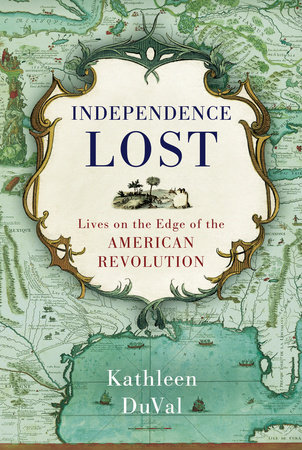
Re-Writing the American Revolution: Kathleen DuVal’s Independence Lost

Kathleen Duval, Independence Lost: Lives on the Edge of the American Revolution (New York: Random House, 2015).

9781400068951When most people think about the American Revolution and its cast of characters, names like Thomas Jefferson, John Adams, and George Washington spring to mind. On the British side, people might think of John André, Benedict Arnold, John Burgoyne, and, sometimes, Lord Dunmore. Though some of these people appear in Kathleen DuVal’s latest book, Independence Lost: Lives on the Edge of the American Revolution, most of DuVal’s narrative centers around people who seldom feature in books or articles on the American Revolution. It is not the American Revolution that most people know. Indeed, “The American Revolution on the Gulf Coast,” DuVal writes, “is a story without minutemen, without founding fathers, without rebels. It reveals a different war with unexpected participants, forgotten outcomes, and surprising winners and losers.” Continue reading

Guest Post: The Art of Absconding: Slave Fugitivity in the Early Republic

Guest Poster Shaun Wallace (@Shaun_Wallace_) is an Economic and Social Research Council-funded Ph.D. candidate at the University of StirlingHis dissertation examines how reading and writing influenced and aided slave decision-making in the early republic. Shaun holds a B.A. (Hons.) and a MRes. from the University of Stirling and is president of Historical Perspectives, a Glasgow-based historical society run by and for graduate students in the United Kingdom.

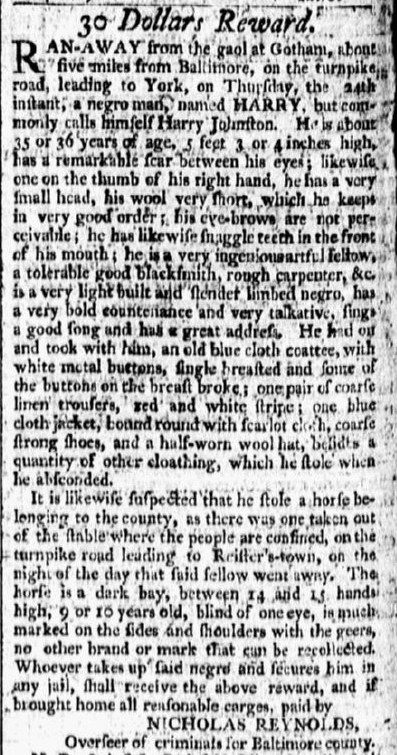
Screen Shot 2015-08-24 at 12.43.09 PMA “very ingenious artful fellow” appears a peculiar description of a runaway advertised for recapture. The advertisement, for Harry or Harry Johnstone, featured in Baltimore’s Federal Gazette newspaper, on May 2, 1800, at the request of Nicholas Reynolds, overseer of criminals for Baltimore County. Harry had absconded from Gotham gaol, near Baltimore. Reynolds described Harry as a “tolerable good blacksmith” and a “rough carpenter.” A “very talkative” slave, he was a man of “great address.” On first impression a relatively congenial description; in actuality, Reynolds’s use of the term “artful” condemned the runaway.[1]
Continue reading

The American Revolution within the British Imagination

british-american-flag-pattern-backgroundFour months ago, I reviewed Andrew D. M. Beaumont’s Colonial America and the Earl of Halifax. A biography of an often overlooked figure, Beaumont makes a strong case for including Halifax in standard interpretations of the coming of the American Revolution. As Beaumont showed, to enrich our understanding of colonial British America, including the 1760s and early 1770s, we must appreciate the importance of high-ranking British officials. We also need to isolate and account for the behavior of the people underpinning and changing the constitutional relationship between Britain and its colonies in North America. Continue reading