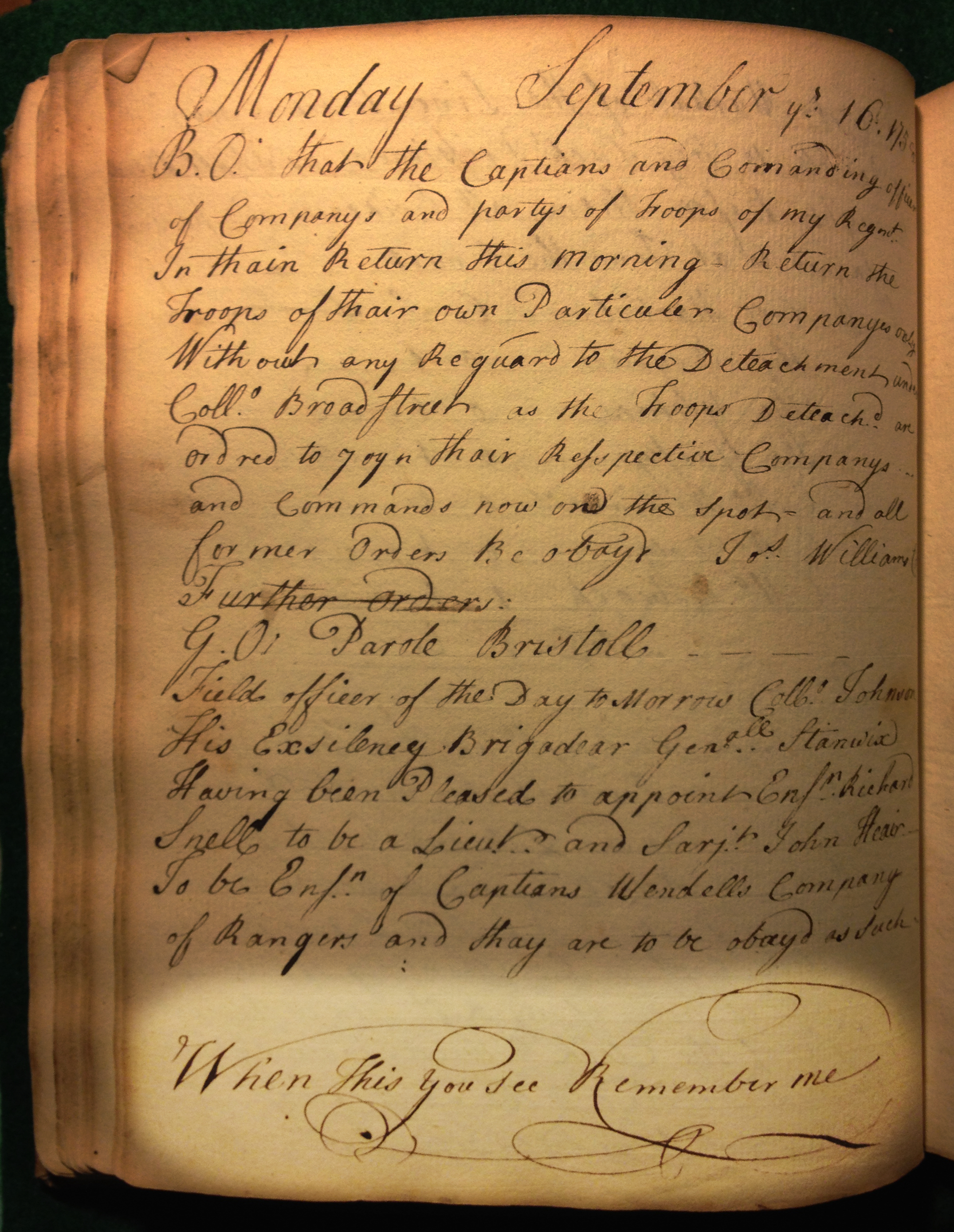
 When wading through account books, muster rolls, and other dry military records, I don’t usually get a sense of the author—there might be a name jotted down, or maybe some distinctive handwriting, but hardly any evidence of personality. Reading through a 1758 orderly book from the Oneida Carry was much the same: a recounting of paroles, provisions, parades, and troop preparations. And then, curiously, tucked between the routine orders and work details, on the bottom of the 51st page:
When This You See Remember me.[1]
An—abruptly elegant—personal appeal hidden in the middle of a bureaucratic record, a record covering the various minutiae of one regiment of the vast British military apparatus but containing no information (other than a name) about the man who had chronicled them all. What on earth was it doing here?
This post began as a simple question about the meaning of private voices in the state record and quickly became something a little more meandering—tracing a phrase, finding its ubiquity in the British Atlantic, and then, in that broader context, pondering how and why it came to be on the page of an official military document. Continue reading



 How does one select a sampling of dozens of pairs of eighteenth-century shoes and translate the assemblage into a coherent museum exhibit housed in one charming, but tiny gallery? How does one translate a five-year study of eighteenth-century consumption patterns, cultural diffusion, and gentility in the Atlantic shoe trade into a show that will excite the imaginations of early Atlantic scholars yet appeal to the general public? How does present a material culture and fashion history exhibition in a refined Athenaeum situated in a corner of New Hampshire?

 Savannah is one of those southern cities where historic atmosphere and charm drape over everything like Spanish moss on live oaks. But amidst all this atmospheric charm, one of the sights I remember most was a distinctly uncharming thing: the desiccated body of a dead squirrel on a tray, tucked away in the attic of the
  The Junto