 Welcome to your weekly roundup of early American headline news. To the links! Continue reading
Tag Archives: Slavery
Commodifying Labour, Commodifying People
 This post is part of an ongoing exploration of the edges of capitalism that I’ve been conducting in the pages of the Junto, most recently here. One element of that exploration, and something that’s been highly visible in the discussion lately—especially with things like the furore over The Economist‘s review of Ed Baptist’s book, The Half Has Never Been Told (we posted our own review)—is the relationship between slavery and capitalism. Today I want to focus on just one element of that relationship: the distinction between commodifying labour and commodifying people. Continue reading
Guest Post: Reclaiming a Buried Past: Slavery, Memory, Public History, and Portsmouth’s African Burying Ground
Jessica Parr received her PhD from the University of New Hampshire at Durham in 2012. Her research interests are race and religion in the Early Modern British Atlantic. Her first book, Inventing George Whitefield: Race, Revivalism, and the Making of a Religious Icon is forthcoming from the University Press of Mississippi (2015). She currently teaches at the University of New Hampshire at Manchester. This is her second guest post for The Junto.
 It was a scene that has been repeated in several American cities. In 2003, during an infrastructure project, 13 coffins containing unidentified human remains were found in Portsmouth, NH. Eight of the remains were exhumed for examination and confirmed as being of African descent, and later as part of a 1705 African Burying Ground, once on the city’s outskirts. As Portsmouth expanded, burying ground was built over and largely forgotten. Five additional sets of remains were found in 2008 during an archaeological dig on the site. Experts believe that 200 or more burials could have taken place in this 1705 African Burying Ground.[1] Continue reading
The Week in Early American History
The past week has brought a number of fascinating developments in the world of academe and early America. But I think by far the most exciting has been the arrival in mailboxes around the country of the Fall 2014 issue of Early American Studies—a special edition dedicated to “Critical Approaches to Sex and Gender in Early America.” The articles are rich, creative, and surprising; I haven’t been able to put the issue down. If you’ve not gotten around to reading it yet, head on over to Project Muse and enjoy. In case you have already savored the new EAS issue, though, here’s your weekly roundup of noteworthy online happenings to bide you through a crisp fall Sunday. Continue reading
The Week in Early American History
Let them eat links!
Is the History of Capitalism the History of Everything?
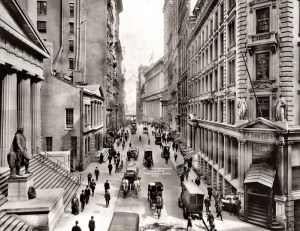 Seth Rockman begins and ends his recent essay on the “new history of capitalism” by describing capitalism as an economic system; but one of the features of the movement he describes is that it rightly treats capitalism as much more than that. As Rockman admits, “it is difficult to say what exactly it excludes.”[1] What’s most provocative and powerful about the new history of capitalism is precisely the fact that it recognizes and tries to historicize the pervasiveness of capitalism as a system that touches every aspect of our lives—everyone’s lives. Capitalism isn’t just in the workplace and the marketplace; as Jeffrey Sklansky has suggested, it’s in our very ways of being, seeing, and believing. But if the history of capitalism is an empire with no borders, just what kind of claims can it be making?[2] Continue reading
Another Kind of Blood: Edward Baptist on America’s Slaver Capitalism
Edward E. Baptist. The Half Has Never Been Told: Slavery and the Making of American Capitalism. New York: Basic Books, 2014.
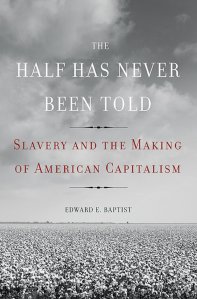 The Half Has Never Been Told attempts a difficult feat: to analyze slavery’s place in the history of American capitalism, but also describe it as a lived experience. This is a story about commodities, bonds, and blood.
To join the abstract and the concrete, Edward Baptist relies on extended metaphors. His narrative traces the form of a human body: the ten chapters move from “Feet, 1783-1810” through “Tongues, 1819-1824” to “Arms, 1850-1861.” Overall, the narrative book follows an image, adapted from a Ralph Ellison essay, of “slavery’s giant body,” stretched across the territory of the United States, serving as the stage on which the drama of American history is acted.[1]
Junto Summer Book Club: Interview with Kathleen Brown
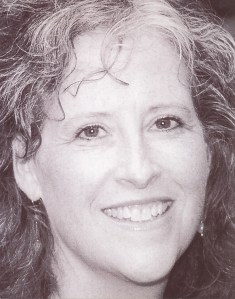 We at The Junto would like to thank everyone who read along with us for the Junto Summer Book Club. To bring the book club to a close, we caught up with Kathleen Brown, the author of Good Wives, Nasty Wenches, Anxious Patriarchs, via email. Brown is a professor of history at the University of Pennsylvania. Her most recent book is Foul Bodies: Cleanliness in Early America.
In our interview, Brown reflects on Good Wives, Nasty Wenches, Anxious Patriarchs eighteen years after its publication, assesses the state of women’s history and gender history, and shares her current project. Continue reading
Summer Book Club, Week 6
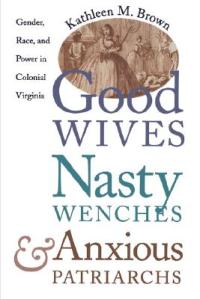 And so we’ve come to the end of the road, a consideration today of the final chapter of Kathy Brown’s Good Wives, Nasty Wenches, & Anxious Patriarchs (the full set of posts is available here). We’ve enjoyed working through the book over the past several weeks, and look forward to a healthy conversation about the final chapter.
Autumn Reads
 Here’s our fall preview of new titles—share your finds in the comments! Continue reading
 The Junto