
Here are your early American history headlines… Continue reading
Here are your early American history headlines… Continue reading
 Groundhog shadow or no, warmer days lie ahead (really). Here’s a roundup of early American art to check out (indoors) in the coming months. Continue reading
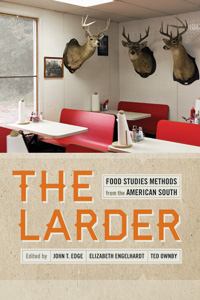 In his concluding remarks to The Larder: Food Studies Methods from the American South, Ted Ownby hopes it “likely that this book will be one of the last collections of academic essays in which any scholars feel the need to explain or defend their choice of foodways as a topic” (363). Ownby and co-editors John T. Edge and Elizabeth Engelhardt have done as much as they can to realize this aspiration; their collection of essays is timely and scholarly rigorous. By assembling a group of scholars who concentrate “not on food but on foodways”—which comprise the production, preparation, or consumption of food—the editors have delved into questions about food studies and southern studies that bridge boundaries between different disciplines and historical time periods (364). Continue reading
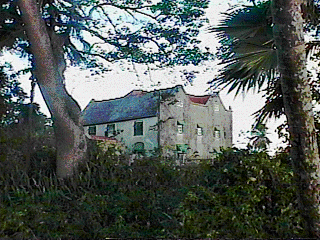 Primary sources form an important part of the assignments for any of my undergraduate classes. As with any set readings, some of these sources work more successfully than others. One source that has proven reliably successful is Henry Drax’s instructions on running a sugar plantation in seventeenth-century Barbados. Back in my graduate student days, I prepared an initial transcription of the instructions as a research assistant. Thankfully, my students don’t have to grapple with some of the more eccentric approaches to handwriting in the original copy, and can instead read the 2009 William and Mary Quarterly “Sources and Interpretations” piece written by Peter Thompson. [1]

‘TWEAH, two nights before Christmas, when thr’out the blog roll
Not a creature was stirring, not even a troll;
The grades were all posted to Blackboard with care,
In hopes that strong evals soon would be there;
The grad students were nestled all snug in their beds,
While visions of fellowships danc’d in their heads,
And Ben Park in his ‘kerchief, and I in my cap,
Had just settled our brains on an early Americanist recap.
 Today, we chat about making digital history with Lauren Klein, Assistant Professor in the School of Literature, Media, and Communication at the Georgia Institute of Technology. Her writing has appeared in Early American Literature and American Quarterly, with a piece forthcoming in 2014 in American Literature. She is currently at work on two book projects: the first on the relationship between eating and aesthetics in the early republic, and a second that provides a cultural history of data visualization from the eighteenth century to the present. Continue reading
 The following is an interview with Ted Andrews, an assistant professor of history at Providence College in Rhode Island. Yesterday, Christopher Jones reviewed his book, Native Apostles: Black and Indian Missionaries in the British Atlantic World (Cambridge: Harvard University Press, 2013), and now Ted is speaking with The Junto about the process of writing it. Ted teaches early American, Atlantic, and Native American history, and he was recently awarded a grant from the National Endowment for the Humanities to explore his next project on global missionary connections among early modern Protestants. Native Apostles is his first book.
Continue reading
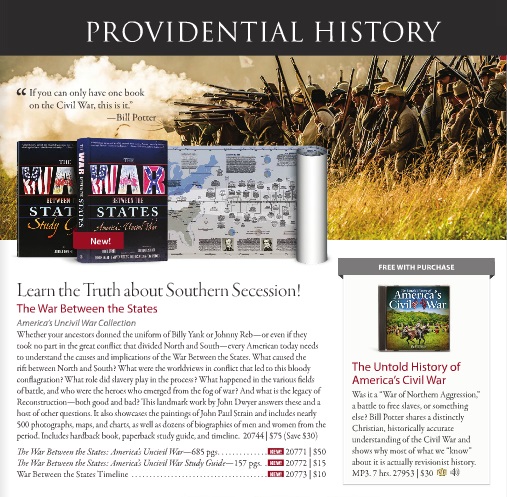 A recent news story has me thinking about the weird enduring appeal of the Lost Cause. It seems to me that this news story about a contemporary religious organization might lead us into an interesting case study. Why, at this late date, do so many Americans still want to see the antebellum South as a tragically vanished world of nobility and grace?
Most early Americanists are familiar with David Barton, a conservative activist who argues that the United States was founded as a Christian nation. He’s been mentioned here several times as the most visible proponent of a view that’s common among members of the “Religious Right.”[1] What’s less widely understood is how often his Christian-founding ideology overlaps with a claim advanced by a few other evangelical conservatives: that the Confederacy—and antebellum southern culture, if not slavery itself—are also part of “America’s Godly heritage.”[2] In these circles, in other words, the Founding is sometimes wrapped up with the Old South.
 It’s been a busy week of headlines for early Americanists: to the links! Continue reading

 The Junto