Guest Post: Candace Jackson Gray interviews Paul Finkelman

finkleman

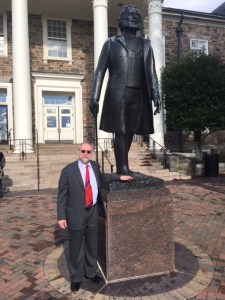
Photo is courtesy of Keydron K. Guinn, Associate Dean of the College of Liberal Arts, Morgan State University

Paul Finkelman is currently the John E. Murray Visiting Professor of Law at the University of Pittsburgh School of Law, where he teaches Constitutional Law and a seminar on the law of slavery. He received his PhD in U.S. history from the University of Chicago and his BA in American Studies from Syracuse University. He specializes in American legal history, slavery and the Founders, American slave law, modern human trafficking, the Civil War era, U.S. Constitutional history and law, the legal history of race relations, the history of Civil Liberties, the history of the electoral college, Constitution and firearms regulation, and Baseball and Law. He is the author of more than 200 scholarly articles and more than forty books. His next book, Supreme Injustice: Slavery and America’s Highest Court, will be published by Harvard University Press in 2017. His work on legal history and constitutional law has been cited four times by the United States Supreme Court, numerous other courts, and in many appellate briefs. He was an expert witness in the famous Alabama Ten Commandments Monument Case and in the law suit over the ownership of Barry Bonds’ 73rd home run ball. He has also recently worked with HeinOnline to create a free database called Slavery In America and the World: History, Culture, and Law, which he discusses below. This interview was conducted by Candace Jackson Gray at Morgan State University in Baltimore, MD on November 30 and December 1, 2016. Continue reading
Guest Post: Historical Narratives, Contemporary Tools

This is the third post in The Junto’s roundtable on the Black Atlantic. The first was by Marley-Vincent Lindsey, and the second was by Mark J. Dixon. Kristin O’Brassill-Kulfan holds a PhD in early American history from the University of Leicester and is Coordinator and Instructor of Public History at Rutgers University. She is currently completing a manuscript on vagrancy and indigent transiency in the early nineteenth century US.

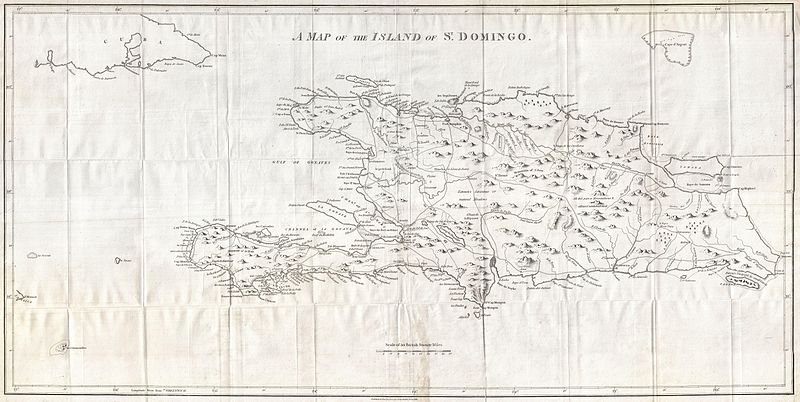
obrassill-kulfan-map-wikimedia-commonsThe early modern Atlantic Ocean was traversed by countless seafarers with varying degrees of maritime experience, in varying degrees of (un)freedom. People used mobility, including travel by sea, to negotiate new identities for themselves, however precarious. Continue reading

Q&A: Ibram Kendi, Stamped From the Beginning

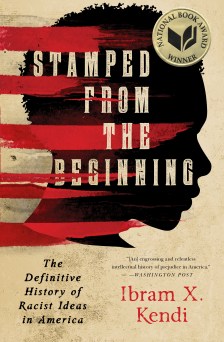
stampedbeginningnbawinnerToday, we are pleased to offer an interview with Dr. Ibram Kendi on his National Book Award winner, Stamped from the Beginning: the Definitive History of Racist Ideas. Kendi is an Assistant Professor of African-American History at the University of Florida, and Associate Editor of the African-American Intellectual History Society blog. You can find his blog posts here. Continue reading
Call for Guest Contributors on the Black Atlantic, c. 1400-1860

Junto LogoCalling all contributors!

December 12-16, 2016. The Junto will host an online roundtable on new scholarship and historical themes that enhance our understanding of slavery and the Black Atlantic, c. 1400-1860. We welcome posts that approach these topics through a focus including—but not limited to—recent scholarship, teaching, public history, or historical memory. Continue reading

Slavery’s Civil War?

Closing our week-long forum on Slavery’s Capitalism, today’s post is courtesy of Kevin Waite, a Lecturer in Modern American History at Durham University in the United Kingdom. He was recently awarded his PhD at the University of Pennsylvania with a thesis entitled “The Slave South in the Far West: California, the Pacific and Proslavery Visions of Empire.”

Slavery's CapitalismNo one could possibly read the fourteen essays that comprise Slavery’s Capitalism and conclude that human bondage was not absolutely central to American, and indeed global, economic development during the nineteenth century. [1] But it’s one of the corollary aims of the book—to move beyond the regionalism that has characterized much of the scholarship on slavery—that seems to me a more provocative, more novel, and perhaps more fraught intervention.
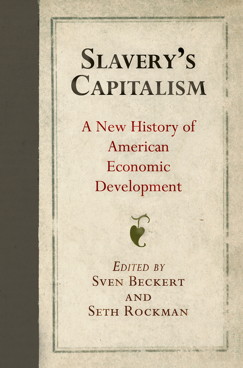
The long tentacles of slavery stretched across the globe and reached into a staggering array of institutions – educational, legal, financial, and political.This becomes especially clear by the final section of the book, “National Institutions and Natural Boundaries.” Compelling essays by Craig Steven Wilder, Andrew Shankman, Alfred L. Brophy and John Majewski provide a fitting capstone to a geographically and conceptually wide-ranging book. This is a history of slavery that catapults us far beyond the slave South.  Continue reading

Slave Economies of the U.S. North

Continuing our forum on Slavery’s Capitalism, today we are pleased to feature a contribution from Christy Clark-Pujara, Assistant Professor of History in the Afro-American Studies Department at the University of Wisconsin-Madison, and the author of Dark Work: The Business of Slavery in Rhode Island (NYU Press, August 2016).

Slavery's CapitalismSlavery’s Capitalism is a timely collection of essays which details the necessity of placing slavery at the center of the economic history of the United States of America. The editors convincingly contend that the nation’s economic rise is inextricably linked to the institution of slavery. Moreover, they demonstrate the necessity of understanding the rise of capitalism in the U.S. as global—the institution of slavery was essential to the rise of capitalism throughout the Western world.  Part III, “Networks of Interest and the North,” examines northerners’ investments in the business of slavery—the buying and selling of goods and people that sustained plantations throughout the Americas and the financial systems that were established to facilitate those trades.   Continue reading

Commodities and Agents in the History of Slavery

This contribution to the forum comes from Justin Leroy, an Assistant Professor in the Department of History at UC-Davis. Prior to joining UC Davis in 2016, he was a postdoctoral fellow in global American studies at Harvard University. He is at work on his first book, Freedom’s Limit: Racial Capitalism and the Afterlives of Slavery.

Slavery's CapitalismSlavery’s Capitalism offers a tremendous amount of evidence to support what scholars of slavery have long known—that slavery underwrote nearly every aspect of American economic development for over two centuries. These essays provide unprecedented detail about the precise workings of slavery’s role in the rise of American capitalism and will inspire many future research projects. Beckert and Rockman’s introduction is an ambitious piece of historiography, drawing together a diverse array of subfields and intellectual debates. Work such as Cedric Robinson’s Black Marxism and Ian Baucom’s Specters of the Atlantic, while key texts for interdisciplinary scholars working on questions of racial capitalism, are not often acknowledged by historians of the “new history of capitalism.” The introduction’s scope makes it an excellent primer for specialists and non-specialists alike. It is the most comprehensive of the recent review essays on slavery and capitalism, yet the breadth of this introduction is not matched by the essays within. Continue reading

The Global and the Hemispheric

Slavery's CapitalismIn their introduction to Slavery’s Capitalism, Sven Beckert and Seth Rockman write that the accumulation of scholarship about early American economic development necessitates “a fundamental rethinking of American history itself” (2). And, for someone who works on the seventeenth-century Caribbean, those words nonetheless resonated with debates very current in my own field of research. In 2011 – the same year that the conference that resulted in Slavery’s Capitalism was held – Latin Americanist John Tutino declared that, “We face a fundamental rethinking of the rise of capitalism” in response to the work of individuals like Dennis Flynn, Arturo Giráldez, and Kenneth Pomeranz. For Tutino, a global perspective on the development of capitalism amends the “enduring presumptions … that capitalism was Europe’s gift to the world,” and “historically antithetical” to places like Spanish America and the Caribbean.[1] Beckert and Rockman recognize in their description of Dale Tomich’s “Second Slavery” the importance of new scholarship in “weaving together transnational and imperial frameworks, the history of capitalism, and the study of slavery as a profit-seeking enterprise” (11).  Continue reading

Slavery’s Capitalism Forum: Introduction

Slavery's CapitalismSlavery’s Capitalism has been a long time coming. The conference from which this book arose was held at Harvard and Brown Universities in spring 2011—years before the New York Times lionised a “new history of capitalism,” co-editor Sven Beckert won the Bancroft Prize for his Empire of Cotton, or fellow co-editor Seth Rockman surveyed the field in the Journal of the Early Republic. The conversations and ideas aired at that conference have been part of public scholarly discussion for the last five years, including many posts here at the Junto. Now we have the book itself, and we want to congratulate the editors and authors for their perseverance! Continue reading

Review: Matthew Karp, This Vast Southern Empire

This review is cross-posted from Ben Park’s own blog, “Professor Park’s Blog: Musings of a Professor of American Politics, Culture, and Religion.”

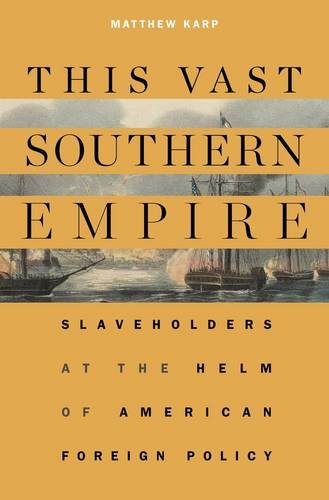
Matthew Karp, This Vast Southern Empire: Slaveholders at the Helm of American Foreign Policy (Cambridge: Harvard University Press, 2016).

This isn’t your grandparents’ antebellum South. A generation ago it was common for historians to talk about the “regressing” southern states in the decades preceding Civil War. The advent of democracy, the spread of enlightenment, and the triumph of free labor left slaveholders reeling and the slave institution crumbling. Secession, this narrative emphasized, was the last-ditch effort of a flailing boxer on the ropes. But scholarship from the past couple decades have put that myth to rest. Michael O’Brien demonstrated that southerners were intellectuals who contemplated the most sophisticated issues of modernity. Edward Baptist showed how the slave institution increased in strength as the financial staple in America’s capitalistic order. Walter Johnson and Sven Beckert displayed how slaveholders were at the forefront of an increasingly global economy. These and many other works all point to the same crucial revision: slaveholding southerners were “modern,” and their ideas and actions cannot be merely dismissed as remnants of an antiquated age. Continue reading