Today’s guest post is by Cassandra Good, Associate Editor of The Papers of James Monroe at the University of Mary Washington, and author of Founding Friendships: Friendships Between Women and Men in the Early American Republic (New York: Oxford University Press, 2015). Follow her @CassAGood.
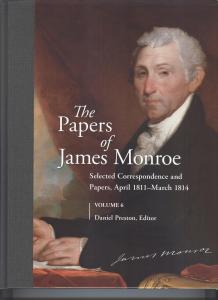 The latest volume of The Papers of James Monroe covers a short but important period in Monroe’s life and career: April 1811 to March 1814. Monroe became Secretary of State in April 1811 and was tasked with trying to repair relations with both Great Britain and France. After war with Britain began in June 1812, his focus broadened to military affairs and included a stint as interim Secretary of War. The bulk of the volume, then, is focused on the War of 1812. However, there are a number of other stories revealed here that will be of interest to a range of historians. Continue reading

 It’s commencement season around the United States, so we wish a hearty congratulations to all of our readers (and our students) graduating this month. Now, straight on to the links!

 George Wythe represented the best of the Revolutionary-era Virginia gentry. Wythe, as a law professor, instructed and inspired many of the leading lights of the Patriot movement, including Thomas Jefferson. Wythe was also a racial liberal. After his wife’s death he freed the family’s slaves and even went as far as to adopt and pay for the education of one of their number, a young man named Michael Brown. By the opening years of the nineteenth century Wythe served as chancellor of Virginia’s court of equity where he handed down a monumental decision in the case of Wright v. Hudgins, which held that the burden of proof in cases of runaway slaves rested with the enslaver – not the accused runaway.
 There’s a lot to get through this week, so let’s jump right into it.
  The Junto
