A special edition of #ColonialCouture, a Junto roundtable on fashion as history in early American life.
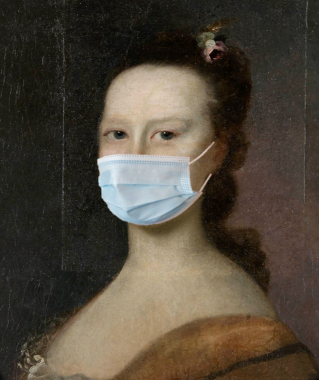
Protective face coverings have emerged as a potent, multifaceted metaphor for the Covid-19 pandemic. Despite inconsistent examples set by elected leaders and conflicting recommendations made by public health officials, unisex masks have steadily assumed a greater role in social distancing measures and become mandatory in certain settings outside the home. Options range from standard blue and white surgical masks to creative DIY improvisations and “Corona Couture.” Some museums are looking to add homemade masks to their collections as a way to document the crisis. Worn for slightly different reasons and more implicitly gendered, the masks owned by early American women and even children were no less symbolic in terms of practical use, commodification, or controversy.
 Kacy Tillman,
  Today at The Junto, Philippe Halbert interviews Katherine Egner Gruber, who is Special Exhibition Curator at the
 Dear Junto readers, Thank you for joining us for two weeks of all-new scholarship tracing the historical patterns of #ColonialCouture! Read the whole roundtable
 Today’s #ColonialCouture post is by Amy Sopcak-Joseph, a doctoral candidate in American history at the University of Connecticut. She is working on her dissertation, “Fashioning American Women: Godey’s Lady’s Book, Female Consumers, and Periodical Publishing in the Nineteenth Century.” Follow her @AmySopcakJoseph.

 The Junto